Earth’s spin is slowing at an unprecedented rate, thanks to climate change
Rising sea levels are slowing Earth’s rotation, lengthening days by 1.33 milliseconds per century
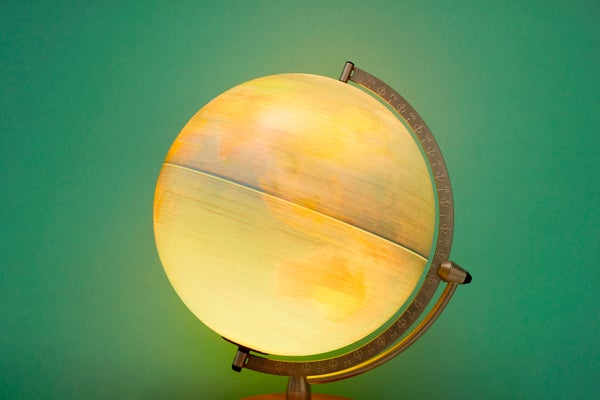
the_burtons via Getty Images
Rising sea levels are slowing Earth’s rotation, lengthening how long an average day lasts. And the current rate of increase to a single average day—1.33 additional milliseconds per century—is unprecedented for at least the past 3.6 million years, a new study finds.
Most people take for granted that a single day will last for 24 hours, not a second more or less. But in reality, the length of any given day varies for different reasons, including the moon’s gravitational pull on the planet and geophysical processes in Earth’s interior and at its surface, as well as atmospheric conditions.
Incredibly, climate change is expected to have more influence over day length than the moon by the end of this century, according to Benedikt Soja, the study’s senior author and a geophysicist at the Swiss Federal Institute of Technology Zurich.
On supporting science journalism
If you’re enjoying this article, consider supporting our award-winning journalism by subscribing. By purchasing a subscription you are helping to ensure the future of impactful stories about the discoveries and ideas shaping our world today.
“Even though the changes are only milliseconds, they can cause problems in many areas, for example in precise space navigation, which requires accurate information on Earth’s rotation,” he said in a statement.
The researchers behind the new study had previously found that climate change affects day length, as rising ocean levels—caused by the melting glaciers and the dwindling polar ice sheets—affect Earth’s spin.
The slowdown is linked to the distribution of mass once held at the poles toward the planet’s midsection. In the statement, lead study author and University of Vienna geoscientist Mostafa Kiani Shahvandi compared the effect to “a figure skater who spins more slowly once they stretch their arms, and more rapidly once they keep their hands close to their body.”
In the new paper, published in the Journal of Geophysical Research: Solid Earth, the researchers show that the rate of increase in day length is higher now than it has been for millions of years. The researchers analyzed the chemical composition of fossils to infer sea-level changes over the past 3.6 million years. Then they calculated the corresponding changes in the length of a day. Using a probabilistic deep-learning algorithm to better model the physics of sea-level change, they found that, as the planet’s ice has formed and melted, day length has fluctuated in lockstep. But today’s rate of increase in day length is an outlier, according to the study.
“Only one time—around 2 million years ago—the rate of change in length of day was nearly comparable, but never before or after that has the planetary ‘figure skater’ raised her arms and sea-levels so quickly as in 2000 to 2020,” Kiani Shahvandi said.
It’s Time to Stand Up for Science
If you enjoyed this article, I’d like to ask for your support. Scientific American has served as an advocate for science and industry for 180 years, and right now may be the most critical moment in that two-century history.
I’ve been a Scientific American subscriber since I was 12 years old, and it helped shape the way I look at the world. SciAm always educates and delights me, and inspires a sense of awe for our vast, beautiful universe. I hope it does that for you, too.
If you subscribe to Scientific American, you help ensure that our coverage is centered on meaningful research and discovery; that we have the resources to report on the decisions that threaten labs across the U.S.; and that we support both budding and working scientists at a time when the value of science itself too often goes unrecognized.
In return, you get essential news, captivating podcasts, brilliant infographics, can’t-miss newsletters, must-watch videos, challenging games, and the science world’s best writing and reporting. You can even gift someone a subscription.
There has never been a more important time for us to stand up and show why science matters. I hope you’ll support us in that mission.