The ongoing discussions about continuing the expired USC-Notre Dame football rivalry should begin with one basic truth.
Notre Dame needs USC more than USC needs Notre Dame.
One need look no further than Sunday, when the Fighting Irish will be selected as one of the 12 teams to compete in this season’s College Football Playoff.
Notre Dame needs to profusely, profoundly thank USC.
USC receiver Tanook Hines attempts to make a catch under pressure from Notre Dame’s Dallas Golden at Notre Dame Stadium on Oct. 18.
(Justin Casterline / Getty Images)
Notre Dame would not be in this position without USC.
The 10-2 Irish lost their first two games of the season before embarking on their usual cupcake schedule. Somewhere in the muck of forgettable games against the likes of Boise State and Boston College and Navy, they needed a marquee win.
USC showed up in October and gave them the opportunity for that marquee win. Every year USC shows up in the middle of the season and gives them a chance at collecting that marquee win.
Notre Dame can’t get that win from a strong conference foe because they refuse to join a conference. Notre Dame can’t get that win from another national powerhouse in late October or November because nobody in their right mind would risk their high ranking at such a late date to play such a strong independent.
USC is Notre Dame’s safety net. USC is Notre Dame’s ace in the hole. USC is Notre Dame’s blue-and-golden ticket.
And what is Notre Dame to USC?
This season, as in the past, they were a poorly timed roadblock that unnecessarily stifled USC’s hopes.
Just as USC handed Notre Dame a spot in this year’s playoff, one could reasonably argue that Notre Dame kept the Trojans out of this year’s playoff.
Imagine if, instead of losing to the Irish during a rainy October evening, the Trojans played a small-time opponent that night at the Coliseum. You know, take a schedule break like those schools in the overrated SEC? You think maybe USC wins that game, finishes 10-2, and it’s enough for the buzz-conscious selection committee to let them join football’s dance?
Of course it would be. The Notre Dame game proved as pivotal in the Trojans postseason hopes as it always does, and that’s increasingly silly.

USC quarterback Jayden Maiava throws a pass under pressure from Notre Dame’s defense on Oct. 18 in South Bend, Ind.
(Justin Casterline / Getty Images)
No other conference-affiliated team endures the annual potential midseason mugging from an established independent like USC.
Every year the Trojans are throwing haymakers through the thick of their conference schedule when suddenly they get pulled out of the ring and dragged into the alley and forced to deal with an old nemesis from down the street.
If they beat him down, their season survives. If they are beaten down, their season disappears. No other conference-affiliated team has to deal with anything like this.
The Trojans belong to the Big Ten, but their season is often decided by the Entitled One, and that just no longer makes sense.
Lincoln Riley, the USC coach, set this issue ablaze two summers ago with quotes that suggested he no longer wanted to play the game, period.
“If you get in a position where you’ve got to make a decision on what’s best for SC to help us win a national championship versus keeping that, shoot, then you gotta look at it,” he said.
Granted, that was a misguided sentiment. Yes, you look at the rivalry, but you don’t even think about eliminating it. We’re talking 96 years of one of the best traditions in sports.
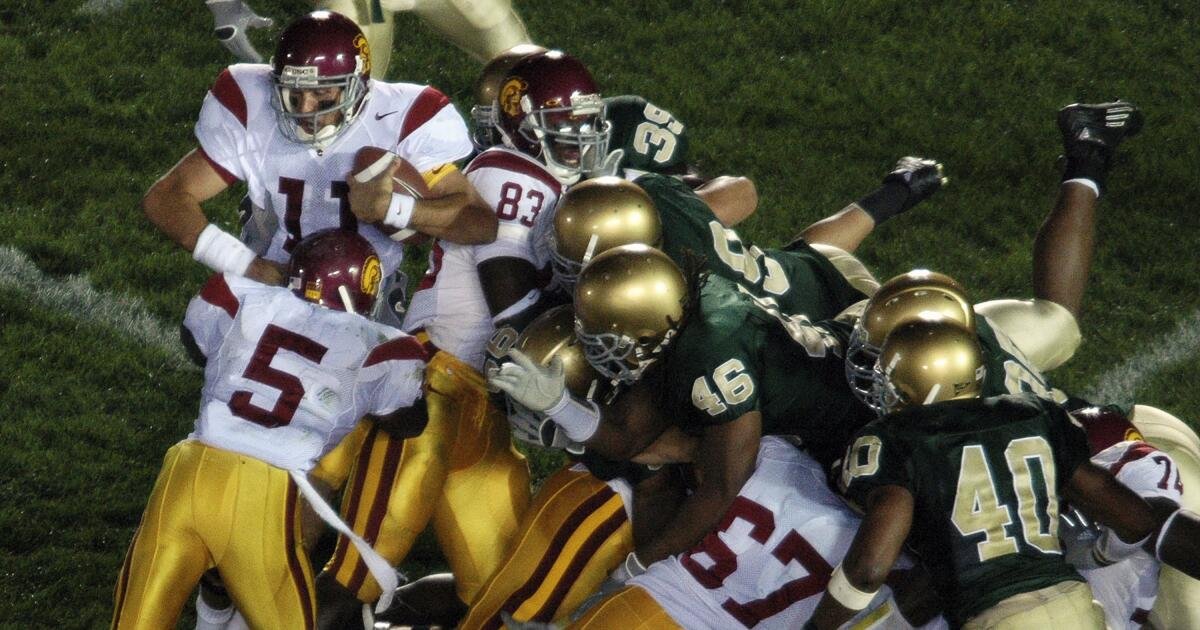
Three words. The Bush Push. I was there, and I’d never before experienced such rollicking waves of breathtaking suspense at any sporting event anywhere.
The tradition is unmatched. The history is undeniable. The rivalry must endure.
But, like many things in the changing world of college football, it could use a little tweaking.
USC should not run from the Irish. But USC should rearrange the Irish.
In their current negotiations with Notre Dame — their contract expired this fall — USC needs to use its leverage and make a stand.
Move the game to the start of the season. Play it in late August. Position it so a loss would not eliminate either team from a potential spot in the playoffs.
Alternate spots every year, but always do it at the beginning of every year, when the teams are at full strength and the results are essentially harmless.
Notre Dame should be thrilled that they keep a decent program on their menu of weaklings, and USC should be thrilled that they maintain the tradition.
You want a second opinion on this, check out USC Athletic Director Jennifer Cohen’s smart explanation of the situation in a recent open letter to Trojan fans.
“For the well-being of our student-athletes, and to schedule equitably with our Big Ten rivals, we want to play our non-conference opponents in the Coliseum as early as possible every year,” she wrote. “USC is the only team in the Big Ten to play a non-conference road game after Week 4 in either of the past two seasons. USC is also the only team to play a non-conference game after Week 4 in both seasons.”
So you see, despite the biased whispers coming from South Bend, Cohen doesn’t want to run from Notre Dame, she just wants her Trojans to be in a fair race.
Moving the Notre Dame game to the beginning of the season seems fair to everyone, even if Notre Dame athletic director Pete Bevacqua seems insistent on keeping USC as their season savior.
“I think there’s no secret that USC would like to play our game earlier in the season,” he told the Dan Patrick Show earlier this fall. “… Where can we position this game so it’s a ‘win win’ for us when we go out there and when USC comes here and visits?”
The Irish are not going to get their win-win. And to end the rivalry over a few calendar dates is a lose-lose.
Both Notre Dame and USC are going to have to compromise to get this done and, for the sake of one of the grandest Saturdays in college sports, here’s hoping they do.
Notre Dame indeed needs USC more than USC needs Notre Dame.
But, in the end, they both need each other.