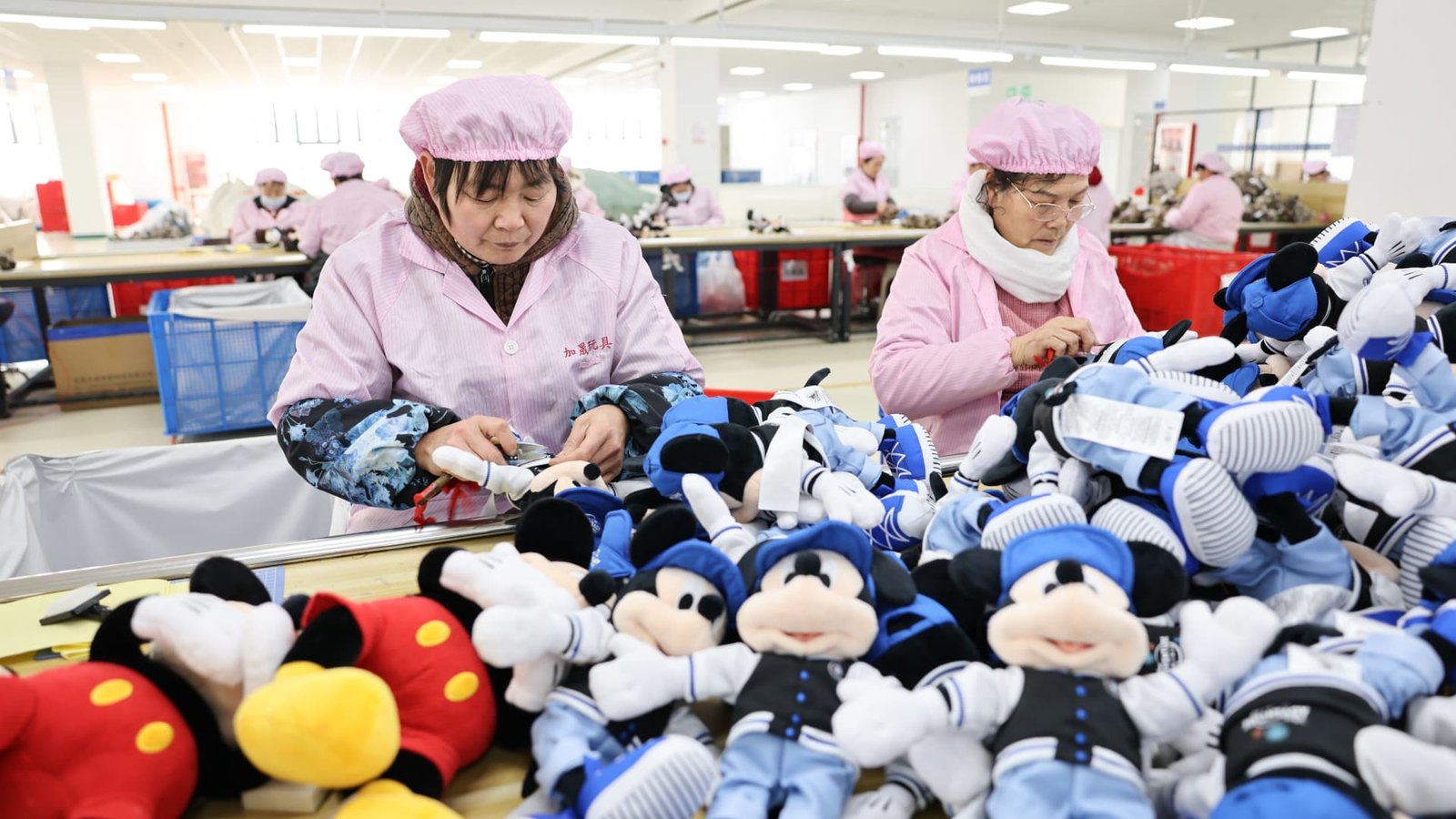
LIANYUNGANG, CHINA – FEBRUARY 28: Employees produce stuffed toys for export at a toy factory on February 28, 2026 in Lianyungang, Jiangsu Province of China.
Si Wei | Visual China Group | Getty Images
China’s official gauge for manufacturing activity climbed more than expected in March to mark its best performance in a year and snapping two months of declines, as export orders showed strong momentum.
The Manufacturing Purchasing Managers’ Index for March rose to 50.4, according to the National Bureau of Statistics on Tuesday, beating economists’ expectations for 50.1 in a Reuters poll. A reading below 50 indicates contraction, while levels above that threshold signal expansion.
That expansion marked a notable rebound after two months of contraction, with the official figure standing at 49.3 and 49.0 in January and February, respectively. In March last year, the reading was 50.5.
Within China’s latest manufacturing PMI, sub-indexes showed that production and new orders expanded while the measures on raw materials inventory, employment, and delivery time remained in contraction.
Manufacturing activity in March gathered momentum as factories rushed to resume production after an extended national holiday in mid-February, said Huo Lihui, chief statistician at NBS.
The non-manufacturing PMI, which measures activity in the services sector such as tourism, rose to 50.1 from 49.5 in February.
Mideast war clouds outlook
Higher shipping fees and costs for imported commodities, including crude oil and chemicals — triggered by the ongoing Middle East conflict — have weighed more on NBS-surveyed companies, Huo said. Price indexes tracking raw material inputs and factory-gate prices rose 63.9% and 55.4%, respectively.
Many factory owners in China expected the disruption to be short-lived as U.S. President Donald Trump has planned a visit to China in May to meet with Chinese leader Xi Jinping, said Cameron Johnson, Shanghai-based senior partner at consulting firm Tidalwave Solution, leaving a period of roughly six weeks of elevated prices and supply challenges.
Inquiries for Chinese-made solar panels and batteries from overseas buyers have picked up in recent weeks, particularly from Europe, India, and East Africa, Johnson said, as China appears somewhat insulated from the supply shock due to its massive stockpiles.
“[But] if we’re talking about the same [disruption] into May, that’s going to be a really big problem,” Johnson noted.
In the first two months of this year, China’s exports surged 21.8% from a year earlier, sharply beating expectations, as robust demand from Southeast Asia and Europe more than offset the slump in U.S.-bound shipments.
A separate private-survey PMI conducted by RatingDog and S&P Global is set to be released on Wednesday and is expected to drop to 51.6 in March from a 5-year high of 52.1 in February, according to a Reuters poll.