In tennis, the only sport I follow, it’s quite common for athletes to change their nationalities, especially as they seek financial support and/or they’re trying to escape politically tricky situations. Since Russia invaded Ukraine, many Russian tennis players have switched their nationalities, becoming French, Austrian or Australian overnight. Well, Eileen Gu is a unique case for Olympic athletes. Gu is a natural born American, and her mother is a Chinese immigrant and her father is American. When Gu began competing as a freestyle skier, she made the bold decision to… not play for America. She “changed her citizenship” and she skis as a Chinese athlete and Olympian. The American media treats Gu like a homegrown champion, and Gu has always trained and lived in America, but the medals she’s won are for China. Well, now the Wall Street Journal is revealing how much Gu is being paid by China to basically ski under the Chinese flag for two weeks every four years. The WSJ also had some interesting info about Gu’s citizenship status.
From the start of her freestyle skiing career, Eileen Gu has been a runaway financial success. When the U.S.-born star opted in 2019 to compete for her mother’s home country of China, sponsors flocked to her camera-ready charisma—and for her access to one of the world’s largest markets. But Gu, who grew up in the Bay Area and studies at Stanford, might be even more valuable to the Chinese government than she is to backers such as Porsche and Red Bull. And in the leadup to this Olympics, it became clear just how much China was willing to pay to support her.
In 2025, the Beijing Municipal Sports Bureau was set to pay Gu and another athlete a combined $6.6 million. That figure emerged in a public budget that was released in early 2025. It accidentally included the names of Gu and figure skater Zhu Yi or Beverly Zhu, another U.S.-born Olympic athlete who competes for China. The document didn’t break down their individual payments, though it’s likely that Gu, a three-time Olympic medalist, received a larger share of the funding.
In total, Beijing’s sports bureau was set to pay Gu and Zhu nearly 100 million yuan, or $14 million over the past three years. The most recent allocation was for “striving for excellent results in qualifying for the 2026 Milan Winter Olympics,” according to the budget.
Gu’s name, along with Zhu’s, was deleted from the budgets soon after they emerged, but not before they spurred surprise and criticism from the Chinese public at a time when budgets were tight for essential services. Those comments were also scrubbed from social media.
Gu is already one of the highest paid female athletes in the world. She earned $23 million last year, almost entirely from endorsements, according to the sports-business publication Sportico. That ranked behind only three other female athletes in the world, tennis players Coco Gauff, Aryna Sabalenka, and Iga Swiatek.
Gu arrived at the Milan Cortina Winter Games as a heavy favorite to add to the titles she won in Beijing. Gu has already won another silver here in ski slopestyle. She will try to repeat her gold-medal performances from the 2022 Beijing Olympics in big air on Monday and in the halfpipe next Saturday.
“Sometimes it feels like I’m carrying the weight of two countries on my shoulders,” said Gu, 22, in Livigno after the slopestyle event.
It isn’t uncommon for athletes in China’s state-run sports system to be paid. But these tend to be closely guarded secrets. The payments to Gu offer a rare glimpse at what an international national star commands.
Although Gu had to become a Chinese citizen to compete for China, her full citizenship picture remains a mystery. Gu was raised in America and originally represented the U.S. when she first began competing internationally as a teenager. China doesn’t allow dual citizenship.
Red Bull, one of Gu’s sponsors, said on its website in 2022 that she had given up her U.S. passport and naturalized as a Chinese citizen to compete for China. But when The Wall Street Journal asked about Gu’s status, that detail disappeared from Red Bull’s site and the brand didn’t answer questions about it. Gu, meanwhile, has always declined to address the specifics of her citizenship. “When I’m in the U.S., I’m American,” she said in 2020. “But when I’m in China, I’m Chinese.”
Honestly, the citizenship issue is more interesting to me than the pay-to-play issue. While it’s no secret that Gu decided to play for China because of the lucrative sponsorship opportunities, I don’t think it’s that shocking in the international sports world to see China pay top dollar (or top yuan in this case) to “adopt” an athlete in this way. China is still building many of their sports programs, especially in the Winter Olympics. They were willing to pay millions of dollars to get an American-born-and-trained “star” who would garner a lot of interest in Chinese AND American media markets. But what would be even more fascinating is… what if Gu never changed her citizenship at a technical level? Or what if China allowed dual citizenship but only in Eileen Gu’s case? “When I’m in the U.S., I’m American. But when I’m in China, I’m Chinese.” But is she ever actually IN China? It’s more like “When I’m at the Olympics, I’m Chinese. Everywhere else, I’m American.”
Photos courtesy of Avalon Red.
-

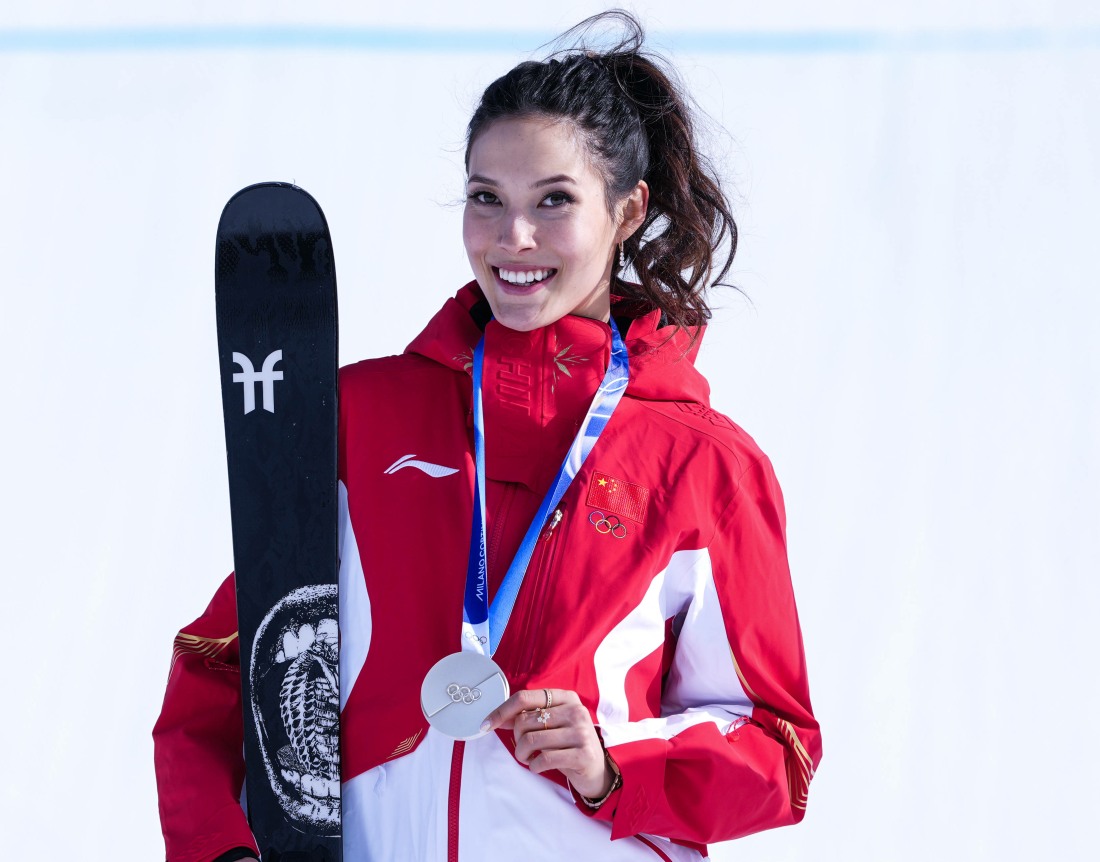
- 09/02/2026, Livigno, Snow Park, Winter Olympics: Women s Freeski Slopestyle Final, 7 Ailing Eileen Gu China Silver Medal Livigno Snow Park Lombardy Italy *** 09 02 2026, Livigno, Snow Park, Winter Olympics Women s Freeski Slopestyle Final, 7 Ailing Eileen Gu China Silver Medal Livigno Snow Park Lombardy Italy Copyright: xJustPictures.ch/JarixPestelaccix jp-en-JaPe-DSC09853-20260209,Image: 1073413678, License: Rights-managed, Restrictions: imago is entitled to issue a simple usage license at the time of provision. Personality and trademark rights as well as copyright laws regarding art-works shown must be observed. Commercial use at your own risk., Model Release: no, Credit line: IMAGO/Jari Pestelacci/Avalon
-

- 09/02/2026, Livigno, Snow Park, Winter Olympics: Women s Freeski Slopestyle Final, medal ceremony with 7 Ailing Eileen Gu China Silver Medal left, 1 Mathilde Gremaud Switzerland Gold Medal center and 2 Megan Oldham Canada Bronze Medal right Livigno Snow Park Lombardy Italy *** 09 02 2026, Livigno, Snow Park, Winter Olympics Women s Freeski Slopestyle Final, medal ceremony with 7 Ailing Eileen Gu China Silver Medal left, 1 Mathilde Gremaud Switzerland Gold Medal center and 2 Megan Oldham Canada Bronze Medal right Livigno Snow Park Lombardy Italy Copyright: xJustPictures.ch/JarixPestelaccix jp-en-JaPe-DSC09131-20260209,Image: 1073414447, License: Rights-managed, Restrictions: imago is entitled to issue a simple usage license at the time of provision. Personality and trademark rights as well as copyright laws regarding art-works shown must be observed. Commercial use at your own risk., Model Release: no, Credit line: IMAGO/Jari Pestelacci/Avalon
-
- 09/02/2026, Livigno, Snow Park, Winter Olympics: Women s Freeski Slopestyle Final, 7 Ailing Eileen Gu China Silver Medal Livigno Snow Park Lombardy Italy *** 09 02 2026, Livigno, Snow Park, Winter Olympics Women s Freeski Slopestyle Final, 7 Ailing Eileen Gu China Silver Medal Livigno Snow Park Lombardy Italy Copyright: xJustPictures.ch/JarixPestelaccix jp-en-JaPe-DSC09612-20260209,Image: 1073415856, License: Rights-managed, Restrictions: imago is entitled to issue a simple usage license at the time of provision. Personality and trademark rights as well as copyright laws regarding art-works shown must be observed. Commercial use at your own risk., Model Release: no, Credit line: IMAGO/Jari Pestelacci/Avalon