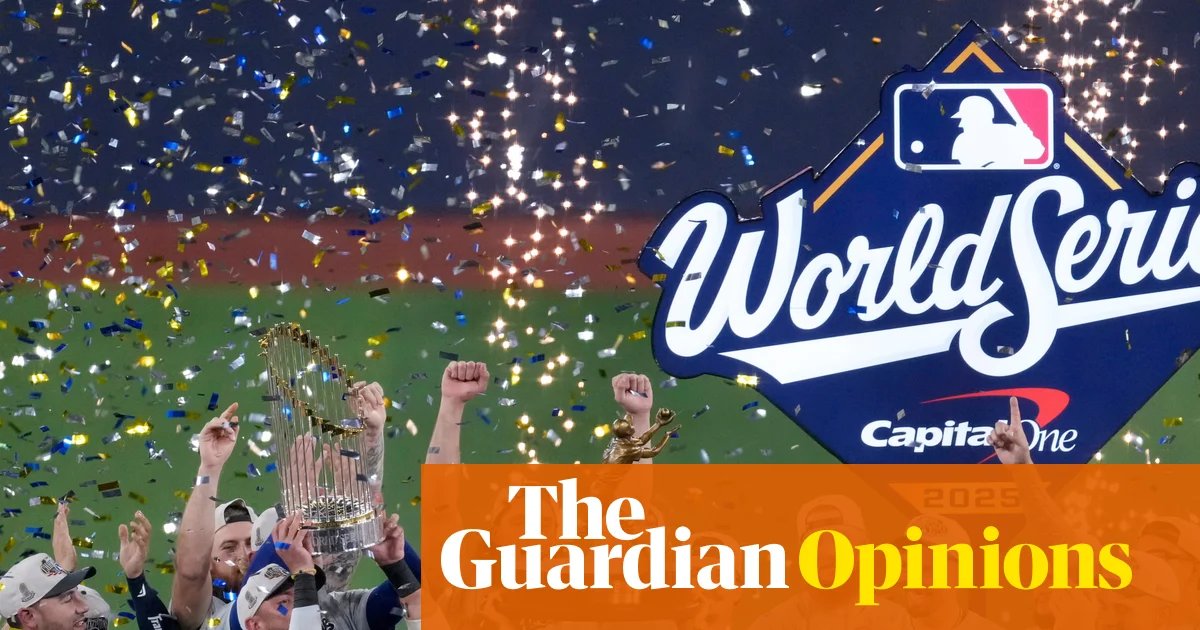
Baseball should be on a high. Spring training has begun and a record-breaking winter makes the games especially welcome – baseball means the good weather is coming soon. Injuries marred the NBA playoffs and the Super Bowl was a dud, but no sport settled its championship last year better than baseball, as the Los Angeles Dodgers barely and thrillingly defeated the Toronto Blue Jays in a seven-game epic that ranks among the greatest World Series ever played.
Instead of basking in the afterglow, however, the game is spending this abundance of capital preparing for war: a 2027 work stoppage portends to be the most catastrophic since the summer of 1994, when the players went on strike and the owners responded by cancelling the World Series for the first time in 90 years.
The turmoil will loom over the entirety of the upcoming season, rooted in a narrative that goes something like this: the game is broken economically. The Dodgers have won the last two World Series and are so rich that no one else stands a chance, either on the field or in competition to sign players. The less-wealthy teams, such as the Athletics and Pirates, are so poor they feel eliminated from playoff contention before the first pitch of the season is even thrown. According to the owners, there is only one satisfactory solution: a salary cap.
For nearly 40 years, the salary cap has been baseball’s irresistible force v immovable object issue. The owners want it. The players have vowed to never accede to it. The owners have been trying to curb salaries since Collusion – the infamous and illegal agreement among the owners during the 1980s to not sign available free-agent players – continuing through the 1994 strike, when the owners, led by then-commissioner Bud Selig, agreed to begin 1995 by using replacement players and unilaterally imposing a salary cap. Only an injunction citing unfair labor practices issued by New York district court judge Sonia Sotomayor thwarted the plan. A decade and a half before her appointment to the supreme court, Sotomayor ruled Selig and the owners had acted illegally in their imposition of a new economic structure without collective bargaining and was called “the Woman Who Saved Baseball”.
Today, baseball is the only of the four major North American men’s team sports to avoid a wage cap – a fact often treated not as a rare compliment to labor solidarity but evidence that baseball’s players are out of step with the realities of modern sports. This time, if the rising doomsday scenario is to be believed, owners will stop at nothing to finally get their elusive salary cap – even if the cost is shutting down the game indefinitely.
On the face, an ample supply of headlines attests to baseball’s brokenness. No team outside the top 10 in payroll have won the World Series since Houston in 2017. John Henry bought the Boston Red Sox in 2002 for a then-record $700m, the same amount the Dodgers spent to sign just one player, Shohei Ohtani. The Mets then signed Juan Soto to a 15-year, $765m deal last year.
Only a cap will create fairness, so claim the owners and much of conventional sports wisdom. But in a country that routinely fights corporate regulation, celebrates both the billionaires who own professional sports teams and the winner-take-all alpha dog capitalist bravado that made them their real-world fortunes while ridiculing the socialism they demand to structure their leagues, since when did everything in sports have to be fair? When was it ever?
For the majority of baseball history, the omnipresence of the New York Yankees made laughable any conversation of fairness in baseball. Whether it was the Yankees’ ability to pay top-dollar – as the Dodgers do now – or the exposure to lucrative outside business opportunities afforded by being in the nation’s greatest media market and the heightened importance that accompanies being a Yankee as opposed to, say, a Marlin, fairness is a fantasy.
Yet “competitive balance” is the vehicle through which baseball aims to win the hearts and minds of fans to achieve its wage controls, an especially effective approach when average people are struggling, orange juice is nearly $9 a gallon, and numerous industries are in collapse. Sympathy for being underpaid at $40m a year to hit a ball with a stick is certainly in short supply.
The owners are leaning on the populist outrage of sticker shock to hide an uncomfortable truth: salary caps do not have much effect on who wins and loses on the field.
Between the NBA’s founding in 1946 and 1984, the year before the NBA imposed its salary cap, the Boston Celtics reached the NBA finals 16 times and won 15 championships. During that same period, the Lakers, originally based in Minneapolis and then Los Angeles, appeared in 19 finals, and won eight. In the four salary-capped decades since, the Lakers have appeared in the finals 13 times and won nine. In 40 years of cap-controlled basketball, the Washington Wizards, have had a losing record 29 times.
In 2005, the NHL shut down the sport for the entire season to force a cap on the players. The NHL got its cap, and two teams – Florida and Tampa Bay – have reached the last six consecutive Stanley Cups finals, combining for four titles.
The NFL, the most financially and player-restrictive league, has had a salary cap since 1993. The result has been one dynasty after another. The New England Patriots have won the AFC East 20 times in the last 33 years, the Buffalo Bills seven times. The Patriots during this period have reached 11 Super Bowls and won the championship six times. The Kansas City Chiefs have come in first place in the AFC West nine of the last 10 seasons. Meanwhile, the New York Jets haven’t been to the Super Bowl since 1969, eight days before Richard Nixon’s first inauguration. Four teams – Cleveland, Jacksonville, Houston, and Detroit – have never reached the Super Bowl. In the salary cap era, 16 NFL teams have not won the Super Bowl.
Meanwhile, in baseball, the sport where teams supposedly cannot win – when the Yankees and Red Sox spent the way the Dodgers and Mets spend now, 24 of 30 MLB teams have reached the World Series since the NFL instituted its cap, and 17 won the championship.
The imposition of a cap does come with one guaranteed benefit: increased franchise values. That’s the actual objective of this looming, self-inflicted Armageddon. It may be outrageous that the Ohtani and Soto contracts are valued higher than the price of the last Red Sox sale, but Henry’s $700m purchase 24 years ago is now valued at $4.8bn. Even the Dodgers’ wild spending – which on its face can appear to be a spirit rebellious against the momentum for a cap – looks suspiciously in service of one. The Dodgers’ plucking away of free-agent talent only increases the self-fulfilling prophecy that no one else in baseball has a chance.
The Dodgers, meanwhile, look as though they are having it both ways by taking one for the team: winning now, and also later. A salary cap would greatly benefit the Dodgers. The team is iconic and historic, playing in one of the sport’s most desirable cities. With cost certainty by controlling salaries, the value of the franchise would skyrocket. The current owners, Guggenheim Partners, led by Mark Walter, bought the team in 2012 for a then-record $2.1bn. The team is now valued at more than $7bn. Simultaneously, Walter last year bought the Lakers for $10bn.
Baseball owners are well aware that franchise values are rising faster in the salary-capped sports. Robert Kraft bought the Patriots in 1994 for $172m. Last year, Forbes valued the team at $9bn. In 2023, Marc Lasry sold his stake in the NBA’s Milwaukee Bucks for $3.5bn after buying it for $550m a decade earlier. A salary cap would boost owner values dramatically.
As the former NBA great Carmelo Anthony once said, “The bottom line is their billions beat our millions.”
Whether the owners have their way and finally break the will of the players, or if the players continue to successfully resist, consumer prices – for tickets, concessions, parking, television packages – will continue to rise. Yet, the idea that caps are designed to give the Pirates and A’s a better chance to win on the field, nevertheless maintains a popular appeal, however erroneous. It is a fallacy – the fallacy that they’re doing it all for you.