Americans’ trust in federal vaccine recommendations declines markedly under Trump
One in three Americans trust childhood vaccine guidance from the American Academy of Pediatrics more than the CDC’s recommendations, a new poll finds
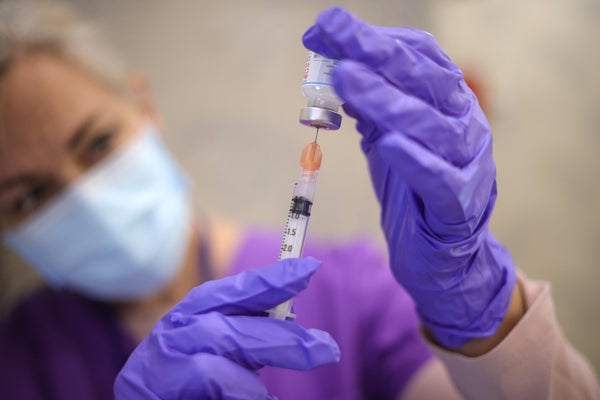
Photo by Win McNamee/Getty Images
Just six in 10 Americans trust the federal government’s childhood vaccine recommendations, a new poll finds. That marks a notable drop from June 2025, when 71 percent of poll respondents said they trusted the government’s vaccine guidance. The greatest decline was among Democrats—from 81 percent to 66 percent—although Republicans’ and Independents’ trust also waned.
About one in three people polled by Ipsos and Axios said they have more confidence in vaccine guidelines provided by the American Academy of Pediatrics (AAP), an independent medical group, than the Centers for Disease Control and Prevention. AAP has been sharply critical of the Trump administration’s sweeping changes to U.S. vaccine policy over the last year. Just 8 percent of survey respondents said they prefer guidance from the CDC, which has historically set vaccine policy for the country.
Since President Donald Trump’s second term began, federal health officials have rolled back recommendations for vaccines that protect against COVID, hepatitis B, meningococcal meningitis, rotavirus, and more. At the same time, the Trump administration’s health and human services secretary and long-time vaccine skeptic Robert F. Kennedy, Jr., dismantled and replaced the members of a key vaccine advisory panel, the Advisory Committee on Immunization Practices (ACIP).
On supporting science journalism
If you’re enjoying this article, consider supporting our award-winning journalism by subscribing. By purchasing a subscription you are helping to ensure the future of impactful stories about the discoveries and ideas shaping our world today.
“It’s encouraging, the fact that the majority of folks are listening to health professionals, but it’s discouraging, the fact that there’s a chorus of opinions now instead of a singular voice,” says Peter Chin-Hong, an infectious disease physician and professor of medicine at the University of California, San Francisco. That’s a problem, he says, because it could harm efforts to encourage people to get vaccinated.
“I think people are confused,” he says.
The poll comes a day after the AAP and five other independent medical groups won a legal challenge against the Trump administration’s overhaul of the country’s childhood vaccine recommendations and replacement of ACIP members. The Department of Health and Human Services has said that it will seek to overturn the decision.
The AAP and other public health experts say that the Trump administration’s actions endanger children and other vulnerable populations’ lives, especially as cases of infectious diseases that are preventable with vaccines such as measles continue to rise. In the new poll, an increasing share of Americans said they were worried about measles—from 18 percent expressing concern in December 2024 to 36 percent in March of this year, although Democrats were more likely to view measles as a risk than Republicans or Independents. The past year has seen the highest rates of measles since before the disease was eradicated in 2000, and the country may already have lost its measles-free status. (The Pan American Health Organization is expected to make a decision on the status at a meeting next month.)
The poll underscores warnings from public health experts that the Trump administration’s changes to vaccine policy would erode trust in federal health agencies, says Jennifer Nuzzo, an epidemiologist at Brown University. “This loss of trust has created confusion for parents who, in the midst of deadly outbreaks, have had to navigate vaccine decisions without a clear source of trusted information,” she says.
Lauren Young contributed to the reporting for this story.
It’s Time to Stand Up for Science
If you enjoyed this article, I’d like to ask for your support. Scientific American has served as an advocate for science and industry for 180 years, and right now may be the most critical moment in that two-century history.
I’ve been a Scientific American subscriber since I was 12 years old, and it helped shape the way I look at the world. SciAm always educates and delights me, and inspires a sense of awe for our vast, beautiful universe. I hope it does that for you, too.
If you subscribe to Scientific American, you help ensure that our coverage is centered on meaningful research and discovery; that we have the resources to report on the decisions that threaten labs across the U.S.; and that we support both budding and working scientists at a time when the value of science itself too often goes unrecognized.
In return, you get essential news, captivating podcasts, brilliant infographics, can’t-miss newsletters, must-watch videos, challenging games, and the science world’s best writing and reporting. You can even gift someone a subscription.
There has never been a more important time for us to stand up and show why science matters. I hope you’ll support us in that mission.