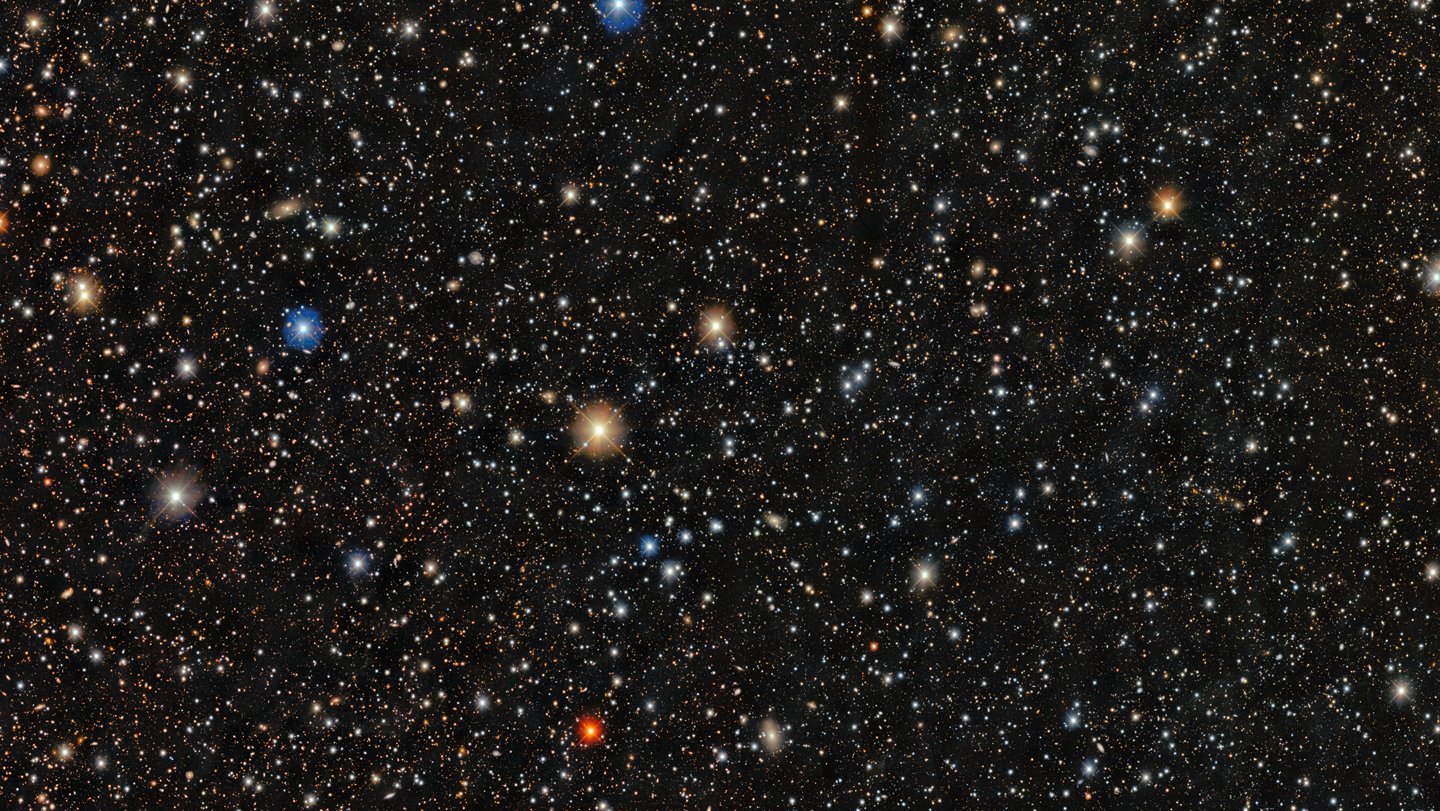
In an ancient dwarf galaxy on the outskirts of the Milky Way, astronomers have discovered one of the most chemically primitive stars ever seen. Named PicII-503, the star’s extreme lack of heavy elements indicates it’s from the second generation of stars, preserving chemical traces from the very first stars in the cosmos.
Described March 16 in Nature Astronomy, PicII-503 is the first unambiguous second-generation star found in an ultrafaint dwarf galaxy, providing a window into how these stars formed during the initial chemical enrichment of the universe.
“It’s a fantastic discovery,” says MIT astrophysicist Anna Frebel, who was not involved in the study. “I know how hard it is to find these stars. They are so, so rare.”
Astronomers have found about 10 stars as primitive as PicII-503 in the Milky Way’s halo, a diffuse sphere of stars surrounding the galaxy’s disk. Researchers think these stars were captured when our galaxy absorbed other, smaller galaxies. “Finding an equivalent star in a … dwarf galaxy — and this one is a particularly old one — is really, really exciting because it very much validates this idea,” Frebel says.
PicII-503 was discovered in 2024 in data from the Víctor M. Blanco Telescope in Chile. Follow-up observations the next year detected extremely low abundances of iron and calcium and a relatively high level of carbon, confirming the star is a relic of the early universe.
“Immediately we knew that there was something really exciting going on,” says astronomer Ani Chiti of Stanford University.
The first-generation stars were made almost entirely of hydrogen and helium. By fusing these elements into heavier atoms before exploding in supernovas, they suffused the early universe with new elements. Those first stars probably survived only a few million years, but the addition of trace elements such as iron, carbon and oxygen to clouds of cosmic gas caused those clouds to cool and fracture into small clumps, leading to the formation of smaller, cooler, longer-lasting stars. Some second-generation stars such as PicII-503 have survived more than 12 billion years to the modern day.
The dearth of iron and calcium in PicII-503 is so extreme that the star probably formed from material produced in just one supernova, putting it near the beginning of the second generation of stars. And like its companions in the Milky Way’s halo, it has a relative excess of carbon. This chemical signature supports theories that the first supernovas were relatively low energy, ejecting outer layers of lighter elements such as carbon while heavier elements such as iron and calcium collapsed back into the stars’ cores.
PicII-503’s presence in an ultrafaint dwarf galaxy also supports this idea. “You must have had a supernova that that was not so energetic because, otherwise, that would have blown the [precursor to Pictor II] apart,” Frebel says.
While telescopes such as the James Webb Space Telescope are looking back into the early universe for signs of the first-generation stars, they cannot directly detect them or the first small galaxies. “We think that these ultrafaint dwarf galaxies are sort of analogous to some of the first galaxies that formed in the universe,” Chiti says.
Astronomers expect to discover more small, ancient galaxies that contain second-generation stars with new telescopes such as the Vera C. Rubin Observatory. By untangling the chemistry of these cosmic artifacts, scientists can develop a clearer picture of the early chemical enrichment of the universe — a key phase of cosmic history that led to the creation of everything that exists today.