NASA spots comet reversing its spin in a first for science
In 2017 NASA’s Hubble Space Telescope zoomed in on a comet as it passed around the sun. And then things took a more unusual turn
NASA, ESA, CSA, Ralf Crawford (STScI)
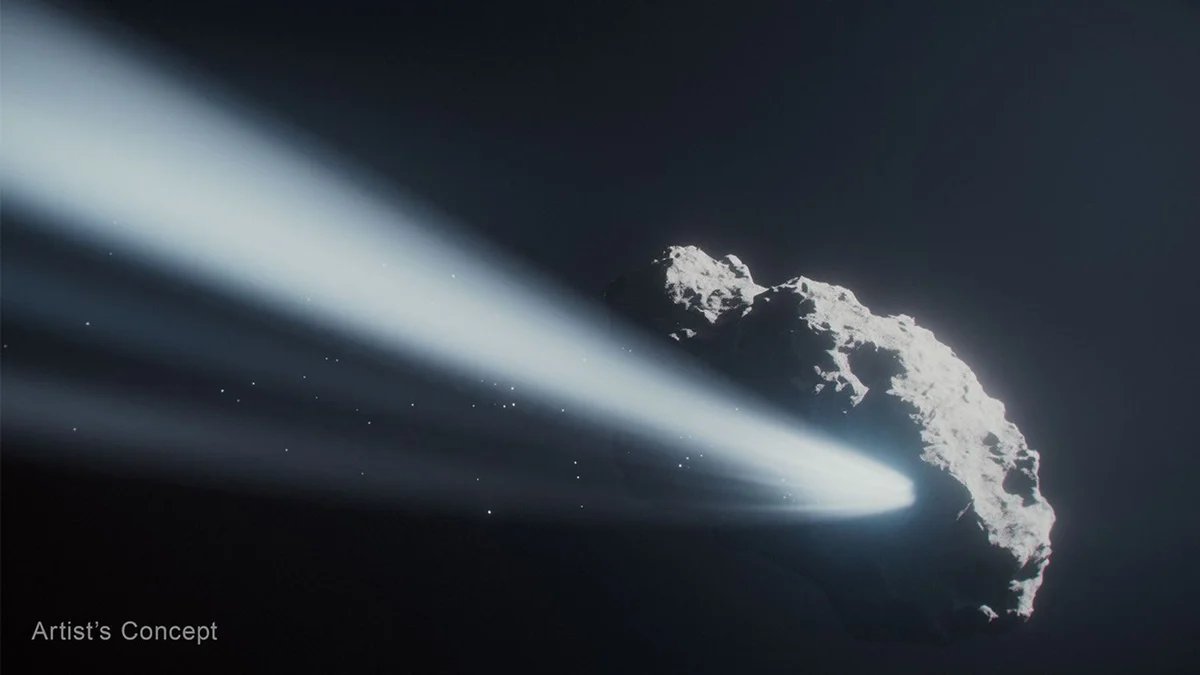
Astronomers caught a comet in the act of reversing its spin. Using NASA’s Hubble Space Telescope, scientists noticed the never-before-seen behavior of Comet 41P/Tuttle-Giacobini-Kresák (41P to its friends) after it passed around the sun in 2017.
In May of that year, data from NASA’s Neil Gehrels Swift Observatory suggested the object was spinning some three times slower than it had just two months before, in March 2017. A follow-up Hubble analysis revealed something even more unusual: after the comet slowed down, it started spinning much faster again. The comet likely slowed to the point of almost stopping entirely before volatile activity at its surface forced it to spin in the opposite direction, the researchers suggest of the odd behavior.
This activity likely took the form of outgassing jets—as the comet approached the sun, the star’s heat would have caused frozen ices to become gas.
On supporting science journalism
If you’re enjoying this article, consider supporting our award-winning journalism by subscribing. By purchasing a subscription you are helping to ensure the future of impactful stories about the discoveries and ideas shaping our world today.
“Jets of gas streaming off the surface can act like small thrusters,” said David Jewitt of the University of California, Los Angeles, a co-author of a paper describing the observations that was published on Thursday in the Astronomical Journal, in a statement. “If those jets are unevenly distributed, they can dramatically change how a comet, especially a small one, rotates.”
Essentially, the jets could have slowed the comet, eventually flipping its direction of rotation.
“It’s like pushing a merry-go-round,” Jewitt said. “If it’s turning in one direction, and then you push against that, you can slow it and reverse it.”
The observations represent a rare opportunity to see the evolution of a comet on a short timescale—generally, changes to a comet on this scale take centuries or more to come about. Comet 41P is believed to have originated in the Kuiper Belt, out at the far reaches of the solar system, before it was flung inward at some point by Jupiter’s gravitational pull. Scientists think it has occupied its current orbit for about 1,500 years, but it appears to be losing mass at a rapid pace, something Jewitt suggests will lead to the comet’s self-destruction.
It’s Time to Stand Up for Science
If you enjoyed this article, I’d like to ask for your support. Scientific American has served as an advocate for science and industry for 180 years, and right now may be the most critical moment in that two-century history.
I’ve been a Scientific American subscriber since I was 12 years old, and it helped shape the way I look at the world. SciAm always educates and delights me, and inspires a sense of awe for our vast, beautiful universe. I hope it does that for you, too.
If you subscribe to Scientific American, you help ensure that our coverage is centered on meaningful research and discovery; that we have the resources to report on the decisions that threaten labs across the U.S.; and that we support both budding and working scientists at a time when the value of science itself too often goes unrecognized.
In return, you get essential news, captivating podcasts, brilliant infographics, can’t-miss newsletters, must-watch videos, challenging games, and the science world’s best writing and reporting. You can even gift someone a subscription.
There has never been a more important time for us to stand up and show why science matters. I hope you’ll support us in that mission.