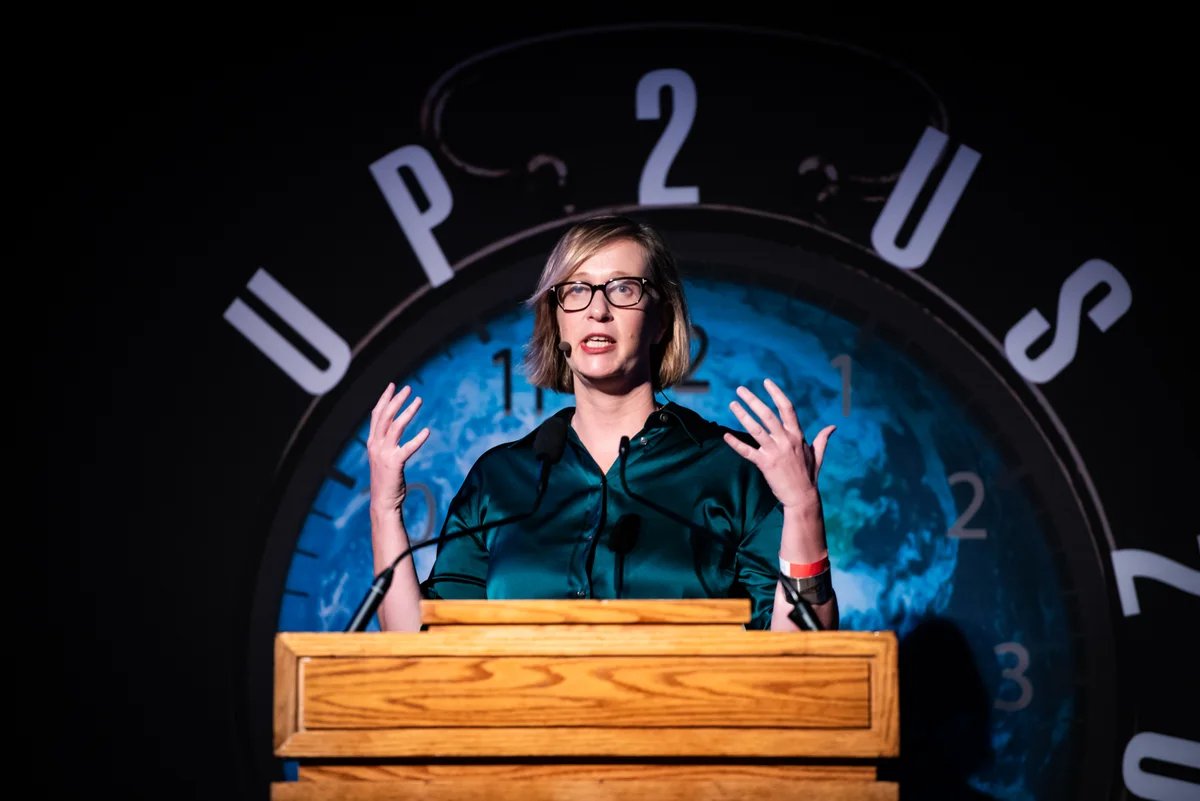
On Tuesday famed climate scientist Kate Marvel joined the more than 10,000 people with PhDs in science, engineering and mathematics who, according to Science, are reported to have left the U.S. federal workforce since President Donald Trump took office in January.
Marvel resigned from NASA’s Goddard Institute for Space Sciences (GISS), where she studied climate change and its effects on Earth’s systems. In her resignation letter, she wrote that “the decision to leave was not an easy one.”
“I thought I’d spend my entire career working at this wonderful place,” her letter stated. But she “never expected that science itself would come under attack, simply because it—like journalism, history, and even the best kind of art—is a way of seeking the truth. I’m leaving because I want to tell the truth.”
On supporting science journalism
If you’re enjoying this article, consider supporting our award-winning journalism by subscribing. By purchasing a subscription you are helping to ensure the future of impactful stories about the discoveries and ideas shaping our world today.
Marvel has done high-profile work to understand Earth’s changing climate and is a frequent public speaker and science writer. (She has previously written for Scientific American.) When asked for comment, a NASA spokesperson said it would be inappropriate for the agency to comment on personnel matters.
Marvel spoke with Scientific American about her decision to quit NASA and the state of American science.
[An edited transcript of the interview follows.]
Tell us a little bit about your job with NASA.
I was a research scientist at NASA. It was my job to learn things about Earth, and that is the greatest job description I can think of, because this is the best planet and there’s so much interesting stuff going on here.
I focused largely on two areas of Earth science. One is detection and attribution of climate change—so what does climate change look like? That means the temperatures rise, but it also manifests in other weird ways: changes in rainfall, changes in extremes, changes in drought risk.
I thought a lot about “How is climate change—not just greenhouse gases but also aerosols and naturally forced climate change like volcanic eruptions—how does that affect the weather patterns, the things that we care about?”
The other part of my job was to look at feedback. So as Earth warms, how does it change, and how do those changes then feed back on the warming?
Recently I had become interested in what we call carbon cycle feedback: When you disturb the Earth system, how much of the carbon dioxide that human beings put in the atmosphere stays up there? That is a story about how living things on the planet are changing, because, right now, about half of the CO2 that human beings put in the atmosphere gets taken out by things that grow, by things that photosynthesize. And we don’t know if that’s going to continue.
What did working at NASA mean to you?
What a dream, right? Those four letters are magic. They stand for exploration and discovery and doing big things. But I think, for me, they also kind of stood for this promise that America could be better than it was, that we could not only provide a good life for everybody but also tell people, “You deserve wonder; you deserve awe and discovery. And space is not a playground for billionaires. Space is something that belongs to everybody who lives on this planet.” I really believed in that mission, and I still really believe in that mission.
Why did you decide it was time to leave the space agency?
There was no real push over the edge. It was the accumulation of thing after thing after thing after thing. It’s hard to be a scientist in general right now, and it’s hard to work for the federal government as a scientist.
There were uncertainties in terms of: Are we going to get fired? Is DOGE going to come after us? What’s going to happen to our program?
[GISS] used to have a lease on a building over Tom’s Restaurant at 112th and Broadway in New York City, and that lease was ended. We were kicked out. We were dispersed. We have been kind of couch surfing at various New York City universities and libraries. That was very disruptive.
And then, when we apply for grants, we don’t hear about them or we hear, “This is a good proposal. Under any other circumstances, we would want to fund it, but we don’t know anything about the money.” So it’s just waking up every day not knowing “Is this the day that I get fired? Is this the day somebody I work with who I respect gets fired? Could I get this money and plan ahead to do this science or not?” I was personally finding that more and more difficult to do.
I had a project that was “selectable” but not selected, which, I think, is where it went through peer review, they said we should fund this, and then it didn’t go any further. That project was to try to future-proof the U.S. electric grid by studying the impacts of the changing climate on things like solar availability, because climate change can lead to changes in cloud patterns.
We also wanted to work on a project looking at the hypothetical impact of solar radiation management [a form of geoengineering intended to lower Earth’s temperature] on plant growth. I’m not saying this is a good idea or that we should do this. But as a trusted scientific body, [NASA] should be the one doing research on this in a model to try to get that information out there to the people who should be the decision-makers. And that was submitted and, as far as I can tell, fell into a black hole.
What are your concerns about the state of science in the federal government?
There are so many people still at NASA who are doing enormously good work against headwinds because they believe in this mission, because they believe in the science, they believe in NASA. And so that gives me hope that there are still so many dedicated people who are looking for ways to continue doing science with integrity.
I think they’re not the only amazing scientists this country has produced. We really punch above our weight in science. We have historically funded science. We have historically led the world in discoveries by any metric—published papers, Nobel Prizes, technology, whatever.
And for a long time, there’s been bipartisan consensus that that’s a good thing. And I was naive. I thought that the benefits of doing science would be self-evident. And I anticipated that our science—as people who look at the planet and see that it’s changing—would come under scrutiny and even attack because the implications are politically inconvenient. We’ve seen that before, and that’s what I expected. What I did not expect was that [the Trump administration] would go after pediatric cancer research first. That they would go after Parkinson’s research first. And they would go after vaccines, the greatest invention of humanity. And that has shocked me, the fact that science is under attack, not because its conclusions are necessarily politically inconvenient but because it is a way of telling the truth. That has been the most disorienting and frightening aspect of all of this.
What do you plan to do now?
I don’t think I can do anything but be a scientist. I’m too nerdy. I’m too excited. I can’t talk about it quite yet because it hasn’t been announced. But I am really excited that I think I’ve found a way to keep doing science in a way that will let me answer the questions that I’m interested in but also speak out about it—say, “Here’s what we know; here’s what we don’t know,”—and be honest about it and to start to think about [how], when we project these futures where the climate is three degrees, four degrees, five degrees [Celsius] hotter, I am perfectly comfortable with saying, “Hey, as a scientist, I’m not okay with that.”
I know that that is a violation of what some people might consider scientific neutrality. But I have a conflict of interest: I live on Earth, and so I don’t want to see this particular future. And so, without stepping into policy, which is very much getting over my skis, I think doing the applied science that helps inform those important decisions is something that I’m really excited about.