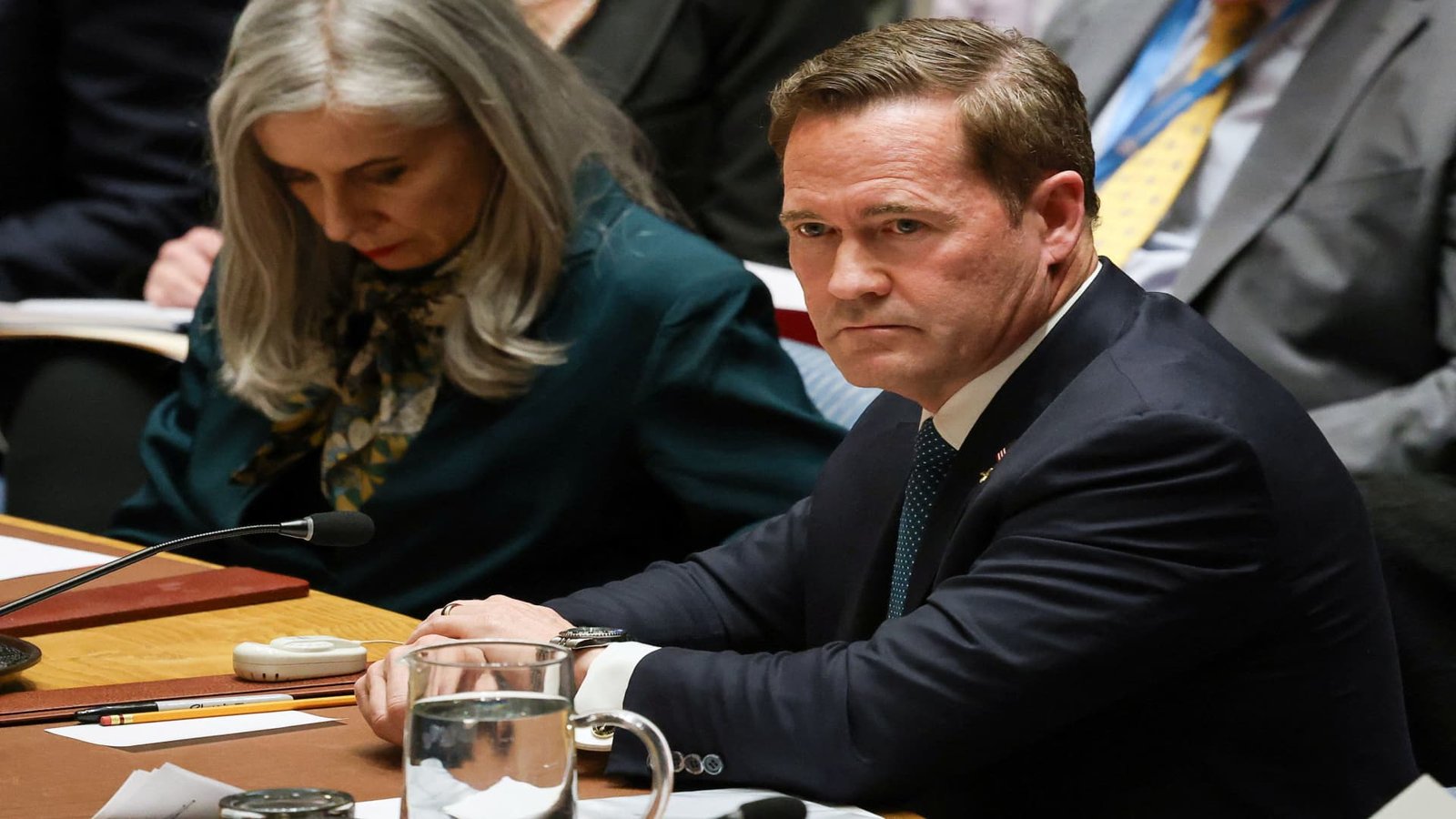
U.S. Ambassador to the U.N. Mike Waltz attends a United Nations Security Council meeting, after the U.S. and Israel launched strikes on Iran, at U.N. headquarters in New York City on Feb. 28, 2026.
Heather Khalifa | Reuters
Mike Waltz, the U.S. ambassador to the United Nations, said Sunday that President Donald Trump is weighing strikes on oil infrastructure on Kharg Island, a key Iranian oil export hub.
“President Trump’s not going to take any options off the table,” Waltz said on CNN’s “State of the Union.”
Kharg Island has been thrust into the global spotlight because it is regarded as one of Iran’s most sensitive economic targets. The terminal accounts for around 90% of the country’s crude exports and has a loading capacity of roughly 7 million barrels per day.
Trump said on Friday that he directed the U.S. Central Command to carry out a bombing raid on Kharg Island’s military targets for the first time but left the oil infrastructure intact. Trump had threatened further strikes on Iran’s oil export hub, even as he repeatedly urged allies to deploy warships to help the U.S. secure the Strait of Hormuz.
“He deliberately hit the military infrastructure only, for now,” Waltz said on CNN. “And I would certainly think he would maintain that optionality if he wants to take down their energy infrastructure.”
Separately, Iran’s Foreign Minister Abbas Araghchi took to social media to say his country is “ready to form a committee with the countries of the region to investigate the targets that were attacked” on Kharg Island.
“Our attacks only target American bases and interests in the region,” he wrote.
In a Telegram post Sunday, Araghchi said: “We have not targeted any civilian or residential areas in the countries of the region so far,” and added, “Occupying Kharg Island would be a bigger mistake than attacking it.”
IRGC vows to end ‘child-killer’ Netanyahu
Tehran on Sunday promised to kill Israeli Prime Minister Benjamin Netanyahu as the U.S.-Israel war on Iran continued to threaten oil supplies in the Gulf.
“IRGC vows to pursue and kill ‘child-killer’ Netanyahu if he is still alive,” Iran’s IRNA news agency said in a post on X, referring to the country’s Islamic Revolutionary Guard Corps. Rumors that the Israeli leader was dead circulated over the weekend, prompting his office to issue a statement calling the reports “fake.”
Israel in return targeted key members of Iran’s leadership over the weekend.
The Israel Defense Forces said they had “eliminated” two senior Iranian intelligence officials of the “Khatam al-Anbiya” Emergency Command.
Late on Saturday, the IDF said in a post on X that it had struck the primary research center of the Iranian Space Agency and an aerial defense system production factory.
Iran continued to retaliate against targets around the region. Israeli emergency services reported a “recent missile barrage” fired at central Israel, but said there were no known injuries.
Israeli security forces check the damage to cars after a rocket strike in Holon, in the Tel Aviv District on March 15, 2026. (Photo by JACK GUEZ / AFP via Getty Images) /
Jack Guez | Afp | Getty Images
Trump’s calls for assistance met with caution
A number of countries responded cautiously after Trump repeatedly called for other nations to send war ships to the Gulf to help the U.S. secure the Strait of Hormuz.
In a Truth Social post on Saturday, the president wrote, “Hopefully China, France, Japan, South Korea, the UK, and others, that are affected by this artificial constraint, will send Ships to the area.” Trump later in the day demanded in a separate post that countries that rely on the strait for their energy supply assist in the U.S. and Israeli military operations in the region.
South Korea’s Foreign Ministry said in a statement on Sunday that it “takes note” of the president’s comments and that it would “closely coordinate and carefully review” the situation. The Korea International Trade Association said it gets around 70% of its crude oil and 20% of its liquified natural gas from the Middle East.
Britain responded that it is ‘intensively’ looking at how to help secure the strait. Asked whether Britain is considering sending minesweepers or mine-hunting drones to the strategic waterway to help shipping return to normal, U.K. Energy Secretary Ed Miliband told Sky News: “We are talking to our allies.”
Miliband told the BBC that “any options that can help to get the strait reopened are being looked at.” He added: “We don’t want a nuclear Iran but ending this conflict is the best and surest way to get the strait reopened.”
In Japan, it is speculated that Trump will ask the U.S. ally to send warships when Prime Minister Sanae Takaichi meets with him on Thursday at the White House.
Rising oil prices may continue
The war has effectively choked off energy supplies moving through the narrow Strait of Hormuz. About 20% of the world’s oil and gas typically passes through the maritime corridor.
On Friday, Brent crude oil futures closed above $100 per barrel for the second straight day, and the global oil benchmark has surged more than 40% since the war in Iran began.
Oil prices could extend gains at Monday’s open as the Iran war enters a third week, but the Trump administration continued to downplay the spike in prices as a short-term issue.
“I think that this conflict will certainly come to the end in the next few weeks — could be sooner than that,” U.S. Energy Secretary Chris Wright said Sunday on ABC’s “This Week.” “But the conflict will come to the end in the next few weeks, and we’ll see a rebound in supplies and a pushing down in prices after that.”
Wright caused confusion and roiled the markets on Tuesday after incorrectly claiming in a post on X that the U.S. Navy has successfully escorted an oil tanker through the strait.
Brent and U.S. crude futures have already spiked sharply, rattling global markets. Both contracts have surged more than 40% so far this month to their highest levels since 2022 after the U.S.-Israeli attacks on Iran brought shipping to a near-halt through the Strait of Hormuz.
Oil-loading operations in the United Arab Emirates’ port of Fujairah resumed on Sunday according to media reports, after being interrupted a day earlier due to a fire caused by falling debris from an intercepted drone.
A spokesperson for Abu Dhabi’s state oil giant, ADNOC, which operates in Fujairah, directed CNBC to the Fujairah Media Office, which did not immediately respond to emailed requests for comment.
Meanwhile, the International Energy Agency said Sunday that emergency stocks of oil “will soon start flowing to global markets.”
The IEA also updated last week’s announcement of 400 million barrels to nearly 412 million. Member countries in Asia plan to release stocks “immediately,” it said, and reserves from Europe and the Americas will be released “from the end of March.”
Major sporting events canceled
The impact of the war has not only severely disrupted air travel but it is now also affecting major sporting events in the Gulf region due to safety concerns.
Formula 1 said on Saturday it has canceled the upcoming Grand Prix races in Bahrain and Saudi Arabia scheduled for April.
“While alternatives were considered, no substitutions will be made in April,” Formula 1 said in a post on X.
And the “Finalissima” match between Spain and Argentina that was scheduled to be held in Qatar on March 27 has been cancelled, the UEFA said in a statement on Sunday.
“It is a source of great disappointment to UEFA and the organisers that circumstances and timing have denied the teams of the chance to compete for this prestigious prize in Qatar,” UEFA said in a statement.
The contest between Spain and Argentina was scheduled to be held at Doha’s Lusail Stadium, where soccer fans would have had the opportunity to watch Lionel Messi go head-to-head with Lamine Yamal.
— Reuters and the Associated Press contributed to this report