
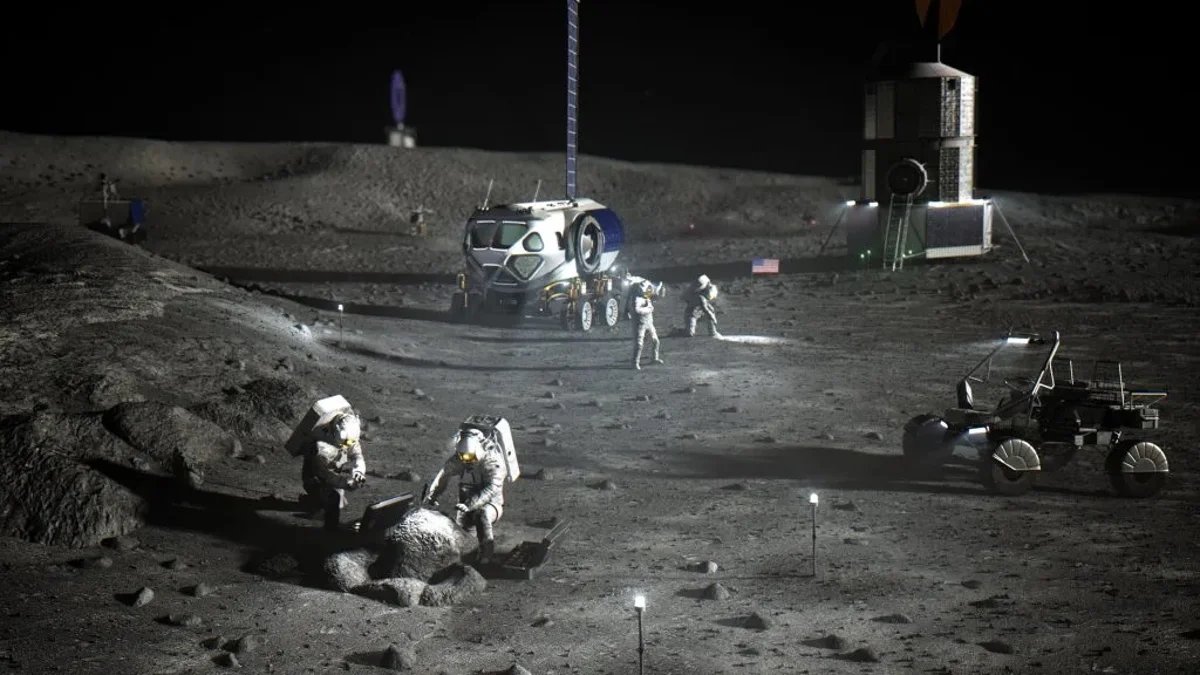
In the U.S.- and China-led race to put astronauts back on the moon, there is, in fact, one overlapping goal: establishing a sustainable, permanent, crewed moon base. But each of the two nations’ specific plans to achieve that moonshot are far from similar, with key differences that could dictate which country gets there first—and, just maybe, which controls the moon itself.
The China Manned Space Agency (CMSA) is aiming for a human landing no later than 2030. It plans to use its Mengzhou crew capsule and Lanyue lunar lander, which will be launched separately on its Long March 10 rockets. Officials haven’t selected a landing area yet, but CMSA appears to be zooming in on a relatively low-risk touchdown site near the equator on the moon’s Earth-facing side—similar to the landing area selection process used by NASA’s Apollo moon program for its first crewed moon landing in 1969.
NASA, meanwhile, is pursuing a landing in 2028. Astronauts will launch to the moon in an Orion capsule atop a Space Launch System rocket and then be ferried to the surface by a commercial lunar lander, such as a version of SpaceX’s Starship vehicle or Blue Origin’s Blue Moon lander, as part of the agency’s Artemis IV mission.
On supporting science journalism
If you’re enjoying this article, consider supporting our award-winning journalism by subscribing. By purchasing a subscription you are helping to ensure the future of impactful stories about the discoveries and ideas shaping our world today.
Unlike China’s hew toward an Apollo-style, “safety first” plan, the U.S.’s astronauts would target more perilous sites near the harder-to-reach, resource-rich lunar south pole. And both nations want this region to be the site of their crewed outposts.
Two rival moon bases, one common goal
China eventually plans to establish the International Lunar Research Station (ILRS), a two-phased moon base built in partnership with Russia’s space agency, Roscosmos.
The initial, uncrewed phase of the ILRS will be led by two autonomous lunar landers, developed and operated by the China National Space Administration (CNSA), the agency responsible for the nation’s uncrewed space programs.
First, the planned Chang’e 7 mission, launching later this year, will likely land at the Shackleton Crater on the south pole to survey it for water ice and other resources that might be used to support the ILRS. Then, in 2029, Chang’e 8 will visit the region to perform demonstrations of key base-building capabilities, such as making bricks from lunar soil. Ultimately, such “in situ resource utilization” could include processing lunar polar ice into potable water or even rocket fuel. The second ILRS phase could support human occupants for extended surface stays.
NASA’s planned outpost, provisionally called Artemis Base Camp, would be U.S.-led but also include contributions from several other nations and a host of commercial partners. It, too, would be constructed in phases using a mix of robots and human astronauts. And it will, at least to start, be a mess: speaking to the New York Times in February, NASA administrator Jared Isaacman noted that, for perhaps a decade after its foundation, Artemis Base Camp will resemble a “futuristic junkyard with lots of landers and rovers around” before it will eventually gain more “pretty cool infrastructure.”
A policy of permanence
NASA has some ideas about what “cool infrastructure” it might put on the moon—notably a fission reactor by 2030—but has stayed mum on most of the details, says Marcia Smith, a space policy analyst who helms SpacePolicyOnline.com. But perhaps the most important detail for Artemis Base Camp, she says, isn’t about a particular gadget or construct but rather a tweak to official national policy.
The tweak in question is in the NASA Authorization Act of 2026 that was passed on March 4 by the Senate Committee on Commerce, Science, and Transportation and calls for the space agency to establish a base on the lunar surface.
During the committee’s proceedings, its chair, Republican senator Ted Cruz of Texas, said the bill explicitly directs NASA “to create a permanent moon base so that we can get there before China does.”
The directive carries considerable weight, Smith says. “Building a moon base has been the stuff of science fiction for decades but is now a stated goal of NASA,” she says, “and legislation is working its way through Congress.”
The law acknowledges it will be an incremental process, but “at what point it becomes a ‘moon base’ undoubtedly will be the subject of much debate in the space community,” Smith says, “especially if other countries like China are doing the same thing.”
Ultimately, establishing a “permanent” human presence on the moon is a very different task from the “permanence” in low-Earth orbit that NASA and other space agencies have achieved via crewed spacecraft like the International Space Station (ISS), says Clive Neal, a longtime lunar exploration advocate and professor of planetary geology at the University of Notre Dame.
“‘Permanent’ on the moon means we have a station on the lunar surface that’s always got a human there,” Neal says. The precedent is the ISS: sustained through international cooperation (but notably excluding China), that orbital facility has enabled a continuous human presence in space for more than 25 years.
But for the moon, “the first thing is having a lunar port with a custom-built landing and launchpad,” Neal says. “It has to be robust and easily repaired, used over and over again without being destroyed, supporting a cadence of human and cargo-carrying craft coming and going from the same spot.”
From there, rovers for surface transport would be critical. “It’s a staged-but-integrated infrastructure,” he says. “It’s power, ports, logistics, resources and habitation.”
And speaking of habitation, “a tin can on the surface ain’t gonna … be it,” Neal adds. A habitat would likely need to be buried beneath lunar soil to shield occupants from cosmic radiation, micrometeoroid impacts and the intense thermal swings associated with the weeks-long lunar day and night.
We’re here to stay—so keep away!
For Michelle Hanlon, executive director of the Center for Air and Space Law at the University of Mississippi, “permanence” on the moon doesn’t necessarily mean a single inhabited structure planted in one spot but rather “the ability to maintain a continuous presence through regular missions, infrastructure buildup and ongoing surface operations.”
A better way to think of a moon base is as a network of systems, Hanlon says. And because these systems can’t all be packed together or directly next to one another (it’s best to keep rocketry far from nuclear reactors, for instance), even a relatively small installation could have a fairly large operational footprint. In other words, permanence on the moon for any nation will not just be matter of high-tech brick-and-mortar, she says.
The foundational legal document for anyone looking to set up lunar shop is the United Nations Outer Space Treaty of 1967. The treaty effectively prohibits national appropriation or private ownership of the moon, favoring a “for all humankind” approach. Loopholes exist, however, allowing lunar explorers to establish “safety zones” to protect their work and themselves from potentially harmful interference by other moon-visiting parties. These zones would be operational buffers to minimize risks, Hanlon says, rather than explicit territorial claims. They could nonetheless prove exclusionary.
“It will be a governance test,” she says. “The real question is whether multiple nations can operate side-by-side at the most valuable places on the moon without turning operational safety into geopolitical exclusion.”
Complicating all this is that the moon’s south pole is rugged and remote from more easily accessible regions, meaning there are surprisingly few places to build there. Several key conditions must align: terrain suitable for landing; near-continuous sunlight for power; proximity to permanently shadowed craters that may contain water ice; and ideally, the capability for line-of-sight communications with Earth.
“Those combinations occur only in limited locations,” Hanlon says. “So the real issue isn’t whether there is room somewhere on the moon but whether there is room at the handful of sites that make sustained operations practical.

