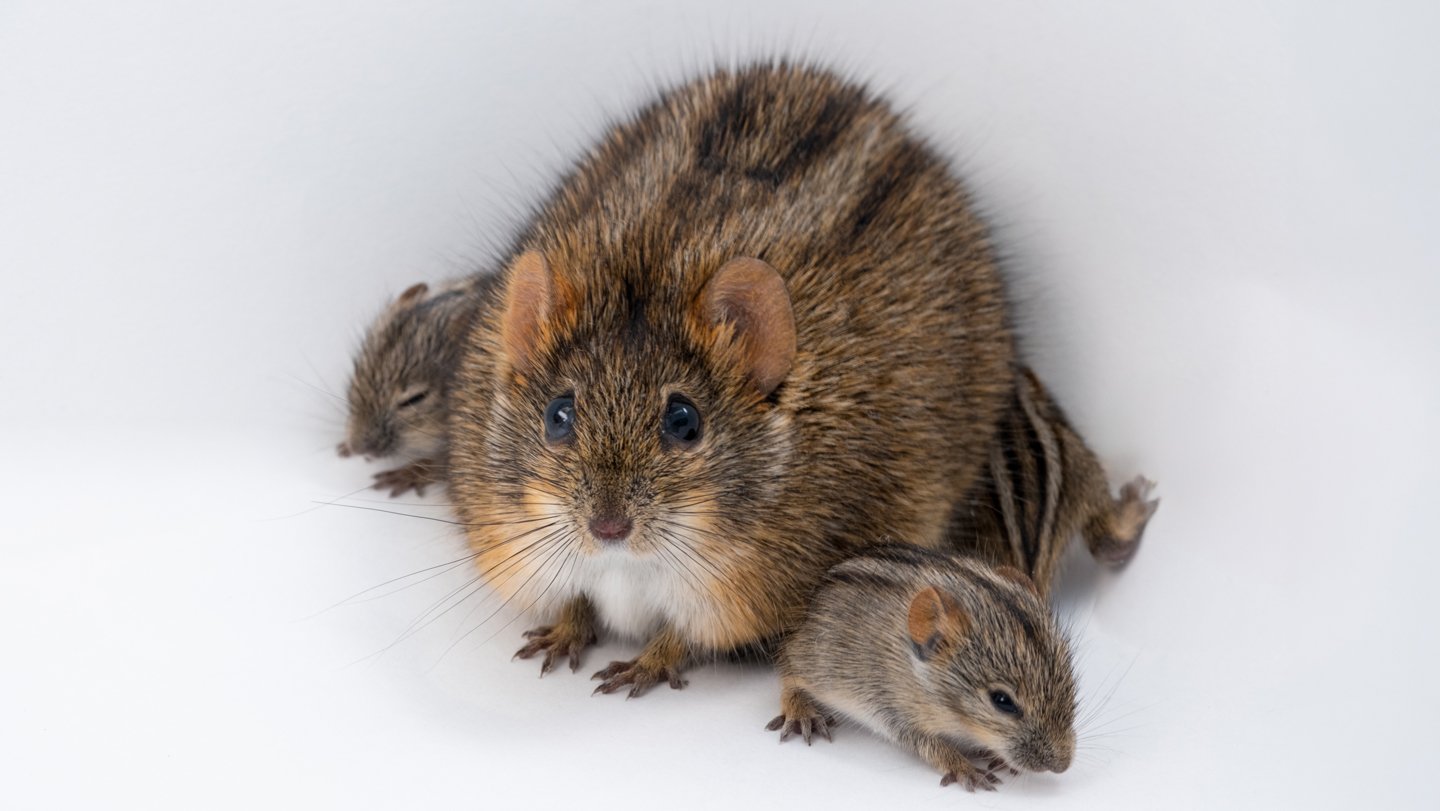
The difference between a doting dad and a deadbeat one may come down to a molecular switch in the brain — at least in African striped mice.
Boosting activity of a particular gene in part of the brain known for regulating maternal care turned nurturing males into standoffish ones and even, in some cases, into mouse pup killers, researchers report February 18 in Nature. The findings reveal how social context can alter gene activity in the brain and thereby shape male caregiving.
Male caregiving is prevalent in fish and amphibians, suggesting that it is a very ancient behavior in vertebrates. Among mammals, however, fewer than 5 percent of species have fathers that stick around to raise their young. Male African striped mice (Rhabdomys pumilio) are one of the exceptions to the rule, though they vary a lot in their nurturing tendencies, making them an ideal species in which to study the factors that influence this behavior.
Some look after the young and groom them; others ignore the pups or even attack them. The same male could become aggressive or doting.
To understand that behavior, comparative neurobiologist Forrest Rogers and his colleagues observed the mice’s social environment. In laboratory settings, group-housed males tended to be aggressive toward mouse pups when introduced to them. But surprisingly, when these males were moved to be housed alone, they became very paternal.
“I thought clearly something must be wrong, because all the work we know of in mice and rats is that if you socially isolate them, they become very anxious and often not the most caring of individuals,” says Rogers, of Princeton University. But the lone African striped male mice didn’t seem anxious at all.
The researchers imaged the brains of the males to identify which regions were activated by interaction with pups. Good caregivers showed greater activity in the medial preoptic area, or MPOA, than hostile males. That brain region was previously known to be rewired in new moms of other rodent species.
“Many of the same neural responses … that are beginning to be so well documented for maternal behavior, those same brain regions are at work in males as well,” says Sarah Hrdy, an anthropologist at the University of California, Davis, who was not involved in the new study.
But when the team drilled down to the molecular level, it got a surprise: A gene called Agouti was more active in the MPOA of aggressive males.
Artificially boosting the activity of Agouti in the MPOA turned previously nurturing males ambivalent and sometimes infanticidal. But when males were moved from a communal living arrangement to a solitary one, the Agouti levels in their brain dropped and they took more interest in caring for pups.
Agouti was previously known to be important for the development of the mouse’s characteristic stripes. So its involvement in the brain “was a big surprise, honestly,” says Princeton evolutionary developmental biologist Ricardo Mallarino, whose earlier work uncovered how the African striped mouse got its stripes.
“This animal has evolved the ability to take in information from its environment and to regulate its behaviors that are often energetically demanding,” Mallarino says. The activity of Agouti in the brain is how the mouse integrates cues about the social environment to balance competing demands, like parenting, feeding and defending territory.
Taken together, the findings support a growing body of research showing how social environment can alter gene activity in the brain, which in turn affects parenting behavior.
Whether something similar is happening in humans is unknown. Unlike the apes we’re most closely related to, many human fathers do take care of babies. We are only beginning to explore the potential biological roots of this behavior. “These are very early days for understanding the nurturing potentials of men,” Hrdy says.