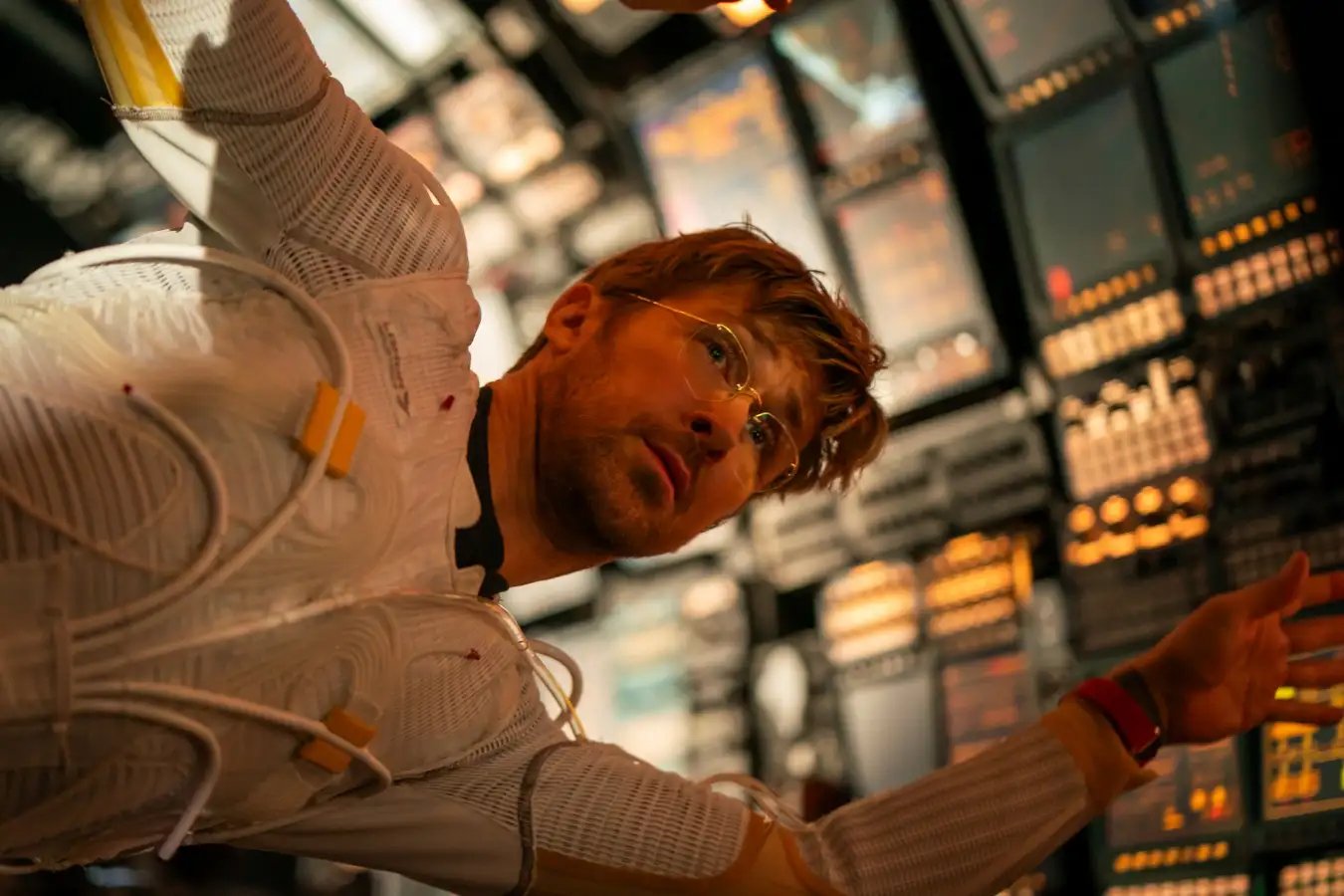
Ryan Gosling as Ryland Grace in Project Hail Mary
Jonathan Olley/Sony Pictures
Project Hail MaryIn cinemas from 19 March
There is so much fun and fascinating stuff in Project Hail Mary, Andy Weir’s novel about a last-ditch attempt to stop our sun from dying, that I felt guilty for abandoning it nary 100 pages in. I couldn’t get past Ryland Grace, a molecular biologist turned teacher turned astronaut who wakes up on a spacecraft light years from home without a clue who he is or why he is there.
I hated Ryland. I hated his immature, sardonic personality. I hated that such a great premise was filtered through the eyes of a person who calls their penis their “gentleman’s equipment”. The questions the book hinted at – like why an interstellar mission would be needed to save our sun – weren’t quite intriguing enough to tempt me to stay inside Ryland’s head for 500 pages. So I stopped reading.
More fool me. Had I pushed through, I would have found a heartwarming, science-filled story – one that the new film adaptation of Project Hail Mary has thankfully revealed to me.
I breathed a sigh of relief in its very first scene, in which Ryland (Ryan Gosling), after spending years in a coma aboard the ship, has his breathing tube and other vital life-support systems removed by a robotic arm. In the book, it is a protracted moment full of flippant asides; in the film, stripped of that god-awful interiority, it is as gnarly as you would expect and over in seconds. Cut to a bearded, dazed Ryland prowling around the ship like a Gen X Tarzan and we’re off, instantly invested.
The scene is representative of this adaptation’s greatest strength: it doesn’t overexplain, trusting that the cast will convey what is needed without heaps of exposition. As Ryland, Gosling makes a smart-aleck loner, cast out of academia for questioning the orthodoxy on what alien life could look like, feel like a genuine everyman – and he’s actually funny.
We slowly learn that Ryland was recruited by the icily competent Eva Stratt (Sandra Hüller). She sets out the stakes: the sun is projected to dim by up to 5 per cent over the next 20 years. If the trend continues, Earth will plunge into climatic chaos and humanity will slowly starve to death. Hüller takes what could have been a one-note role and fills it with tightly controlled emotion – between her, Gosling and James Ortiz in a role that I won’t spoil, Project Hail Mary is full of performances that will make you laugh and break your heart in equal measure.
And the science – my god, the science! – is everything you could have hoped for from writer Drew Goddard, who also adapted The Martian, another Weir book. Like its spiritual sibling, Project Hail Mary is a film about a lone genius battling to survive in space and how the scientific process might save him, although it is less concerned with the minutiae of that survival than it is with big, bold ideas in physics and biology.
Nevertheless, Ryland is forced to put his considerable brain to work when he realises the team’s pilot and engineer have both died on the journey, leaving him alone in space and ill-equipped to finish his mission. With nothing but time on his side, Ryland is able to come up with some canny solutions to his situation that will please hard sci-fi fans, even if not everything is explicitly spelled out.
Without revealing the twists and turns this story takes, I’ll just say the question of what life is and what makes it matter is central to Project Hail Mary. Not everything in the film is effective: like its source material, it can overindulge in Ryland’s goofier side and lurch into corniness on occasion. But perfect is the enemy of good, and while he still wouldn’t be my choice of guide to the stars beyond our own, I was astonished how much I cared about Ryland’s fate by the end of the film.
Project Hail Mary is a beautifully shot, utterly charming adventure – and for me, a lesson in pushing through your initial misgivings. I may even take a second crack at finishing the book.
Topics: