Of all the asteroids that have imperiled the planet, 2024 YR4 is unparalleled. Soon after it was spotted in December 2024, worldwide telescopic observations quickly positioned it as the most dangerous space rock ever discovered—one that stood a 3.1-percent (or 1-in-32) chance of crashing into Earth on December 22, 2032. If it were to hit one of the cities potentially in its path, this 60-meter asteroid would have unleashed a force comparable to several atomic bombs, devastating the unfortunate metropolis.
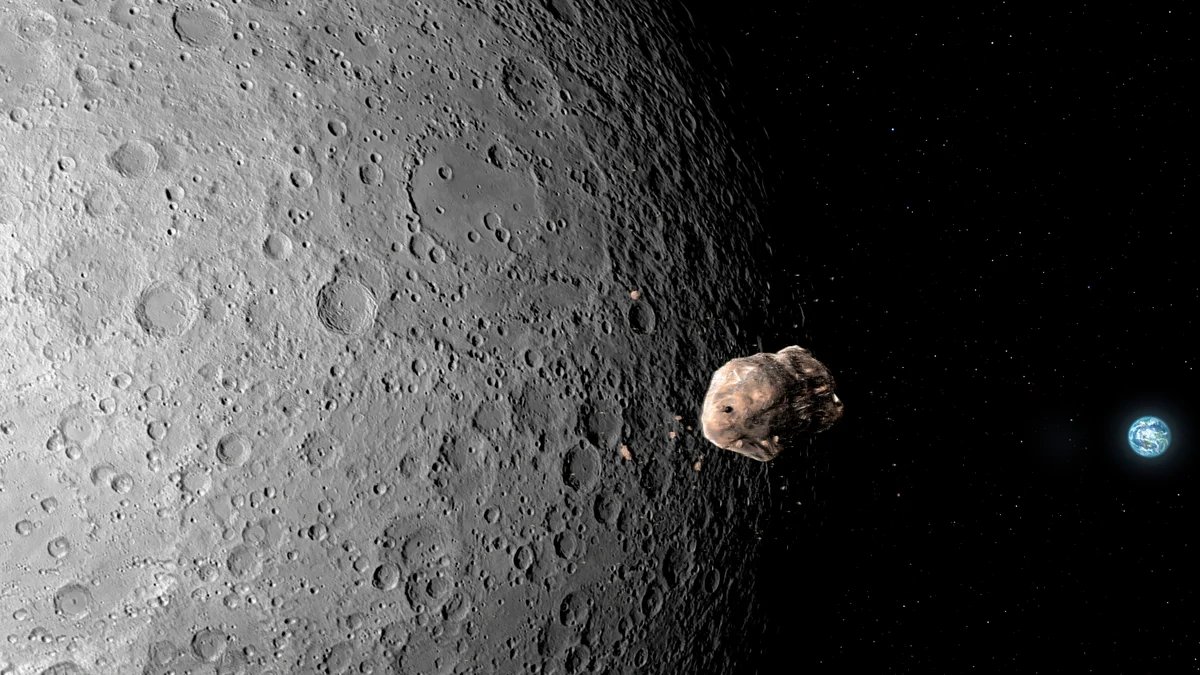
An Earth impact was eventually ruled out in February of last year. But a late plot twist revealed 2024 YR4 stood a 4.3-percent (1-in-23) chance of slamming into our moon on the same date. Now, a concerted effort by astronomers indicates the asteroid will comfortably miss our alabaster companion too—by 21,200 kilometers.
Remarkably, this revelation comes from the James Webb Space Telescope (JWST), an observatory that was designed to look at ancient black holes, distant galaxies, convulsing stars and far-flung planets—not help defend the planet from rogue asteroids. Its incredibly perceptive infrared vision, however, was able to track the asteroid in February when it was 450 million kilometers from Earth—a feat no other telescope could manage.
On supporting science journalism
If you’re enjoying this article, consider supporting our award-winning journalism by subscribing. By purchasing a subscription you are helping to ensure the future of impactful stories about the discoveries and ideas shaping our world today.
“We think this is certainly the faintest solar system object that has ever been observed,” says Andy Rivkin, an astronomer and planetary defense researcher at Johns Hopkins Applied Physics Laboratory in Maryland, who led the JWST effort to track 2024 YR4.
“I am truly amazed at what JWST has been able to do for us with a real-life, short-term response to an asteroid threat,” says Kathryn Kumamoto, the head of the planetary defense program at the Lawrence Livermore National Laboratory in California.
Some may grumble that a seemingly harmless 2032 lunar impact—one explosive enough to be visible to the naked eye—is no longer in the cards. But there was a real risk some of the impact debris jettisoned off the moon could have sliced up several Earth satellites. If JWST had determined that 2024 YR4 was on course for a violent rendezvous with the moon, experts would have had six extremely short years to try to deal with it. “It’s really good that we’re not being forced to mitigate this asteroid on that timescale,” Kumamoto says.
The NASA-funded Asteroid Terrestrial-impact Last Alert System (ATLAS) telescopic network first discovered 2024 YR4 just after Christmas Day in 2024. Initially, there appeared to be nothing to worry about. But additional observations by other observatories a 1-percent chance of an Earth impact in 2032. Those impact odds eventually rose to their unnerving peak of 3.1 percent in mid-February of 2025.
All the relevant scientists were keen to find out if those impact odds would continue to rise or fall. But refining 2024 YR4’s orbit was a tall order: it was rapidly moving away from Earth, and by May 2025, it would have faded from view until it swung back around years later. “We were not expecting to observe the object again until the spring of 2028,” says Juan Luis Cano, an aerospace engineer with the European Space Agency’s Near-Earth Object Coordination Center.
That would have given astronomers just four years to prepare if a catastrophic asteroid strike became likely. Even eight years was, according to planetary defense experts, insufficient to prepare a spaceflight mission that could swat the Earthbound asteroid away.
Astronomers first needed to ascertain its true size. Observations with visible light can reveal just rough estimates of a space rock’s dimensions. But when viewed in infrared, the thermal glow of an asteroid corresponds almost exactly to its size.
The same month 2024 YR4 was discovered, a study concluded that JWST could be used to hunt down small asteroids of interest. So when 2024 YR4 ambushed everyone, Rivkin and his colleagues submitted a proposal to scope it out with the $10 billion telescope. It worked wonders: they found the asteroid was 60 meters across, making it a comfortable city wrecker.
By May, once an Earth impact was ruled out, scientists placed the odds of a lunar collision at 4.3 percent. Aside from the fact that there would likely be both American and Chinese astronauts on the moon by 2032, who certainly wouldn’t appreciate being pancaked or blasted into space by 2024 YR4, modeling studies suggested a shotgun spray of debris might knock several of Earth’s communication satellites out of the sky. “That would have had potentially global consequences,” Rivkin says.
That prompted planetary defenders to outline a plan to prevent the lunar impact, which they described in an arXiv preprint. “In the event that substantial threats to space assets were demonstrated from an impact, there’s a reasonable chance we would have tried to do something to stop the asteroid from hitting,” says Kumamoto. But “you couldn’t really deflect it” in the time remaining. That left three options: ram it with a spacecraft to shatter the rock into tiny pieces, vaporize it with a nuclear device-armed spacecraft, or let the impact happen.
“When we saw it might hit the moon, we wanted to follow up,” Rivkin says. “JWST was the only facility that could do that before 2028.” They had a small window of opportunity for two observations in February when 2024 YR4 would be close to several background stars that astronomers knew the positions of with high confidence; that would allow them to monitor the movements of the asteroid with great precision.
During JWST’s observations, “the asteroid was four billion times fainter than the human eyes can see,” says Julien de Wit, a planetary scientist at the Massachusetts Institute of Technology and a member of Rivkin’s team. And yet it worked. Next, NASA’s Center for Near-Earth Object Studies in Southern California and the European Space Agency’s Near-Earth Object Coordination Center in Italy used the observations to recalculate 2024 YR4’s orbit. The upshot? The moon, too, was safe from harm.
2024 YR4 may no longer be a danger. But NASA’s Near-Earth Object Surveyor space observatory (launching 2027) and the imminently operational Vera C. Rubin Observatory in Chile are set to find hundreds of thousands of potentially hazardous asteroids in the next few years. That JWST can lend a hand in protecting not just Earth, but the moon too, is welcome news.
“We are prepared to face any future threats,” says Cano. “And they will come.”