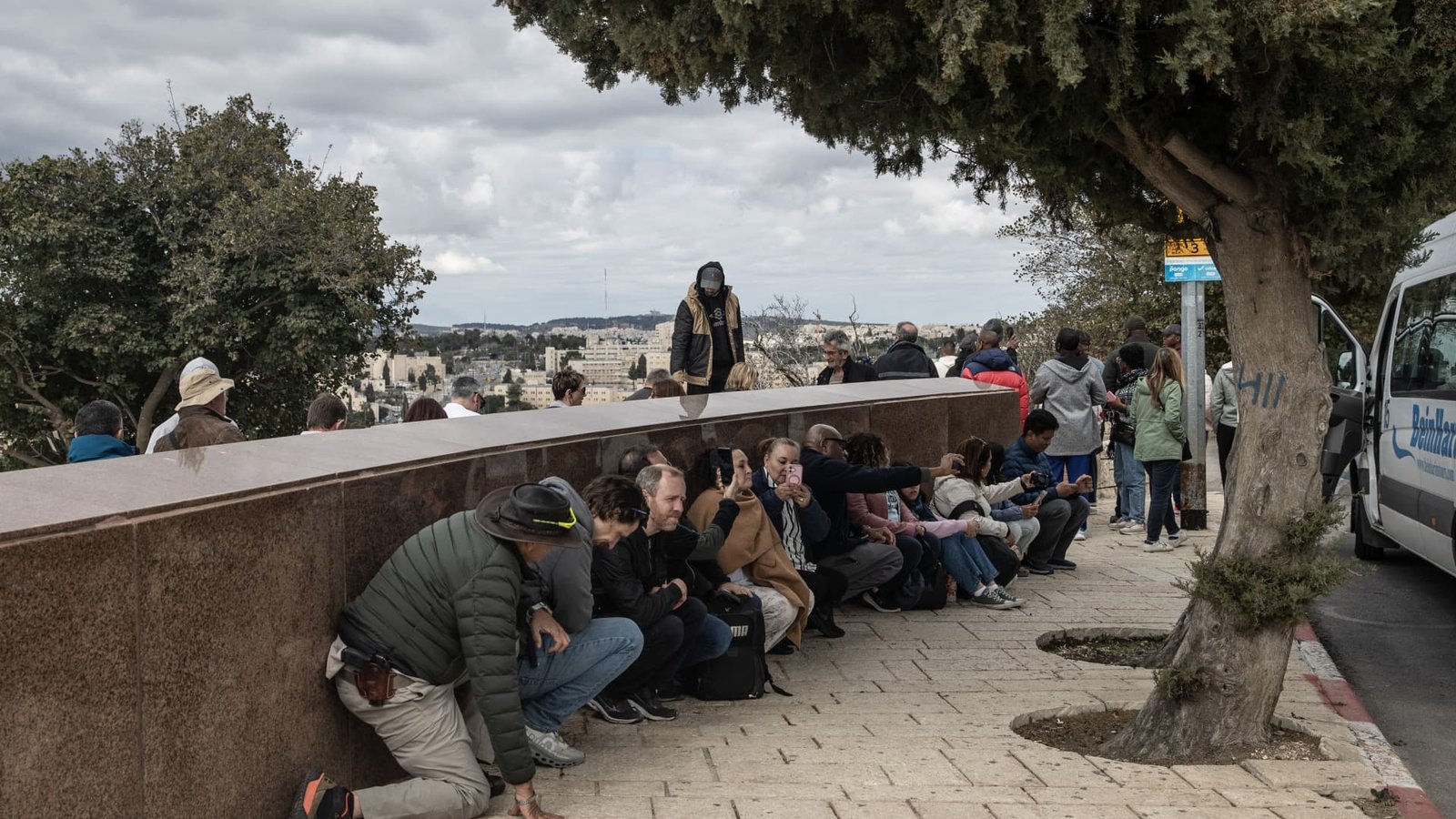
JERUSALEM – FEBRUARY 28: People take shelter as Iran launched missiles and drones towards Israel following the US-Israeli attacks, in Jerusalem on February 28, 2026.
Mostafa Alkharouf | Anadolu | Getty Images
The U.S. and Israel launched their most aggressive attack ever on Iranian targets over the weekend that killed the Islamic state’s longtime supreme leader Ayatollah Ali Khamenei, thrusting the region into a widening conflict as Tehran retaliates with air strikes across the Middle East.
Here’s what we know so far as investors brace for impacts when markets open after the weekend.
Iranian Supreme Leader killed
Iran’s state media announced Khamenei’s death early Sunday.
Trump, making the biggest foreign-policy gamble of his presidency ahead of the mid-term election in November, called the killing “the single greatest chance for the Iranian people to take back their Country.”
Trump also warned on Truth Social that the “heavy and pinpoint bombing will continue, uninterrupted throughout the week or, as long as necessary to achieve our objective of PEACE THROUGH THE MIDDLE EAST AND INDEED, THE WORLD!”
The president had stated on Saturday that the aggressive strikes were aimed at ending a decades-long threat from Iran and ensuring it could not develop a nuclear weapon.
Missiles fired at Gulf states
In Israel, sirens and mobile-phone warnings sent people rushing to air raid shelters as Iran launched a series of missile barrages that were mostly intercepted.
Blasts were reported in the United Arab Emirates, Jordan, Qatar and Bahrain, Saudi Arabia, with footage showing people fleeing a smoke-filled passageway at Dubai International Airport.
Drone strikes have caused damage and injuries at Dubai International Airport and Zayed International Airport in Abu Dhabi.
It comes after the Iranian foreign ministry, in a statement Saturday, said the country “will not hesitate” in its response to the U.S.-led strikes. Separately, a spokesperson for Iranian armed forces reportedly warned that “we will teach Israel and the U.S. a lesson that they have never experienced in their history.”
In a Truth Social post Sunday, meanwhile, Trump warned Tehran against further retaliatory moves, threatening to “HIT THEM WITH A FORCE THAT HAS NEVER BEEN SEEN BEFORE” if Iran continued to strike.
Market hedges
Investors are braced for risk-off trades once markets reopen after the weekend, with potential gains expected in so-called safe-haven assets like the U.S. dollar and gold, while equities could pull back.
Offering some indication of how markets could respond, on crypto-exchange Hyperliquid, which allows 24/7 trading, perpetual swap futures tied to oil jumped nearly 5% to $71.7 per barrel, while those for gold rose roughly 1.2% to $5,334 per troy ounce.
Bitcoin was rattled in the hours immediately after the bombing began on Saturday before recouping some of the losses to finish the day 1.8% higher at $66,725. The cryptocurrency slipped to $66,325 as of 4:48 a.m. EST on Sunday.
Oil moves
Oil market participants have been closely watching the conflict, which risks a major oil supply shock in the Middle East.
Bob McNally, a former White House energy advisor to former President George W. Bush, predicted crude future prices could rise by $5 to $7 per barrel when trading opens at 6 p.m. ET Sunday, if there is no sign of de-escalation.
Brent crude
Iran is the fourth-largest oil producer in the Organization of the Petroleum Exporting Countries (OPEC) and could threaten to make the Strait of Hormuz — a narrow waterway that connects the Persian Gulf and the Arabian Sea — unsafe for commercial traffic. This could see oil prices spike above $100 per barrel, McNally said.
More than 14 million barrels per day flowed through the Strait in 2025, or a third of the world’s total seaborne crude exports. About three-quarters of those barrels went to China, India, Japan and South Korea. China, the world’s second-largest economy, receives half of its crude imports from the Strait.
Investors reassess risk
For markets, a key question is what comes next.
Standard Chartered’s Global Head of Research Eric Robertsen said in a note that investors had already been underpricing geopolitical risk.
The U.S. dollar is only modestly weaker year-to-date, but the dispersion beneath the surface is telling: commodity-linked currencies are outperforming, he said, suggesting markets are paying for exposure to scarce resources and terms-of-trade winners.
Ben Emons of FedWatch Advisors argued that leadership strikes in Tehran raise regime-change tail risks and leave an uncertain endgame. Markets could swing between risk-on relief — if regime collapse removes the threat of oil blockades or nuclear escalation — and risk-off persistence if conflict drags on and supply disruptions intensify, he said.
The immediate pressure point may be energy. A sustained surge in crude prices would ripple quickly through inflation expectations and hit Asia’s oil-importing economies hardest, analysts say.
As trading resumes, how oil prices and the U.S. dollar trade versus Asian currencies will be the first real signal of how seriously this shock is being priced in.
Travel chaos
Travel chaos spread as far as Brazil and Australia. Airspace closures also forced carriers to scrub flights that would normally transit the region.
More than 1,800 flights in and out of the Middle East countries were canceled on Saturday, according to aviation data firm Cirium, with another 1,400 flights in and out of the region were canceled for Sunday.
Qatar Airways said it was temporarily suspending all flights, while Dubai-based Emirates said service at Dubai International Airport, one of the world’s busiest airports, was halted.
— CNBC’s Spriha Srivastava, Spencer Kimball, Pippa Stevens and Leslie Josephs contributed to this story.