
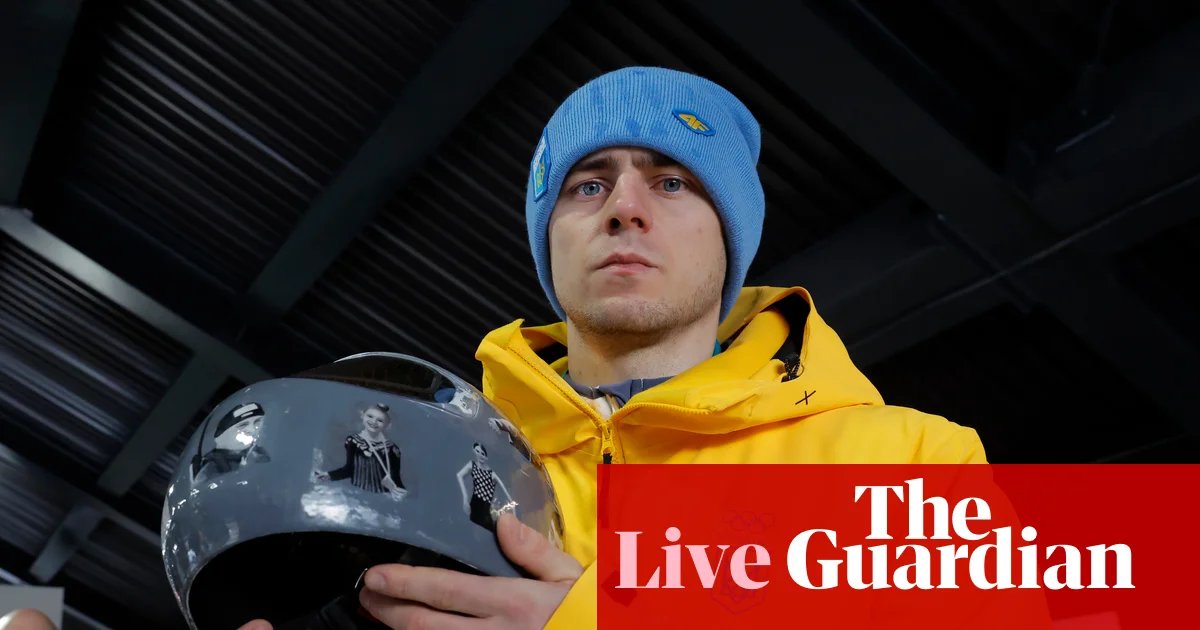
Banned Heraskevych accuses IOC of fuelling Russia’s propaganda
Sean Ingle
Vladyslav Heraskevych has accused the International Olympic Committee of doing Russia’s propaganda for them after he was barred from racing in the Winter Games because he wanted to wear a “helmet of memory” in honour of Ukraine’s war dead.
Speaking to journalists following the IOC’s decision, the 27-year-old was asked how he felt. “Emptiness,” he replied. “Yesterday was amazing training. I could be among the medalists in this event, but suddenly, because of some interpretation of the rules which I do not agree with, I am not able to compete.
“I was at many funerals when I was in Ukraine and it’s a truly terrible tragedy that young people at such a young age were killed for nothing,” he added. “Because of their sacrifice, we’re able to be here today, and I want to honour them, and I want to honour their families.”
Heraskevych also thanked the IOC’s president, Kirsty Coventry, for meeting him at 8.30am, an hour before the skeleton competition began, and for what he said were her kind words to him. But he added: “But, as I told her, this situation plays along with Russian propaganda and it does not look good. I believe it’s a terrible mistake that was made by the IOC.”
Key events
Women’s 5000m speed skating: It’s two athletes at a time in this event, who must switch from inner to outer lane at the end of each lap to ensure they cover the same distance. Fastest athlete overall wins. The rink is 400 metres round, which leaves the competitors 12 and a half laps of agony.
The third pair are now on the ice: Nadezhda Morozova of Kazakhstan, in a natty blue hooded suit, and 20 year old German Maira Jasch. It’s a game of long strides, low crouches and looped arms.
Women’s 5000m speed skating: Time to zip back into our aerodynamic suits and return to Milan for the next medal event: the women’s 5000m speed skating.
The likely contenders include Italy’s Francesca Lollobrigida, who won the 3000m event on Saturday, the silver medallist in the same event, Norway’s Ragne Wiklund, and Canada’s Isabelle Weidemann, who was second at Beijing four years ago.
Steve Cram has such a soothing voice, yet has never read a CBeebies bedtime story.
For now, we have to settle for him interviewing victorious Team GB captain Bruce Mouat. “We are having a great time,” Moat says. “Our family and friends are still here, the German spectators are probably the loudest I’ve ever heard.”
Men’s team curling: The defending champions Sweden concede the game to Great Britain (6-3), who now have two wins from two in this round-robin set of matches. Sweden, who lost to Italy last night, retire to find some form.
In the other two round-robin games, Switzerland have defeated the USA 8-3, and things remain tight between Norway and Germany. Germany currently lead 4-3.
Norway still sit on top of the medal table
Europe dominate the top end of the medal table, with Italy taking full advantage of “home ice”:
1 🇳🇴 Norway 🥇 7 🥈 2 🥉 4 – Total: 13
2 🇮🇹 Italy 🥇 5 🥈 2 🥉 7 – Total: 14
3 🇺🇸 United States 🥇 4 🥈 6 🥉 3 – Total: 13
4 🇸🇪Sweden 🥇 4 🥈 3 🥉 1 – Total: 8
5🇨🇭 Switzerland 🥇 4 🥈 1 🥉 2 – Total: 7
Team GB are yet to get off the starting blocks, but Matt Weston has an excellent chance in the skeleton final tomorrow.
That medal table in full:
Curling: A reminder of what all the frantic brushing is for – the friction melts the ice and produces a thin layer of water which allows the heavy stones to slide more easily. It can also change the trajectory, the degree to which a stone curls.
The team with the stone closest to the centre (button) scores a point after each end, and gains one point for every stone closer to the button than the opponents stone.
It’s looking good for Team GB who have gone 6-2 ahead after seven ends.
Curling: Some fantastic Scandinavian beards on show from the Swedish quartet while the Brits are youthfully clean-shaven. At the moment, the rub of the green lies with the less hirsute nation. We’re still in the seventh end, and some vigorous brushing sends the latest British stone safely into the house. GB currently lead 4-2.
Curling: Time for a gentler pastimes, as we join Team GB in the men’s team curling event. The British quarter lead Sweden 4-2 and will take the hammer into the seventh end. Captain Bruce Moat, so disappointed in the pairs event, looks remarkably chilled
Co-currently, Germany, supported by chanting supporters, are leading Norway 3-2; while Switzerland lead the USA 6-2.
As the fallout continues over Vladyslav Heraskevych’s disqualification from the skeleton, an email from reader Charles Coull:
“IOC spokesperson Mark Adams said that the IOC could not become involved in conflicts and wars and that was why Vladyslav Heraskevych was banned from competing. He went on to say that bringing conflicting nations together through sport was the Olympics way of solving conflict. If that is the case why was Russia banned from Olympic competition for its unprovoked aggression in invading Ukraine?
“Vladyslav Heraskevych’s helmet simply commemorated those athletes killed by that act of unprovoked aggression which in itself was punished by the IOC in banning Russia from competition. Surely if Heraskevych’s simple act of modest and dignified remembrance in the face of an aggressor nation is a political statement then the IOC’s entirely correct action in banning an entire nation from competition for that same aggression is a political statement of significantly higher magnitude?
“It makes no sense whatsoever.”
Historian Bruce Berglund discusses the repercussions from that IOC ban on Russia, below.
🥇 Gold for Alessandro Haemmerle in the men’s snowboard cross
Wow! A thrilling final to the men’s snowboard cross, as Austria’s Alessandro Haemmerle comes through at the last to retain his title. Poor young Aidan Chollet of France goes from first to fourth in the last 23 metres.
Canada’s Eliot Grondin takes silver, and another Austrian, Jakob Dusek grabs bronze
That is one fun sport.
That is all from me today. But never fear, Tanya is here to take you through the rest of the afternoon.
In pictures: Our fantastic picture desk has collated these snaps from day six. Have a look.

Andy Bull
Skeleton: Great Britain’s Matt Weston is poised for the podium after setting the pace in the opening two runs of the men’s skeleton.
Weston posted a new track record of 56.21sec on his first run, with that time broken twice more before he again laid down a new marker of 55.88sec.
His teammate Marcus Wyatt sits in seventh place on a total time of 1:53.21, 1.12sec behind Weston and 0.66sec off the medals.
Vladyslav Heraskevych was banned about 21 minutes before the start of the event, so late the two British competitors, Matt Weston and Marcus Wyatt said they didn’t even find out about it until after they had finished.
“It’s just a shame that he’s missed out on a chance of being able to compete at an Olympics, which is very sad, said Matt Weston.
Beau Dure gets in touch to add some context to Jessie Diggins’ reaction after crossing the finish line in the cross-country skiing, women’s 10km interval start free:
Not sure how much this was shown globally, but the images on US TV of Jessie Diggins after crossing the finish line will surely be an indelible Olympic moment. She was crying out in pain and holding her ribs, which she bruised in her crash in the skiathlon. A teammate came over to support and knelt by her. Diggins finally got up soon after the last person who had a chance to knock her off the podium passed the finish line, and she melted into her teammate’s arms. We’re used to seeing cross-country skiers and biathletes collapse into the snow after the finish line, but this was on another level.
It’s easy to be cynical at times – and people in the USA are outraged over the judging in yesterday’s ice dance – but it’s hard to see something like that and not be moved.
My broadcast showed her grimacing but cut away quite quickly.
Snowboard: Quarter-finals in the men’s snowboard cross are under way. Austria’s Jakob Dusek wins the first heat and a photo-finish is needed to confirm that Aidan Chollet of France beats his compatriot Merlin Surget to sail into the semis.
Canada’s Nathan Pare is disqualified in the second heat after taking out Spain’s Lucas Eguibar Breton. The Canadian initially won the heat but French duo Jonas Chollet and Loan Bozzolo go through.
Italy’s Lorenzo Sommariva and Nick Baumgartner of the United States progress from the third heat and Canada’s Eliot Grondin and Austria’s Alessandro Haemmerle in the fourth.
Chris gets in touch via email regarding the IOC’s decision to ban Heraskevych.
The IOC seems determined to be on the wrong side of the Heraskevych situation. Couldn’t they at least have an ‘In Memoriam’ period at the Closing Ceremony – including ALL Olympians who have died since the last Games? Instead they’re penalising an athlete for having a conscience.
Zelenskyy condemns IOC decision to ban Heraskevych

Luke Harding
Volodymyr Zelenskyy has bitterly accused the IOC of playing into Russia’s hands by banning the Ukrainian athlete Vladyslav Heraskevych from wearing his “helmet of memory”, saying: “Sport shouldn’t mean amnesia”.
In a trenchant post on social media, Ukraine’s president said the Olympic movement should “help stop wars” rather than rewarding “aggressors”. He paid tribute to Heraskevych, who was banned from competing on Thursday an hour before the skeleton competition began. “We are proud of Vladyslav and of what he did. Having courage is worth more than any medal,” Zelenskyy wrote.
He added: “I thank our athlete for his clear stance. His helmet, bearing the portraits of fallen Ukrainian athletes, is about honour and remembrance. It is a reminder to the whole world of what Russian aggression is and the cost of fighting for independence. And in this, no rule has been broken.”
“It is Russia that constantly violates Olympic principles, using the period of the Olympic Games to wage war. In 2008, it was the war against Georgia; in 2014 – the occupation of Crimea; in 2022 – the full-scale invasion of Ukraine. And now, in 2026, despite repeated calls for a ceasefire during the Winter Olympics, Russia shows complete disregard, increasing missile and drone strikes on our energy infrastructure and our people.”
The IOC’s decision has caused widespread anger and outrage in Ukraine, where more than 600 athletes have been killed since Vladimir Putin’s full-scale invasion four years ago. Zelenskyy pointedly noted that they would not be able to take part in the Olympics or other international competitions – in contrast to 13 Russians who are “currently competing in Italy”.
Zelenskyy added: “They compete under “neutral” flags at the Games, while in real life publicly supporting Russian aggression against Ukraine and the occupation of our territories. And they are the ones who deserve disqualification.”
Kyiv’s mayor and former boxer Vitali Klitschko – who won gold in the 1996 Atlanta Olympics – said the IOC wanted a “perfect TV show”. He said: “The Olympic ideal is being lost in the cold calculations of the global sports business. When I think of my Olympic gold medal today, I don’t feel pride any more. I feel shame.”
Snowboard: The top 16 in the men’s snowboard cross quarter-finals have been confirmed.
Team GB’s Huw Nightingale failed to make it to this round but will compete in the mixed team event with Charlotte Bankes on Sunday.
Four Frenchmen have made the quarter-finals, but have ended up in the same two heats as one another (Aidan Chollet and Merlin Surget in heat 1 and Jonas Chollet and Loan Bozzolo in heat 2). This is the Chollet brothers’ first Olympic Games.
Nick Baumgartner, 44, of the United States is aiming for his first individual Olympic medal (he won mixed team gold four years ago in Beijing).
Italy are second in the medal table with five golds compared to Norway’s seven and lead in overall medal tally. Beau Dure asks whether ‘home ice’ has given the host nation an edge?
To an extent, a host-country boost is typical in the Olympics. The US shattered their medal records at Salt Lake City 2002. Canada set a record for gold medals in one edition of the Winter Olympics when they hosted in 2010, though that record has since been broken by Norway. South Korea and China won more medals as hosts in 2018 and 2022 than they ever had in any previous edition. (The 2014 Games in Russia can’t provide a solid point of comparison because of the pervasive doping issues involving the host country.)
Read the full feature below.
🥇🥈Sweden win one-two in women’s 10km interval start free
Frida Karlsson collapses as she crosses the finish line in the women’s 10km interval start free. Her time of 22:49.2 is not going to be beaten and she will take gold for Sweden. Her compatriot Ebba Andersson finishes second and Jessie Diggins of the United States just sneaks bronze ahead of Norway’s Astrid Øyre Slind.
Cross-country skiing: Frida Karlsson of Sweden has extended her lead in the women’s 10km interval start free. She is almost a minute clear of compatriot Ebba Andersson.
Banned Heraskevych accuses IOC of fuelling Russia’s propaganda

Sean Ingle
Vladyslav Heraskevych has accused the International Olympic Committee of doing Russia’s propaganda for them after he was barred from racing in the Winter Games because he wanted to wear a “helmet of memory” in honour of Ukraine’s war dead.
Speaking to journalists following the IOC’s decision, the 27-year-old was asked how he felt. “Emptiness,” he replied. “Yesterday was amazing training. I could be among the medalists in this event, but suddenly, because of some interpretation of the rules which I do not agree with, I am not able to compete.
“I was at many funerals when I was in Ukraine and it’s a truly terrible tragedy that young people at such a young age were killed for nothing,” he added. “Because of their sacrifice, we’re able to be here today, and I want to honour them, and I want to honour their families.”
Heraskevych also thanked the IOC’s president, Kirsty Coventry, for meeting him at 8.30am, an hour before the skeleton competition began, and for what he said were her kind words to him. But he added: “But, as I told her, this situation plays along with Russian propaganda and it does not look good. I believe it’s a terrible mistake that was made by the IOC.”
🥇Woods wins freestyle skiing gold for Australia in men’s moguls final after tie-breaker
What a twist! Australia’s Cooper Woods and Canada’s Mikaël Kinsbury score 83.71 in the men’s moguls final but Woods takes top spot due to the better score on his turns. Kingsbury wins silver and Japan’s Ikuma Horishima takes bronze with a score 83.44.
That is Australia’s first medal at these Games!
Freestyle skiing: Mikaël Kingsbury of Canada takes the lead with one athlete to go! He attacks his second run in the men’s moguls finals and scores a 83.71. Will the three-time medallist nab his second gold?
IOC to allow Heraskevych to keep Olympic accreditation
The Ukrainian skeleton racer Vladyslav Heraskevych had initially been told he would be stripped of his accreditation after being disqualified from the Winter Olympics for refusing to back down from wearing a “helmet of memory” in honour of Ukraine’s war dead.
The IOC has now reversed that decision, saying that Heraskevych was allowed to keep his credentials and stay at the Milano Cortina Games after the IOC president, Kirsty Coventry, asked its Disciplinary Commission to “reconsider the withdrawal” of the athlete’s accreditation.
Freestyle skiing: Ikuma Horishima is about to start his second run in the men’s moguls final … a fantastic landing after spinning like a top, twisting in to a 1440 on the bottom jump. Good turns and great speed. He snares top spot with a score of 83.44.
Ice hockey: Switzerland lead France 2-0 as we go into the second period with, with goals from Damien Riat (powerplay) and J.J. Moser.
🥇Brignone wins gold for Italy in the alpine skiing women’s Super-G
Federica Brignone’s long, painful climb back to the top is complete. The 35-year-old wins the first Olympic gold medal of her decorated career by winning the women’s super-G.
Less than a year removed from breaking multiple bones in her left leg – which resulted in two surgeries and months of rehab – Brignone navigated the tricky technical Trofane course in 1:23.41. Romane Miradoli of France and Cornelia Huetter of Austria won silver and bronze.
Thank you Tanya and hello all. We have a confirmed gold medal coming up …
Time for me to grab a coffee, Yara El-Shaboury will be your guide for the next couple of hours.
Men’s Moguls: The first part of this two-part final is done, with the top eight going through to the final showdown on the lumpy slopes. Australia’s Cooper Woods qualifies first, followed by 13-time world champion Mikael Kingsbury, and another Australian, Matt Graham. Competitors do not carry any points through to Final 2.
It looks like gold for Federica Brignone in the Women’s Super G, which will move Italy up to second place in the medal table. Ten athletes are yet to ski, 13 have not finished.
It would be sensational comeback for Brignone, who fractured her leg last April and was out of action for nearly 300 days.
Finland ski jump coach sent home after breaching booze rules
Sean Ingle
The Finnish ski jumping head coach Igor Medved has apologised after being sent home for violating team rules by drinking alcohol at the Winter Olympics.
The news was confirmed by the Finnish Olympic committee, who said that Medved had left Italy due to “alcohol-related issues”.
“Medved has travelled home today,” said Janne Hänninen, head of elite sports at the Finnish Olympic Committee. “This is about alcohol-related issues. We take rule violations very seriously and will act quickly in the matter.”
Hänninen refused to go into further details about Medved’s behaviour, which the Swedish newspaper Aftonbladet has described as a “drunkeness scandal”. However he added: “The priority is to ensure peace of mind for the athletes and the coaching staff.”
A history of previous IOC rule violations by athletes
There have been a number of incidents over the years where athletes protested on the field of play or on the medals podium.
The most famous case dates back to the 1968 Summer Olympics in Mexico City when U.S. sprinters Tommie Smith and John Carlos raised black-gloved fists during the 200 metres medal ceremony to protest racial injustice in the U.S. That led to their expulsion from the Games, although Smith kept his gold medal and Carlos his bronze.
More recently, at the 2024 Paris Summer Olympics, Afghan breakdancer Manizha Talash, a member of the refugee Olympic team, was disqualified after wearing a cape with the slogan “Free Afghan Women” during a pre-qualifying competition.
However, there have also been cases where athletes and teams escaped punishment when their action was not deemed political.
Australia’s women’s soccer team unfurled a flag of the first peoples of Australia at the Tokyo Olympics in 2021 but, while not one of the recognised flags of participating nations at the Games, the team were not sanctioned.
Two Chinese cycling medallists who wore badges featuring the head of their country’s former leader Mao Zedong on the Tokyo Olympics podium escaped with a warning. Reuters
Super G: Watching so many athletes crash out before you, must affect the nerves of the waiting skiers … as another one goes out, the USA’s Mary Pocock. She sprays into the air over the roller and flips awkwardly on the snow. An air bag inflates to rescue her yet, somehow, she is able to stand up and walk away.
Super G: Quiet falls over the crowd as Breezy Johnson, the women’s Olympic downhill champion, becomes the next athlete not to finish, crashing soon after the start. She hooks one of the gates, loses balance and slams into some side netting. Thankfully, she seems to be ok.
Super G: Back on the slopes, the very first skier to set off, Italy’s Federica Brigone, is still on top. Although some of her fellow medal contenders have skied off course, there are plenty of big names still to come.
Skeleton: … Weston plummets down the track, chin just above the ice, and finishes with a 0.30sec lead going into the second day. He gives his coach a huge hug and pumps the air. His teammate Marcus Wyatt sits in seventh place.
Skeleton: With just Matt Weston to go it’s a German one-two: the silver medallist from four years ago, Axel Jungk, just ahead of Christopher Grotheer. Weston needs a new track record to stay in first. Here he comes with a sprint on to his sled …
Skeleton: Great Britain’s Marcus Wyatt has a smooth descent into (temporary) first place, but his lead is only 0.01 seconds, with the top six still to come.
Super G: They’re falling like ninepins in the mountains, first Germany’s Emma Aicher, then the Czech Republic’s Ester Ledecka, who has a nasty fall, but manages to pick herself up and reach the bottom. And now Sofia Goggia – who hurtles down the slopes but goes out on the same gate as Aicher. Six have so far not finished.
Women’s Super G: In the mountains, the Women’s Super G. It’s hazy at the top, the athletes launching themselves through the mist on to an unfamiliar course before hurtling down at whistle-stop speed.
Ah no, Germany’s Kira Weidle-Winkelmann makes a mistake and skies off the course. And so does the next athlete, Austria’s Mirjam Puchner.
Because the athletes haven’t had a chance to ski the course, there is a real disadvantage to going early.
At the sliding centre, the USA’s Austin Florian zips down on his tin tray into first place – but with 13 sliders still to come, and sliding in reverse order of results in heat one.
A quick catch up on sporting events this morning:
Men’s moguls: Ikuma Horishima of Japan, who won bronze in Beijing, is top of the qualifiers in the men’s moguls, with 85.42 points. Two Canadiens, Julien Viel (79.56) and Mikael Kingsbury (79.11) lie in silver and bronze. Team GB’s Mateo Jeannesson was knocked out at the qualifying stage, finishing 30th, frustrated by a flaring heel injury.
Men’s snowboard cross: France’s Aidan Chollet is top of the pops in the first seeding run. Britain’s Huw Nightingale was 10th fastest and automatically qualifies for the knockout stage.
Heat two of the luge is under way, Britain’s Matt Weston, in pole position, will slide last.
Medal events
Women’s Super G 11.30am GMT
Men’s moguls 12.15pm GMT
Women’s cross-country 10km interval 1pm GMT
Men’s cross snowboard 2.56pm GMT
Women’s speed skating 5000m 4.30pm GMT
Mixed luge team relay 6.30pm GMT
Womens half pipe 7.30pm GMT
Women’s speed skating 500m short track 9.35pm GMT
Men’s speed skating 1000m short track 9.48pm GMT
A devastated Vladyslav Heraskevych has been talking to reporters in the mixed zone.
“[I am feeling] Emptiness. Yesterday was amazing at training. I could be among the medallists in this event but because of some interpretation of the rules which I don’t agree with I am not able to compete … rememberance is not a violation of the rules.”
In the BBC studio, Lizzie Yarnold is still working through her thoughts. “Not being able to compete in your childhood dream just minutes before, and having your accreditation taken away so you won’t be allowed to support your fellow athletes. We are part of a community, so I think I’m just left with a real sense of sadness and real surprise.”
Away from events at Cortina for a moment, there are nine golds waiting to be hung around necks today, on the ice, the snow, the half pipe and down the stomach-churning sliding centre.
Mid-morning, we have the blue riband Women’s Super G, where Mexico’s 46 year old Sarah Schleper, skies for middle aged women everywhere.
A little later, Japan’s Horishima Ikuma is the man to beat in the men’s moguls finals, while there is another medal up for grabs in the women’s cross-country skiing at 1pm. Anna Pryce goes for Team GB.
Two finals then unroll in the snowboarding – the men’s cross and the women’s half-pipe, where Chloe Kim is the huge favourite to win her third successive gold under lights this evening.
The chaotic team relay in the luge – women’s singles, men’s singles, women’s doubles and men’s doubles – starts at 6.30pm GMT.
And then the women’s 5000m speed skating at 4.30pm GMT, before two evening finals in the short track speed skating, women’s 500m and men’s 1000m, close the day.
The skeleton event, in which Heraskevych was supposed to have been racing, is well under way at the Cortina Sliding Centre. After run one, Britain’s Matt Weston is currently in the lead, with Britain’s Marcus Wyatt in seventh.
Run two starts at 10.08am GMT, with the final tomorrow.
BBC commentator, and two-time Olympic bobsleigher, John Jackson, was asked about his view on Heraskevych:
“For me, being military and now a veteran, remembrance is really important to all veterans,” he said. “We have all lost friends and colleagues in conflict and we all know someone who isn’t here and paid the ultimate sacrifice.
“I support him in what he was trying to achieve. It is really important to remember those who have given their life for something that ultimately doesn’t need to happen.”
IOC president Kirsty Coventry was in tears speaking to the media after the decision to disqualify Heraskevych. “This is price of our dignity,” Heraskevych posted on X shortly after his meeting with Coventry.
The Kyiv-based artist Irina Protz, who has known Heraskevych since he was a child, decorated his helmet of memory, which showed 24 athletes killed in the Russian war.
“The world is becoming more apathetic every day,” she has said. “That is why I took on this work to remind the world that we had athletes who could have been here.”
The skeleton event, in which Heraskevych was a medal contender, is under way without him.
Sean Ingle
The Ukrainian skeleton racer Vladyslav Heraskevych has been disqualified from the Winter Olympics after he refused to back down from wearing a “helmet of memory” in honour of Ukraine’s war dead.
The decision was announced by the International Olympic Committee just 21 minutes before the first round of the men’s skeleton competition in Cortina on Thursday after last-ditch talks between the IOC president, Kirsty Coventry, and Heraskevych failed to find a breakthrough.
Lizzy Yarnold, who won skeleton gold for Team GB in 2014 and 2018, is on pundit duty for the BBC and was asked about the decision to expel Heraskevych from the Olympics.
“He’s had his accreditation taken away, which means he needs to leave the Games … This is the wrong decision, and the IOC owe him an apology.”
Heraskevych on ban: ‘It’s emptiness’
From the Associated Press:
International Olympic Committee President Kirsty Coventry was waiting for Heraskevych at the top of the track when he arrived at around 8.15am Thursday, or roughly 75 minutes before the start of the men’s skeleton race.
They went into a private area and spoke briefly, and Coventry was unable to change Heraskevych’s mind. He was holding the decision from the International Bobsled and Skeleton Federation when he briefly addressed reporters and said he would appeal to the Court of Arbitration for Sport.
“It’s hard to say or put into words. It’s emptiness,” he said. Coventry spoke with reporters after the meeting, tears rolling down her face as she spoke. “It’s a message of memory and no one is disagreeing with that,” Coventry said. The IOC added that it made its decision “with regret.”
Heraskevych kicked out of skeleton for memorial
Good morning and welcome to our daily live coverage from Milano Cortina.
Some breaking news: The Ukrainian skeleton athlete Vladyslav Heraskevych is out of the Games after refusing a last-minute plea from the International Olympic Committee to use a helmet other than the one that honours the nation’s war dead.
We’ll have more details soon on that and the rest of day six’s action, where nine golds are up for grabs.


