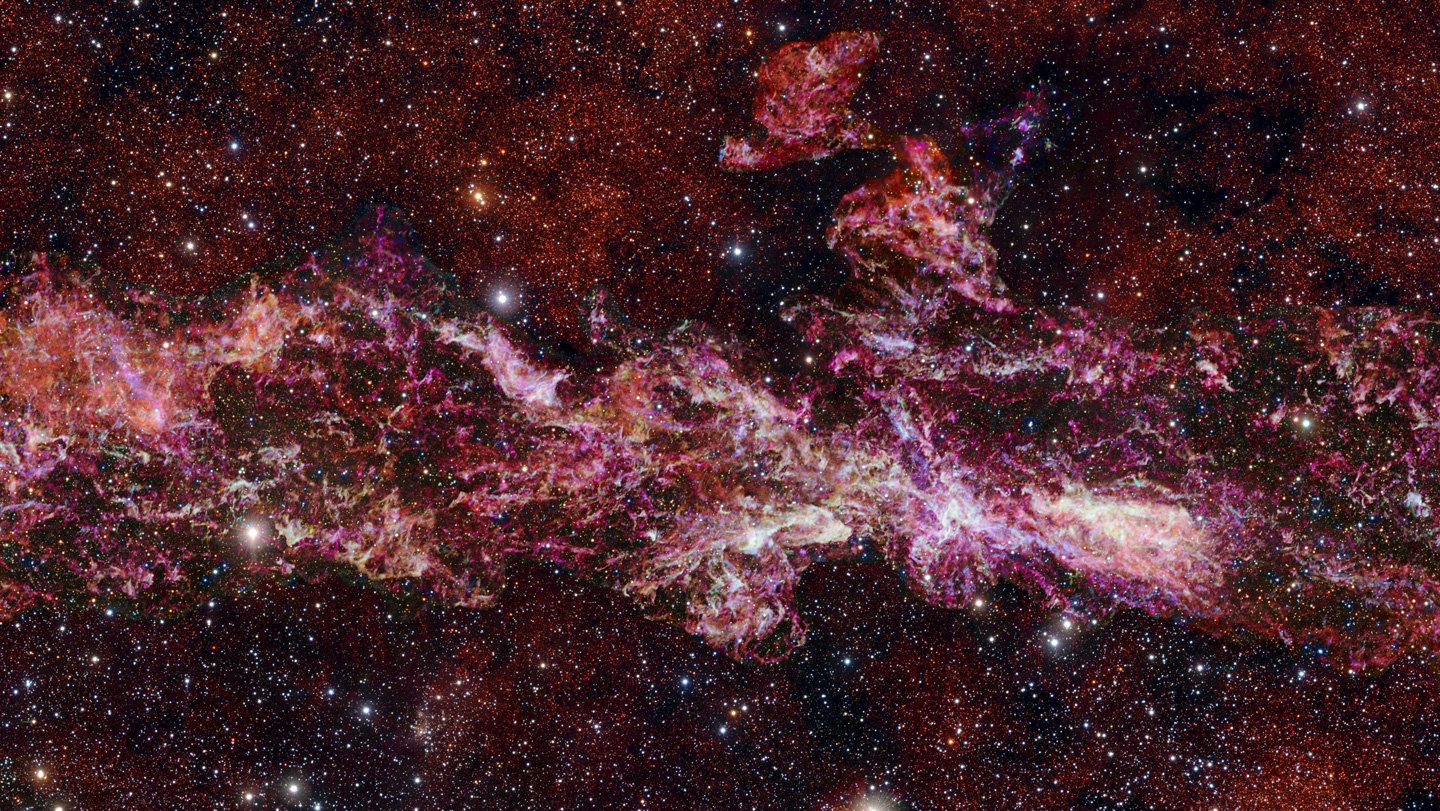
After 50 years of searching, astronomers have finally found evidence of a mild wind blowing from the supermassive black hole at the center of the Milky Way.
New observations reveal a cone-shaped path leading away from Sagittarius A* that could only be carved by a hot wind, researchers report June 4 in Astrophysical Journal Letters. “We’ve never seen gentle breezes from black holes, but likely that’s what they do most of their lives,” says astrophysicist Lena Murchikova of Northwestern University in Evanston, Ill. “Now, for the first time, we see this gentle breeze from the black hole.”
As black holes consume gas and dust, their cosmic munching heats up nearby debris. That heat emits radiation that pushes away gas and other material, creating wind. When a black hole is consuming a lot, these winds can be very powerful, sending material clear out of the galaxy. But when a black hole is eating minimally and in a quiet state, as Sagittarius A* currently is, astronomers think that the wind would be lighter.
Astronomers have been searching for this theorized wind since the discovery of Sagittarius A* in the 1970s, when astronomers were just starting to think the unidentified object could be a supermassive black hole. But since our view of the galactic center is shrouded by gas, stars and dust, it is difficult to see what’s going on there.
In the past 15 years, some X-ray and gamma-ray evidence for wind was found far from the black hole, even extending outside the galaxy, suggesting episodes of strong gales in the past. But nothing close to the black hole had been confirmed, so astronomers weren’t sure if the black hole was still breezy.
In the new study, Murchikova and astronomer Mark Gorski, also at Northwestern, amassed more than 100 hours of observations of Sagittarius A* taken over five years with the Atacama Large Millimeter/Submillimeter Array radio telescopes in Chile. The observations revealed the distribution of cold carbon monoxide, a key indicator of gas, up close to Sagittarius A*.
Leveraging a new way to process the data, the team was able to see gas, dust and other materials 100 times fainter than what could be seen before, and create an image of the black hole’s neighborhood 80 times sharper. The results showed a stark cone-shaped gap by the black hole that, unlike the surrounding area, is devoid of cold carbon monoxide. The geometry of the void and previous observations of X-rays showing hot gas in the same region suggest the culprit must be hot wind flowing out from the black hole, the astronomers say.
“Supermassive black holes throughout the universe live most of their time in a quiet state,” Gorski says. “So [these findings] tell us that even though most black holes are pretty quiet, they’re still having an impact.”
Winds from black holes can slow star formation and limit the food available to the growing black hole, or they can help trigger star formation by compressing clouds of dust. Understanding wind from a quiet black hole like Sagittarius A* can illuminate how black holes sculpt their galaxies.
“The potential discovery of a wind coming from Sagittarius A* is indeed a big deal,” says astrophysicist Rebecca Diesing of Columbia University, who was not involved in the new research. “It would demonstrate that our supermassive black hole is not unique, that it produces a wind just like those in other galaxies.”
But Diesing would like to see more evidence than just an absence of gas. Future observations could help confirm the wind by probing the velocity of gas being swept out of the cavity. It may even be possible to see the edges of the void wobble over time as the wind keeps on blowing.