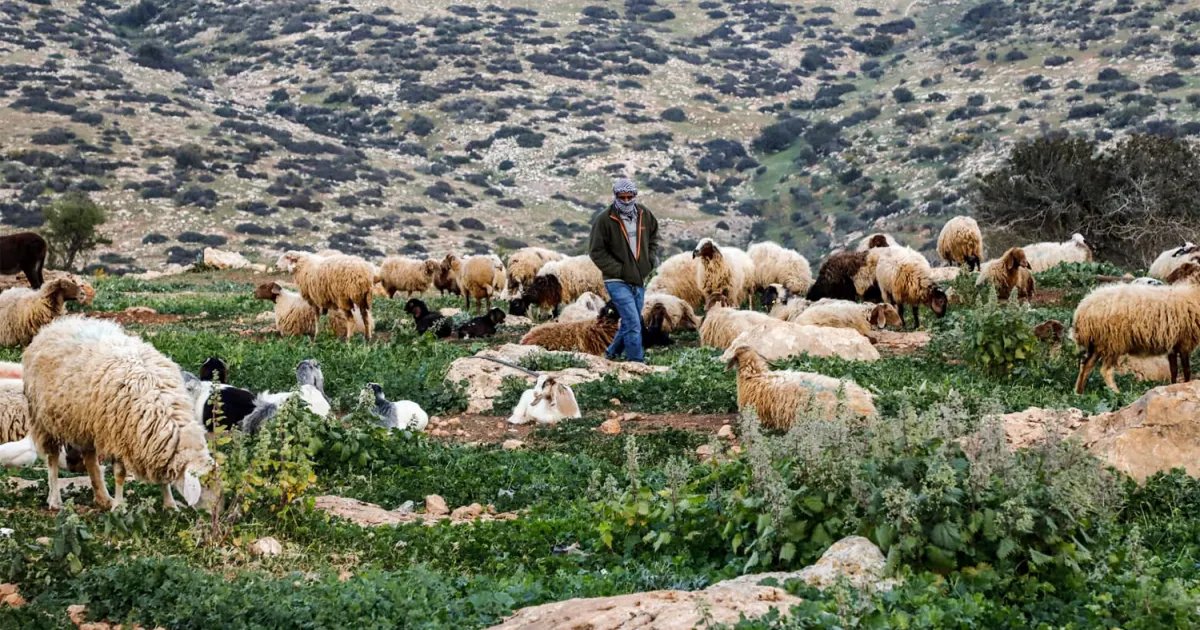
Mukhlis Masa’id of Khirbet Yarza in the occupied West Bank has lived in a state of sorrow since settlers intensified their attacks on his Jordan Valley community three years ago.
He and other local Palestinians have seen settlers destroy their crops, attack their homes, and assault shepherds and farmers working the grazing lands around the village, with growing ferocity and incidence.
Fourteen families, about 100 Palestinians in total, called this region home until increasing violent settler activity forced them to consider their future here. Early this year, locals decided they had had enough with the near-daily settler attacks, so they gathered their surviving livestock and left the village.
This sustained targeting of agriculture in the area – on which almost the entire community relies – appears to be part of an organised and systematic campaign of intimidation by settlers, intended to drive whole Palestinian farming communities from their land.
“The settlers have many means of communication among themselves. When they attack the shepherds, dozens of them gather to intimidate them. Meanwhile, we have no means of transportation to reach the shepherds and try to protect them. Our roads are also rough and unpaved, unlike the roads used by the settlers,” Masa’id told Al Jazeera.
The settlers didn’t stop there; they stole hundreds of sheep and cattle, the lifeblood of this northern West Bank community.
“We feel like we’ve lost a son. What happened to us is the worst thing that could ever happen – to leave the homes we’ve lived in all our lives, homes we hoped our children and grandchildren would live in too,” he told us.
The settler attacks intensified from October 2023, months after a new Israeli government came to power with far-right ministers – who led or are part of settler movements – appointed to key posts. The campaign continued until the community had fled their homes in March 2026, but even then, their troubles did not end.
“Dozens of sheep died from diseases after we moved. When we left, we had to leave the fodder in the rain because there was nowhere else to store it, and it spoiled,” Masa’id said.
“Now, we graze the remaining livestock in cramped, overcrowded areas like the countryside around Tubas. Nothing we’re living now resembles our life in Yirza.”
The pattern of repeated attacks by settlers doesn’t only target Area C, the part of the occupied West Bank fully under Israeli control and which makes up more than 60 percent of the West Bank.
There appear to be broader objectives related to the entire Palestinian territory, which has been under Israeli occupation since 1967. This includes Area A, a zone technically under full Palestinian Authority control but witnessing increasing settler activity.
Zuhair Abu Shaar, from Jifna, north of Ramallah, was shocked to see a group of Israeli settlers unexpectedly storm his livestock pen, in the heart of the village, on April 15.
The villagers confronted the band, who briefly left the area, but they returned half an hour later with 12 Israeli military vehicles in support.
“The soldiers got out of the vehicles on foot and came to us with the settlers. They stole 180 head of cattle, took them away, assaulted us, and shot one of my neighbours in the leg,” Abu Shaar told Al Jazeera.
“They also struck my nephew hard in the side, in the area of a surgery he had months ago, causing him to fall to the ground. When I tried to defend him, they beat me, handcuffed me, threw me to the ground, and pointed a gun at my head.”
The army emptied the entire pen except for one sick sheep that couldn’t walk and withdrew behind a cloud of tear gas, with a donkey and a car they found in the village in tow.
Zuhair estimates his losses at no less than 450,000 shekels ($150,000) and has no information on the livestock, his sole source of income, that were stolen by the settler party.
“I’m like someone whose house is demolished and is rebuilding it brick by brick. I’m trying to start from scratch. This is an occupation, and we expect anything from them as they try to force us out of our land,” he added.
![Zuhair Abu Sha'ar [Courtesy of Mohamad Turkman]](https://www.aljazeera.com/wp-content/uploads/2026/06/processed-5362C8FE-FF3F-4BAE-85C1-F2E2CDC2FA44-1-1780414552.jpg?w=770&resize=770%2C513&quality=80)
Nidal Younis, head of the Masafer Yatta village council, south of Hebron, told Al Jazeera that over the past three years, almost all the grazing lands in the area have been seized by settlers.
Settler groups have established 12 new outposts around Masafer Yatta, in addition to appropriating more than 90 percent of land cultivated with winter crops, such as wheat and barley, according to officials in the area.
“Last year, settlers prevented people from harvesting their crops while simultaneously bringing their sheep to graze on them,” said Younis. “They also prevented farmers from ploughing their land by attacking tractors and assaulting the farmers.”
On January 27, settlers attacked a village in the Masafer Yatta area and stole 300 head of livestock. Even those grazing sheep on land outside the area were attacked, had their livestock stolen, or were beaten.
“The cost of livestock has become very high for people, and many families have sold part of their herds to be able to feed the rest,” he said.
“There is a sharp annual decline in livestock in Masafer Yatta, and what remains is less than 25 percent of what it was several years ago.”
According to a report issued by the United Nations Office for the Coordination of Humanitarian Affairs (OCHA) in mid-May 2026, the Jordan Valley has seen the number of monthly incidents resulting in injuries or property damage rise from two per month in 2020 to 27 in the first four months of 2026.
These cases are no longer limited to individual attacks on Palestinians, but have targeted the whole way of life for these agricultural communities after sustained attacks on pastures, water sources and reservoirs. Agricultural equipment and facilities, such as animal pens, have also been destroyed.
The OCHA warned that the repeated targeting of Palestinian agriculture threatens to undermine families’ ability to maintain their livelihoods, due to many residents depending on herding as their primary source of income. A 2025 report published by the Food and Agriculture Organization of the United Nations (FAO) showed that nearly two-thirds of the 72,000 farming and herding families in the occupied West Bank required emergency assistance.
Abbas Melhem, head of the Union of Palestinian Agricultural Associations, told us that 87 percent of the livestock sector is concentrated in an area stretching from Masafer Yatta to the Jordan Valley in the east, most of which is in Area C.
More than 90 percent of the area between Masafer Yatta and the Jordan Valley in the east is off-limits to Palestinian farmers and shepherds. Israeli settlers’ flocks, meanwhile, have unrestricted access to the grazing lands, he said.
This campaign of settler violence and Israeli restrictions on Palestinian farmers has led to a decline in the number of livestock in the West Bank and Gaza, 1.75 million head four years ago to only 480,000 today, Melhem said.
Combined with settlers’ targeting of olive groves during harvest season, the main West Bank crop, it will be the complete destruction of a way of life that has survived for centuries in Palestine.
“I am not exaggerating when I say that if the situation continues as it is, without support for livestock breeders, then Palestinians will be forced to buy sacrificial animals from settlers who are fully protected by the Israeli army,” Melhem told Al Jazeera.
“We are on the brink of collapse in food security in both the plant and animal sectors if there is no international intervention to protect [us].”