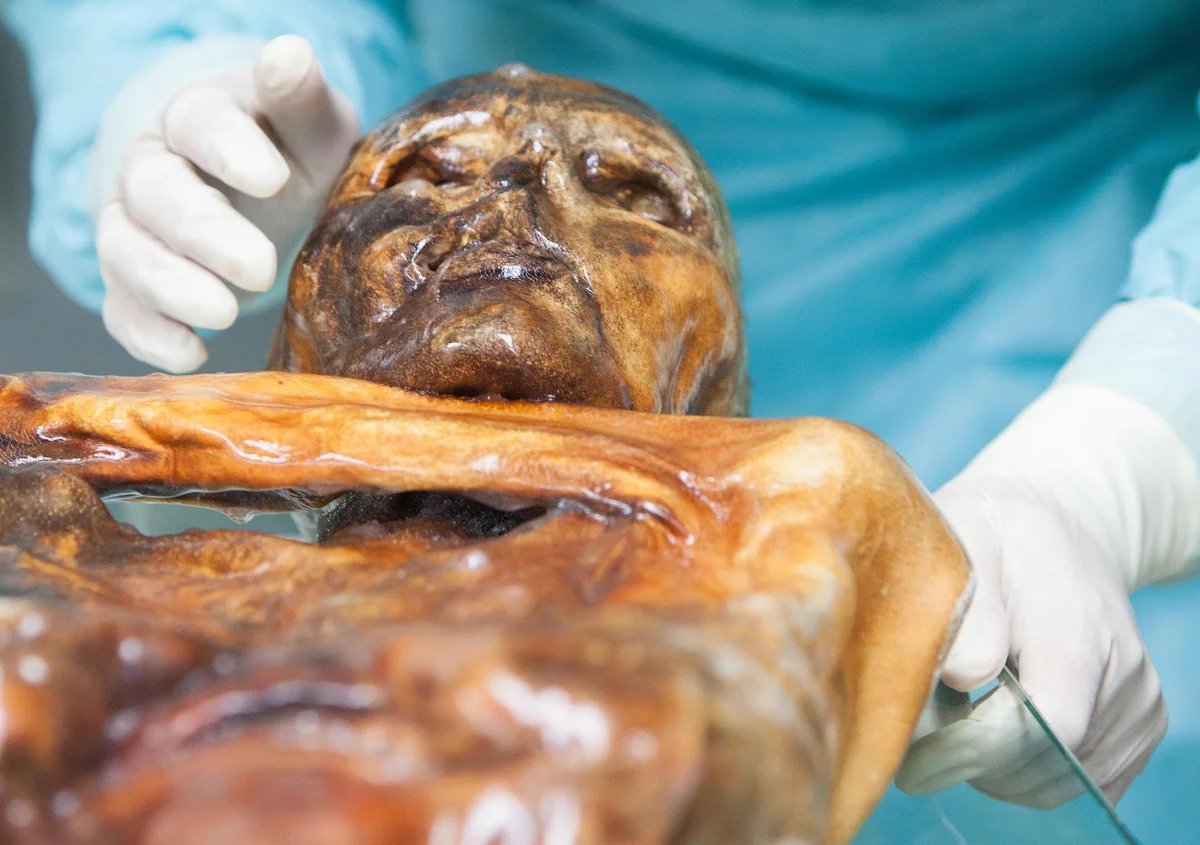
Ötzi the Iceman may have been murdered by an arrow some 5,300 years ago, but his body is still buzzing with microbial activity, researchers reveal. Yeast strains that may have lain dormant in the mummy for millennia, some of which were specially adapted to extreme cold, may still be metabolically active, a new study published in Microbiome finds.
Ötzi died in a glacial area of the Italian Alps; the cold and relatively low oxygen preserved his body, effectively mummifying it for millennia. Since then the body has been kept in a refrigerated chamber at minus six degrees Celsius (21.2 degrees Fahrenheit) and high humidity to keep it intact. Incredibly, fragments of genetic material from the microbes living in Ötzi’s gut were also preserved—thanks to both the conditions before he was discovered and after.
“This combination preserved the DNA of the mummy and also the DNA of the bacteria, the indigenous microbiome, but also the environmental DNA surrounding the mummy,” says Mohamed Sarhan, a microbiologist at Italy’s Eurac Research Institute for Mummy Studies and lead author of the new paper.
On supporting science journalism
If you’re enjoying this article, consider supporting our award-winning journalism by subscribing. By purchasing a subscription you are helping to ensure the future of impactful stories about the discoveries and ideas shaping our world today.
Sarhan and his team analyzed the microbial and fungal populations on Ötzi’s skin, various tissues and thawed water collected from inside the mummy. They found multiple species of anaerobic bacteria, such as Romboutsia hominis, Clostridium moniliforme, Ruminococcus bromii and others, that would have helped Ötzi digest his food. A previous analysis of his stomach and its microbiome suggested that Ötzi, who was discovered by hikers in 1991, ate a high-fat diet and snacked on dried wild meat and cereals, as well as a poisonous fern. And his gut microbes largely seem to match that diet, Sarhan says, because the identified species are well suited to thrive on those foods. Some of them can still be found in the intestines of modern-day humans. But others that are present in the mummy have become far rarer as our diets have evolved.
Eurac Research/Andrea De Giovanni
“We have two or three species that were never reported before in [Ötzi’s] case that we know already are very rarely found in modern humans,” Sarhan says. “We can still find them in some nonindustrialized societies, like some tribes in Africa or South America and also some places in Europe, but in very, very rare cases.”
Samples of yeast taken from the mummy’s skin and stomach, as well as from meltwater that had seeped into the body, revealed several cold-adapted species, which suggests these microbes originated in the environment where Ötzi was found. When the researchers compared these samples to some taken nine years earlier, however, they found that the yeast populations had changed. Species that were able to digest phenol, a chemical used to disinfect the Iceman, have grown—despite the below-freezing temperatures that Ötzi is kept in. This finding could have important implications for mummy preservation, Sarhan says.
“This needs to be to be followed up on in the future to understand what happened during this time and also what will happen in the future,” he says. “How we can stop this…? One of the things that we don’t want to forget is that the conservation of the Iceman includes everything: the Iceman as a body but also the biomolecules, proteins, DNA, metabolites and also the internal bacteria.”
This knowledge could help Ötzi’s caretakers keep the body well preserved into the future and enable other researchers to do the same for other frozen biological discoveries.
“The main motivation of this study was the microbiological conservation of the mummy,” Sarhan says. “We wanted to understand whether the current conditions of the preservation are good enough.”
Sarhan expects more discoveries to emerge from the Iceman’s remains as sequencing and bacterial cultivation technology improves—although the mystery of how exactly Ötzi died may remain a cold case.
It’s Time to Stand Up for Science
If you enjoyed this article, I’d like to ask for your support. Scientific American has served as an advocate for science and industry for 180 years, and right now may be the most critical moment in that two-century history.
I’ve been a Scientific American subscriber since I was 12 years old, and it helped shape the way I look at the world. SciAm always educates and delights me, and inspires a sense of awe for our vast, beautiful universe. I hope it does that for you, too.
If you subscribe to Scientific American, you help ensure that our coverage is centered on meaningful research and discovery; that we have the resources to report on the decisions that threaten labs across the U.S.; and that we support both budding and working scientists at a time when the value of science itself too often goes unrecognized.
In return, you get essential news, captivating podcasts, brilliant infographics, can’t-miss newsletters, must-watch videos, challenging games, and the science world’s best writing and reporting. You can even gift someone a subscription.
There has never been a more important time for us to stand up and show why science matters. I hope you’ll support us in that mission.