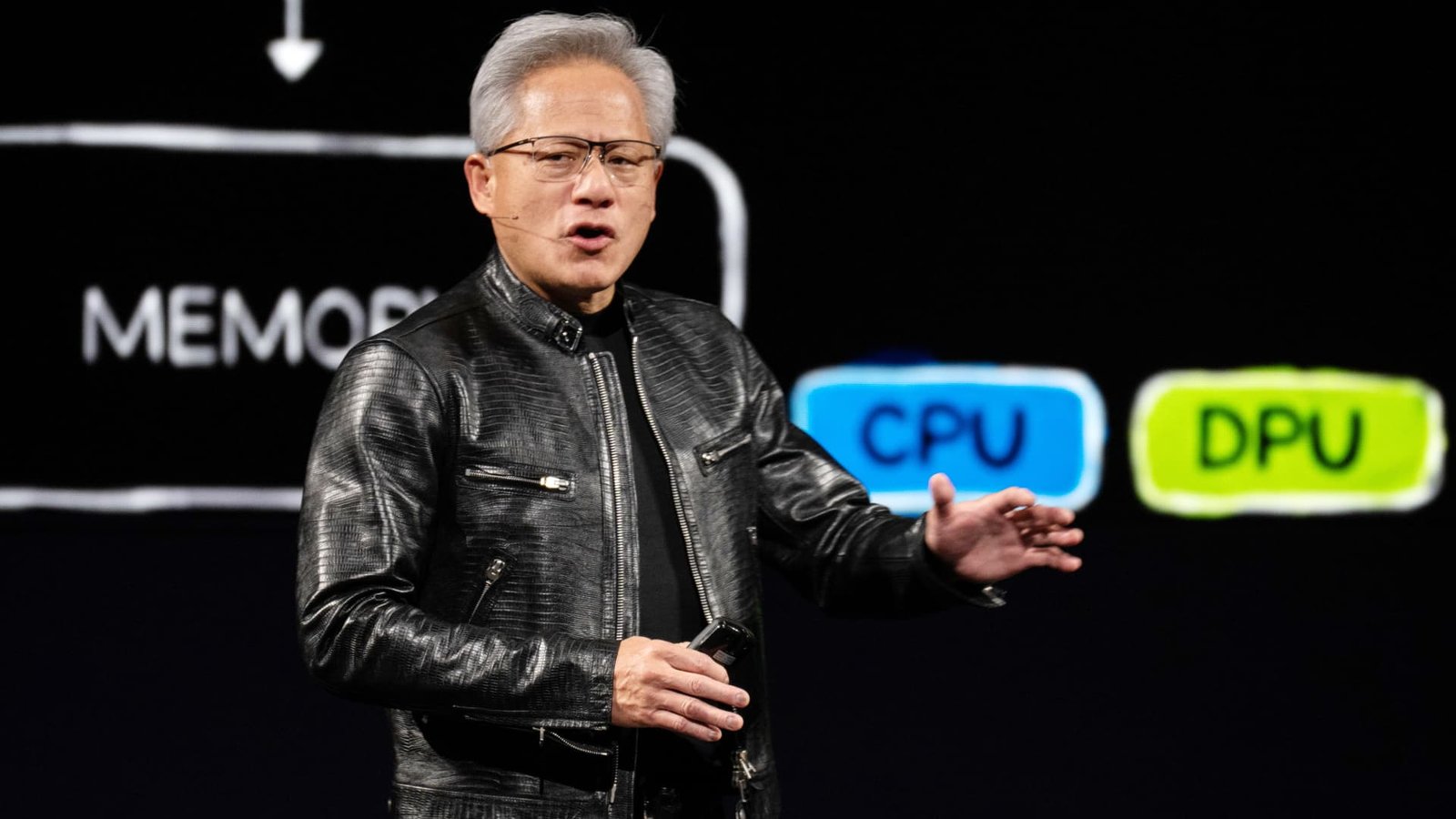
Jensen Huang, chief executive officer of Nvidia Corp., presents the RTX Spark Superchip at the Nvidia GTC conference on the sidelines of Computex 2026 in Taipei, Taiwan, on Monday, June 1, 2026.
Lam Yik Fei | Bloomberg | Getty Images
As important as Nvidia has become to the tech industry, its entire run-up in recent years has been tied to the data center. Now the chipmaker is going after the PC market, and Wall Street is recognizing the threat it poses.
During a keynote address at Taiwan’s Computex conference on Monday, Nvidia CEO Jensen Huang said his company, along with Microsoft, is going to “reinvent the PC.” Nvidia’s plan to build system-on-chips, or SoCs, for PCs sent shares of Advanced Micro Devices, Intel and Qualcomm downward.
It’s the latest sign of Nvidia moving beyond the data center for artificial intelligence and to the so-called edge, where smaller devices like phones or computers run advanced AI models on their installed chips without tapping the cloud.
“Nvidia getting into the space is Jensen recognizing that he wants to own every bit of the AI stack in some shape,” said IDC analyst Tom Mainelli.
While makers of PC central processing units, or CPUs, and mobile phone chips sank on Monday, Nvidia’s stock popped more than 6%. With a market cap of about $5.4 trillion, Nvidia is worth more than any company on the planet, and is almost $1 trillion above its closest U.S. peer.
Nvidia is officially entering the PC market with a chip called RTX Spark, which is a joint effort with Taiwan’s MediaTek. The RTX Spark, which Huang also referred to as the N1X, debuts later this year on a fresh line of Windows PCs from Microsoft, Dell, HP, ASUS, Lenovo and MSI.
“This reinvention of the computer is as big of a deal as the reinvention of the phone into what we now know as the smartphone,” Huang said, pointing to the fact agentic AI will run across all new computers.
Nvidia has a major balance sheet advantage and has all the momentum in the world. But that doesn’t mean it’s going to be easy to crack a market that has historically been controlled by the duopoly of Intel and AMD. Additionally, Qualcomm has introduced new SoCs for Windows laptops in the past two years, and Apple, which has about 9% of the PC market, started making its own processors in 2020.
Nvidia’s rise has been fueled by selling systems based around the data center graphics processing unit, or GPU, which is better suited for running cutting-edge AI models with unlimited power, cooling and space. As chips become powerful enough to perform AI at the edge, Nvidia is racing to get there.
“All AI computing, regardless where it is, that’s the prize,” said chip analyst Patrick Moorhead. “Jensen is not going to be happy if they just get data center or data center and auto. They want everything on the edge.”
Second chance for AI PCs
Financially, the PC is just a blip for Nvidia, at least in the near term.
Creative Strategies analyst Ben Bajarin estimated on Monday that Nvidia’s networking business alone — which reported about $15 billion in sales in the most recent quarter — will be at least 20 times the size of Nvidia’s PC business. Total data center revenue in the latest quarter topped $75 billion.
Intel’s client computing group, mostly comprised of PC chip sales, reported $32.2 billion in revenue for all of 2025.
“PC for Nvidia is highly underpenetrated, so this is the start of an attempt to gain share for an edge story,” Bajarin said.
Jay Goldberg, an analyst at Seaport Research Partners, wrote in a note he doesn’t expect material numbers from Nvidia’s PC chips “any time soon.” He has a sell rating on the stock.
It’s also far from the high-growth market that Nvidia’s been leading since generative AI took off in late 2022. Market researcher IDC estimates that 296 million PC chips were shipped in 2025, increasing for the first time in three years, but still well below the pandemic-era peak of 361 million in 2021. Nvidia could sell 10 million PC chips over the next two years, Moorhead said.
But some analysts say Nvidia’s prowess in AI could bring a different level of enthusiasm and credibility.
“Nvidia’s not the first to do it,” Mainelli said. “But because they bring the GPU chops and because so much of AI in the cloud is built on Nvidia, the fact they’re pushing this out to the device is pretty interesting.”
Nvidia’s RTX Spark chips will pair the company’s cutting-edge Blackwell GPU with a MediaTek CPU on the same SoC. It will also have a feature called unified memory, which allows the CPU and GPU to access the same memory on a single SoC, eliminating a major AI bottleneck and allowing the chip to run bigger and more capable AI models.
In revealing the chip, Huang connected the technology to one of the hottest trends in Silicon Valley: AI agents. Every developer is seemingly obsessed with their ability to run agents like OpenClaw or Hermes Agent in the background to become much more productive.
Huang suggested that those kinds of agents might run perfectly well locally, where they’ll be cheaper than in the cloud.
“Look how beautiful it is — this agent could run 24/7, meter free,” Huang said, holding up a small Nvidia-based computer from MSI. “No meter anxiety.”
Nvidia CEO Jensen Huang introduces the RTX Spark during his keynote speech at Computex 2026 in Taipei on June 1, 2026. Nvidia unveiled a powerful laptop chip for Windows machines on June 1, staking its claim in the market for next-generation consumer PCs integrated with artificial intelligence.
Photo by I-Hwa Cheng / AFP via Getty Images
Another chip in the x86 wall
Nvidia’s announcement is also the latest sign of the power of Arm.
For decades, CPUs have been built on the x86 instruction sets pioneered by Intel in the 1970s and AMD a couple decades later.
Arm’s alternative power-efficient architecture went mainstream when Apple adopted it for the first iPhone in 2007. Then Amazon popularized Arm-based chips for data centers when it announced its in-house Graviton processor in 2018. Nvidia tried to buy Arm for $40 billion in 2020 in a preview of its SoC ambitions. The deal was spiked by regulators.
Cloud rivals Google and Microsoft followed Amazon with their own custom Arm CPUs for data centers. Now the entire CPU market is having a resurgence as mass AI adoption shifts from call-and-answer chatbots to task-oriented agentic apps. The overall market for CPUs is exploding into what Huang says will be a $200 billion industry.
Within the CPU renaissance, a flurry of companies have been switching from x86 to Arm.
Apple ended a 15-year reliance on Intel x86 chips in 2023, and now uses its own Arm-based processors for its computers. The latest MacBooks released in March come with a higher price tag and Apple’s latest M5 CPU.
Arm unveiled its first in-house CPU in March, with Meta, OpenAI, Cloudflare and SAP as early customers. AMD is also reportedly working toward an Arm-based PC chip.
Nvidia’s RTX Spark chips are likely to show up first in pricey computers, with budget options coming down the road. Nvidia-powered computers with AI features from companies like Adobe and Microsoft could be the first laptops in years to give Apple’s MacBooks significant competition in the premium category.
“This is the closest thing to take on the MacBook Pro for the Windows ecosystem,” Moorhead said.
WATCH: Arm launches its own CPU, with Meta as first customer