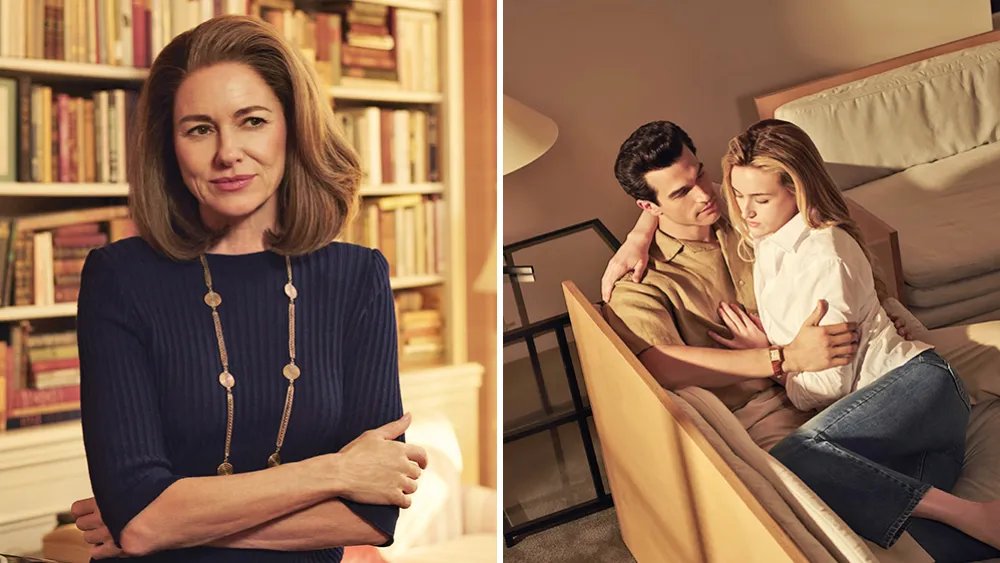
FX’s “Love Story: John F. Kennedy Jr. & Carolyn Bessette” was a world crafted in muted, minimalist and romantic themes.
Set in the 1990s, the Ryan Murphy production follows the relationship of John F. Kennedy Jr. and Carolyn Bessette. Production designer Alex DiGerlando hails from New Jersey and attended NYU; he knew the era well.
While building a world that was period-accurate, he also found places to take creative liberties. Here, DiGerlando breaks down the series’ key film sets.
Jacqueline Kennedy Onassis’ Fifth Avenue apartment
The few photos that existed of Jackie Kennedy’s apartment came from “Cooking for Madam: Recipes and Reminiscences from the Home of Jacqueline Kennedy Onassis.” The Sotheby’s auction catalog following her death provided further insight.
“It’s an amazing apartment, and she has impeccable taste, but some of her design choices were a little at odds with what we wanted for the show,” says DiGerlando, who took creative liberty in his designs. But he was constantly asking the question of how much to match it exactly versus how to “twist the dials that were our overall vibe.”
Most of the furniture was an exact match.
“We tweaked the upholstery. She had a blue striped sofa in the dining room, but we made it pink and white striped just to keep it within that tone,” he explains. Elsewhere, Onassis had “busy red-patterned wallpaper in her dining room” — one DiGerlando’s team decided to replace with a blush tone.
John F. Kennedy Jr.’s loft

DiGerlando looked at loft spaces from that era when designing the space, leaning into plain white walls and choosing not to hang artwork.
“It was a scary choice,” he admits. But by doing that, it allowed the focus to remain on the actors. “I think it paid off because when you watch the show as an overall piece, the actors really move to the foreground, and the artwork is them.”
Tinseltown’s golden era was an inspiration.
“When you look back at classic Hollywood romances, those sets were built with a tighter budget,” he says. “Back then, they were called stars for a reason because they pulled the focus, and that’s all you really need. So we used that philosophy.”
The Calvin Klein offices
Klein’s headquarters took over an entire 17-story building on 39th Street in Manhattan, and DiGerlando used interior designer Joe D’Urso, the grandfather of high-tech minimalism, to decorate the space with industrial materials and fixtures.
When Klein moved his flagship store to Madison Avenue in the 1990s, he hired minimalist architectural designer John Pawson. “Ryan and I were both very inspired by Pawson’s designs. He took minimalism to a new level,” says DiGerlando, who kept a treasure trove of archival photos from the era.
He also reflected the modern minimalist style Klein favored, with exterior floodlight fixtures on the wall, and gray sheet-metal industrial shelving, restricting the color palette to grays and neutrals.
The Roxy
New York’s iconic Roxy nightclub doesn’t exist anymore, so DiGerlando went to Brooklyn’s Bushwick neighborhood to find Elsewhere, a much smaller venue with “big, cavernous space and high ceilings.” That was enough for DiGerlando and his team to add swings, banquettes, disco balls and chandeliers, and transform a modern club into the 1990s venue.
Panna II Garden Restaurant
Before the series debuted on FX and Hulu, it was easy to get a table at Panna II. All that has changed
as New Yorkers and visitors now flock to the site.
“In the script, that was one of the restaurants that wasn’t called out by name. It was just specified as an Indian restaurant because some of the dialogue related to John’s time in India,” DiGerlando explains.
He looked at multiple Indian restaurants, as well as non-Indian restaurants that he could possibly convert. But he couldn’t find anything that fit his aesthetic.
“Miraculously, Panna II still exists, and it pretty much exists exactly as it did back then,” he says.
“Although the owner says they ate there — I don’t know if that’s true or not — but we thought it was an appropriate place. It’s off the beaten track enough that you could believe that he would take her there to be out of the spotlight.”
The restaurant’s busy aesthetic was an opportunity to break from the minimalist rule. “This is the inciting incident where they’ve seen each other before, but now their spark is solidified,” he adds. “What better way to visualize that than in a cornucopia of exploding Christmas lights?”
DiGerlando had to work to make the exterior period-correct, and change the health food store underneath: “It was a considerable amount of work, but I’m really happy with it.”