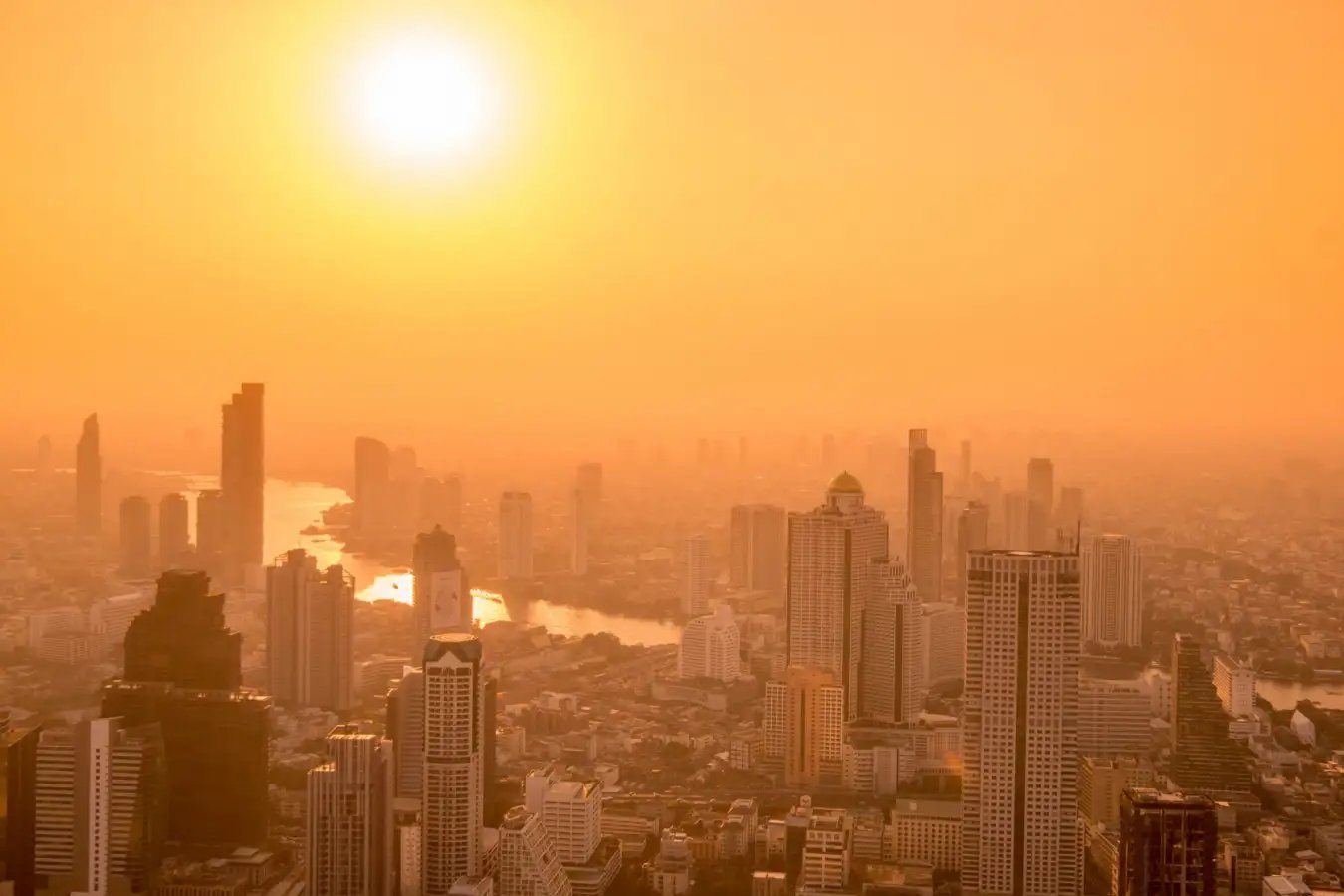
Hum is set in an over-heated near-future metropolis
Ingram Publishing / Alamy
Hum by Helen Phillips, the story of a mother’s struggle to protect and nurture her small family in a broiling, near-future metropolis, has won this year’s Climate Fiction prize. Supported by Climate Spring and worth £10,000, the award is intended to recognise “storytelling that engages with the realities of climate change”, and was won in 2025 by Abi Daré for And So I Roar. This year, Phillips’s novel beat shortlisted titles including Susanna Kwan’s tale of a future San Francisco where the streets are rivers, Awake in the Floating City, and Endling, Maria Reva’s story of the journey of a very endangered snail.
Judge Friederike Otto, professor in climate science at Imperial College London, said that Hum “tackles the central reason that nothing is done about the climate crisis – privilege. It destroys your opportunities and human rights”. Her fellow judge Jessie Greengrass, a novelist, called Hum “a book about what to do with your anxiety when there’s no right thing, or when all choices have consequences that seem to make things worse”.
The novel takes place in the near-future, in a city peopled by superintelligent robots known as hums “living” alongside humans. It centres on May, a mother of two who is desperate to get her children away from their addictive devices, so spends money she doesn’t have on a trip to an oasis of nature in the heart of the city. Phillips joined us to discuss her book – and the difference storytelling can make.
Alison Flood: What inspired you to tell this story?
Helen Phillips: I feel like any novel comes from millions of little seeds, but one seed I really think about with Hum was one day, some years ago, I was walking home from work, and it crossed my mind that I really needed to buy new dish rags – just an idle, personal, private thought. And when I got home, dish rags were immediately advertised to me on my computer, and I had this strange feeling – not an unfamiliar feeling to any of us – that, wow, how did the algorithm know that I had the thought that I wanted dish rags? The eeriness of that stayed with me, and I started to think about an extreme version of that kind of surveillance by an algorithm that could really cause a problem for someone, and that helped inspire the central problems I give my protagonist, May.

Helen Phillips, author of Hum
Andy Vernon-Jones
You live in a city with your partner and children, just like May. How much is Hum a reflection of your own anxieties about the climate crisis, surveillance, inequality?
Writers take inspiration from a lot of different things. For me, my anxiety is my greatest source of inspiration, so I’m grateful to my anxiety, I suppose. But as I was setting out to write, there were a number of things on my mind, including climate change, surveillance and artificial intelligence.
A line that really struck me was when a wise machine tells May: “You know the world is damaged, but you don’t know what that means for the lives of your children. You want to prepare them for the future, but you’re scared to picture the future.” A lot of us feel like that – May is just a bit further ahead…
That’s a very important moment, close to the end of the book, and I was inspired by the writer Elizabeth Kolbert’s article, “A Vast Experiment: The climate crisis from A to Z”, which appeared in The New Yorker on 28 November, 2022.
This book, as you may have noticed, has 12 pages of end notes, because, as I was working to process the aforementioned anxieties, I turned to a lot of writers and thinkers who are researching the future and trying to conjure the future in non-fiction.
Something else that also struck me in Hum was this line, that “the goal of advertising is to rip a hole in your heart so it can then fill that hole with plastic”. In the end notes you say it comes from an interview that you had with a professor of urban sustainability.
That line is one of my favourites in the book. It comes from my colleague, professor Ken Gould at Brooklyn College [New York], who studies sociology and climate change. With his generous and enthusiastic blessing, I put those words in the mouth of the hum, and it is a line that stands out a lot to readers, that searing articulation of what the problem is with consumption and how it’s connected to the degradation of the environment.
This book is set in a world of the future, but everything in it is seeded from our present reality. I often think of Margaret Atwood famously saying that everything in The Handmaid’s Tale, which seems like a quite outlandish tale, is seeded from some real-world example. I was very inspired when I heard that, and I thought of that a lot when I was creating the world of Hum, so really, so much of what you see in the book is just an extrapolation or an exaggeration of where we are now.
How did you decide how far into the future you were going to set your story? And what became the heart of it as you wrote?
In terms of how I decided when to set it, I would not say that it’s set in a particular year, I didn’t want to pin it down that way. The adults in this world are old enough to remember a time when so much of the tech that exists in the book didn’t exist in their lives – so that to me is the most meaningful thing in terms of when it’s set. The children are having a dramatically different experience of technology than their parents, and a very dramatically different experience than their grandparents. So, the society I evoke is very much at a transition moment.
The emotional core of the story was May, who is really striving, as I think most parents do, to give her children a good life, and is finding it hard to do so in the way that she wants, because she has lost her job to artificial intelligence and, in the world she lives in, the environment has degraded. Throughout the book, May is seeking connection: she wants to connect to her children, to her partner, Jem, to her physical environment and most importantly, to herself, and that connection is elusive. There are a lot of things in the book that are working against that connection, and to me, that’s the emotional journey of the book, her trying to find that connection and being thwarted, and then, without any spoilers, inching closer to it at the end.
I’ve just read Grace Chan’s Every Version of You. That book, and now yours, made me want to rush out and luxuriate in the beauty of the world we have. Is what you wanted to achieve – to say, look what we’ve got right now?
If that is what you feel at the end of reading my book, I’m very happy, that is certainly an outcome that would be very desirable for me – for us to cherish the nature we still have, to think about how we can protect it for the future, to remind ourselves to not take it for granted.
Do you think that stories can make a difference? Did you write yours in the hope that you could make a difference?
I do think that stories can make a difference, but I don’t think that you can set out to make a work of art with a didactic purpose, and much as I was certainly exploring my own anxieties about climate change and technology in Hum, I certainly didn’t feel like I’ll write this book and teach people how to be, certainly not that. But I think that the mere act of conjuring this world, of exploring this world, of putting a family in motion in this world, showing humans having psychological, emotional, and logistical reactions to this world, hopefully that is illuminating. But I do feel that a novel, or maybe any work of art, is more of a question than an answer. A question that gets people thinking along these lines, rather than delivering some clearly packaged message.
Given you have just won a prize for climate fiction, did you set out to write a work of climate fiction?
Writing about the climate has been a priority of mine for a long time, even in my first published book, And Yet They Were Happy, which is a book of microfiction stories published in 2011. So even going back that far, this has been a recurring theme. As I said, my writing arises from my anxieties, and I have been anxious about climate change for a long time. I don’t know exactly that I say, oh, I’m going to set out and write climate fiction, but climate being one of my central preoccupations and anxieties, it will be in my work.
Is another future possible for the characters of Hum? Do you see hope for them, for us?
I do think that the first step of any of this is that we are connected to one another, that we really perceive one another’s humanity, that we really want to join together in this effort of caring for our world. The first step is connecting with other humans and having a sense of shared value.
Topics: