Israel’s military has told residents across a swathe of southern Lebanon to leave and head north, as the Israeli prime minister, Benjamin Netanyahu, said his forces were escalating their offensive against Hezbollah.
The Israel Defense Forces (IDF) said in a post on social media that all areas south of the Zahrani River, which runs about 40 kilometres (25 miles) north of the de facto Israel-Lebanon border, were considered combat zones.
“In light of the repeated violations of the ceasefire agreement by the terrorist organisation Hezbollah, the IDF will act against it with great force,” the military’s Arabic-language spokesman, Avichay Adraee, wrote on X.
The warning late on Wednesday was the first since a ceasefire that took effect on 17 April, and came a day after Israel launched more than 120 airstrikes against Lebanon in one of the heaviest days of bombing in weeks.
The ceasefire brokered by the US last month now appears close to total collapse, complicating negotiations to bring a definitive end to the US-Israeli war with Iran.
Tehran, which has a close relationship with Hezbollah, has repeatedly signalled that an end to Israel’s offensive in Lebanon is a condition of any deal with Washington.
Donald Trump told reporters at the White House on Wednesday that Iran wanted to make a deal, but that the US was not satisfied with it yet.
“Iran is very much intent, they want very much to make a deal,” he said. “So far they haven’t gotten there … we’re not satisfied with it, but we will be. We
will be either that or we’ll have to just finish the job.”
Observers said Israeli officials and military commanders wanted to inflict as much damage as possible on Hezbollah before a deal between Tehran and Washington imposed new limits on or stopped the current offensive.
Israel’s military said it targeted 100 sites linked to Hezbollah across southern Lebanon and the eastern Bekaa valley area, including storage facilities, command centres and observation points that Israeli officials say are used to attack troops and residents in northern Israel.
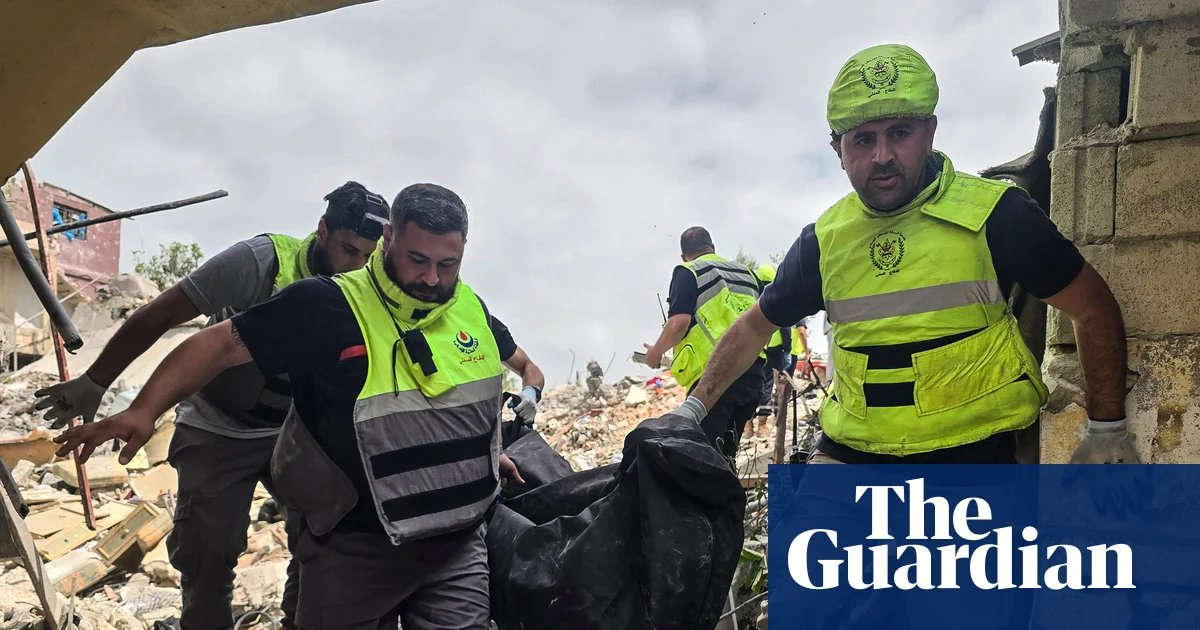
Lebanon’s national news agency said at least 10 people, including women and children, were killed in one strike on the town of Burj al-Shamali in southern Lebanon, while another strike on the eastern village of Mashghara killed 12 people including several members of the same family.
Netanyahu said in a statement that the Israeli military was “operating with large forces in the field and capturing and controlling areas”.
“We are fortifying the security strip to protect the northern communities [in Israel],” Netanyahu said in a reference to a self-declared security zone occupied by Israeli troops several kilometres inside southern Lebanon.
The veteran Israeli leader, who faces a tough battle for re-election later this month, is under pressure to show results against Hezbollah, especially as few of the apparent aims of the war Israel launched with Iran in February have been achieved.
Politicians and commenters in Israel have called in recent days for Netanyahu to ignore any pressure from Washington to limit its military operations in Lebanon.
Writing in the Maariv newspaper, Avi Ashkenazi called for “sustained around-the-clock attack waves of strikes using hundreds of aircraft simultaneously”.
“The ground in Lebanon must tremble. Residents of Beirut, Tyre and Sidon must sit in shelters just as residents of [Israel’s] north are being forced to remain confined to their homes,” he wrote.
Beirut has so far been spared Israeli strikes since the start of the ceasefire, but the prospect of an escalation of the offensive has caused widespread concern.
“By just saying a few words on TV, [Netanyahu] causes everyone to panic and flee their homes,” said Tony Aboud in Beirut’s bustling Hamra district. “I don’t know what’s going to happen and how long we can live like this.”
There were reports on Wednesday of new fighting in southern Lebanon between Israeli troops and Hezbollah. Hezbollah said its fighters clashed with Israeli forces in a town north of the strategic Litani River in southern Lebanon – the current de facto boundary in Lebanon, with large areas to the south under Israeli military control.
Strikes hit the outskirts of the southern city of Tyre on Wednesday, state media and an Agence France-Presse correspondent reported, after the Israeli army issued an evacuation warning for much of the city and its surroundings.
Israel’s military has ordered residents not to return to dozens of villages in the buffer zone it is seeking to establish between five and 10 kilometres into Lebanon, where its troops have been destroying homes.
An Israeli military official said the military was “operating in a targeted manner beyond the Forward Defense Line in order to remove direct threats to the citizens of the state of Israel [and Israeli soldiers]”.
In recent weeks, Hezbollah has boasted that it was using new fibre-optic drones, which Israeli troops have struggled to intercept, hitting Israeli forces and northern Israeli villages.
Israel has told people there not to gather in large numbers. On Wednesday, air raid sirens were activated in the area of Shlomi in the western Galilee after reports of a drone infiltration. “What this requires of us now is to increase the blows, to increase the intensity. We will smite them hip and thigh,” Netanyahu said earlier this week.
Over 1 million people in Lebanon have been displaced in the latest round of hostilities between Hezbollah and Israel, which began when the Islamist movement fired rockets into northern Israel in March, two days after Israel launched strikes against Tehran which killed the then Iranian supreme leader, Ayatollah Ali Khamenei.
At least 3,213 people have been killed in Israeli strikes since the start of the war, according to the Lebanese Health Ministry, with more than 9,700 wounded.
According to Netanyahu’s office, 23 Israeli soldiers and a defence contractor have been killed in or near southern Lebanon, and two civilians have been killed in northern Israel.
The Israeli military said that 10 of its soldiers had been killed since the 16 April ceasefire, six of them by Hezbollah’s explosive drones. Hezbollah has not released figures for its own casualties.
Israel’s defence minister, Israel Katz, said the military had killed Mohammed Odeh, the new leader of Hamas’ military wing, during airstrikes in Gaza City, less than two weeks after killing his predecessor. At least five people were killed and 12 injured, according to local hospitals.
Reuters, Agence France-Presse and Associated Press contributed to this report