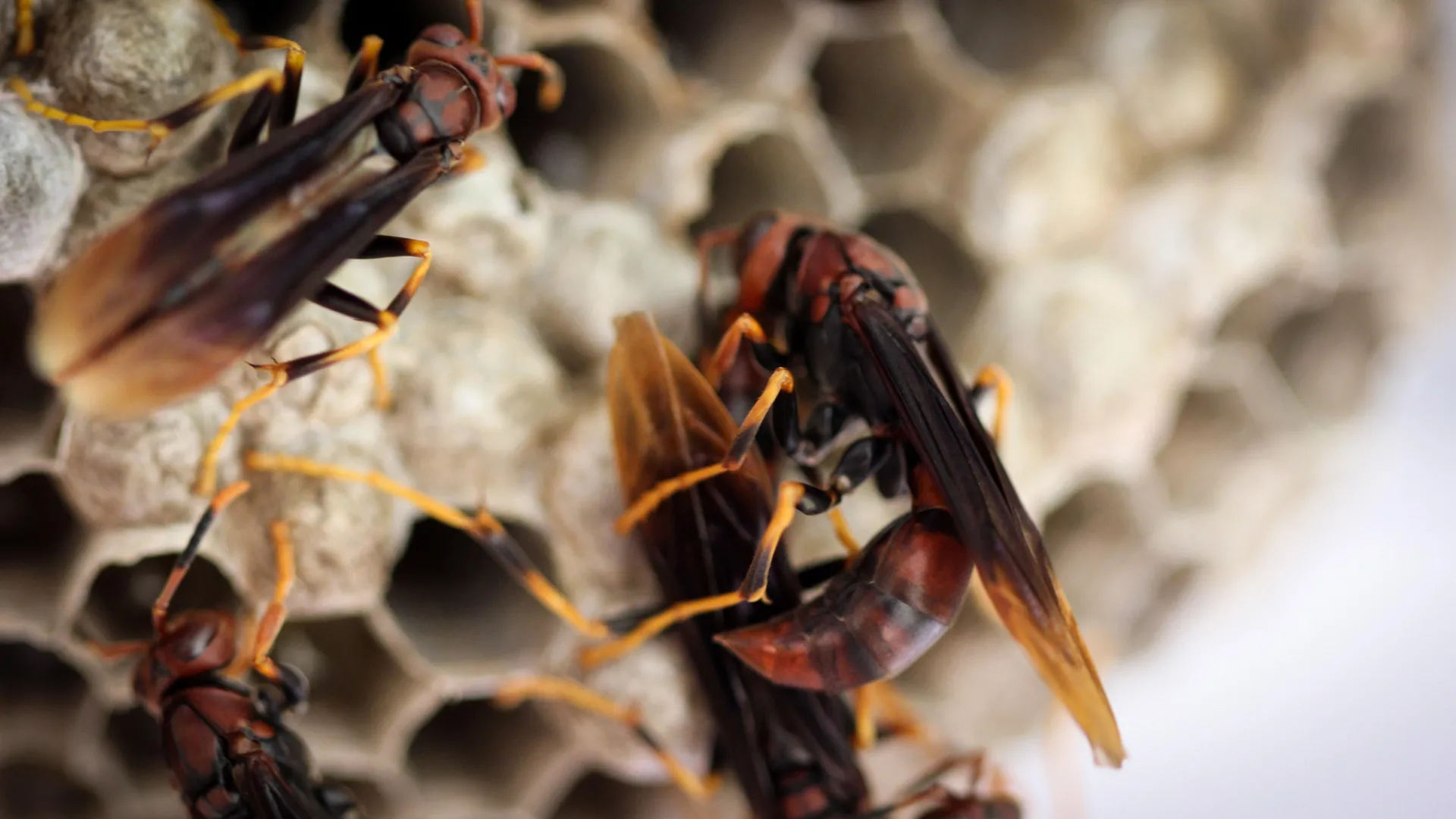
Losing a queen throws a tropical wasp colony into turmoil, triggering violent power struggles and social breakdowns. But new research led by UCL scientists found that some wasps quietly step in to keep the colony functioning during the chaos.
The study, published in Animal Behaviour, examined tropical paper wasps (Polistes canadensis) in the Caribbean. These colonies are built around a single dominant breeding female, but unlike some social insects, the other females are still capable of reproducing themselves. That means if the queen disappears, several wasps may compete to take her place.
To investigate what happens after a queen is lost, researchers removed queens from established colonies and watched how the insects responded.
Violent Fights Break Out After the Queen Disappears
The effects were immediate. Female wasps began aggressively competing for dominance, and the colony’s normal social structure quickly unraveled. Instead of an orderly transfer of leadership, the colonies entered a period of intense conflict involving many individuals.
Despite the upheaval, the colonies did not collapse.
Researchers discovered that a separate group of wasps took on a crucial role during the unrest. Rather than joining the fights, these individuals focused on essential tasks such as collecting food and caring for developing young. The scientists called these wasps “compensators” because they helped offset the damage caused by the conflict.
By continuing to feed larvae and maintain daily colony functions, the compensators helped the society survive even while leadership battles were unfolding around them.
Cooperation Continues Even During Conflict
The study found no clear biological differences between the wasps involved in aggressive competition and those acting as compensators. According to the researchers, that suggests these behaviors may reflect strategic choices instead of fixed social roles.
Some wasps may see fighting for dominance as their best chance to reproduce in the future. Others may gain more by helping ensure the survival of the brood, which often includes their siblings.
Lead author Dr. Owen Corbett (UCL Centre for Biodiversity & Environment Research, UCL Biosciences), who carried out the study during his PhD at UCL, said: “The conflict after queen removal was intense, but it wasn’t the whole story.
“While some individuals fought over dominance, others completely avoided the conflict and quietly stepped up to keep the colony running. Cooperation didn’t disappear; it was redistributed.”
A Different Kind of Wasp Society
Most previous research on cooperative insect societies has focused on temperate species found in Europe or North America. Those species often have more rigid dominance hierarchies and predictable succession systems.
This study instead examined tropical wasps with a far less orderly social structure, where leadership changes are driven by aggression and competition. The findings expand scientists’ understanding of the many ways animal societies can handle leadership crises.
The research was based on a new analysis of behavioral data originally collected during fieldwork in Panama in the early 2000s by members of the research team.
What Wasps Can Teach Us About Cooperation
The findings challenge the idea that societies can only remain stable through orderly, rule based leadership transitions. Although aggressive succession systems are often considered too costly to last, the study suggests they can still work if some individuals compensate by maintaining essential tasks.
Senior author Professor Seirian Sumner (UCL Centre for Biodiversity & Environment Research, UCL Biosciences) said: “Understanding how animal societies manage conflict can help us think differently about cooperation more broadly. In times of turmoil, society depends on those who keep doing the essential work in the background. In many ways, we may be more like wasps than we realize.”
The research was funded by the Natural Environment Research Council (NERC) and the Smithsonian Institution.