Andrew here. The water-cooler talk in Silicon Valley is all about the Vatican. DealBook’s Bernhard Warner, who’s based in Rome, takes us inside the debate about Pope Leo XIV’s missive about A.I. and the dignity of work.
Also, Benjamin Mullin has a scoop for us: California’s attorney general revealed his thinking on Paramount’s deal for Warner Bros. Discovery. Finally, the first Enhanced Games — a steroid-friendly version of the Olympics backed by Peter Thiel — just finished, with results that don’t look so enhanced. More below.
Who will listen to Leo?
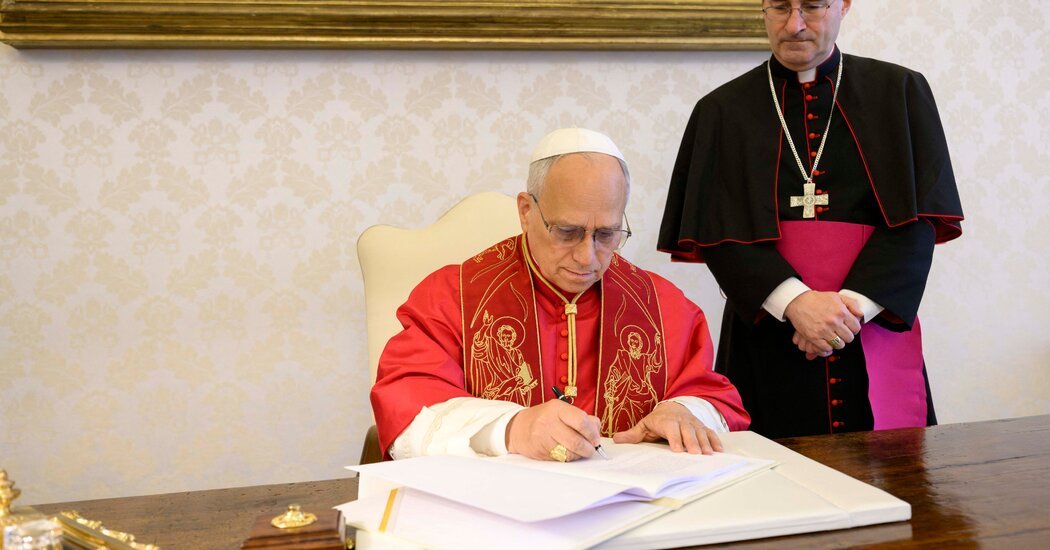
Artificial intelligence has taken hits recently from college graduates and voters. Now the pope is taking a turn.
Politicians, labor officials and tech executives are continuing to weigh in on Pope Leo XIV’s “Magnifica Humanitas,” a 42,300-word encyclical squarely aimed at A.I.’s risks to humanity and Big Tech’s lock on the technology.
But while Leo’s views may influence wider societal debate, they seem unlikely to slow down Silicon Valley.
Leo warned the A.I. race could lead to a new “Tower of Babel,” writing that ambitious undertakings that promote homogeneity and compete with religion end badly.
Leo also wrote about:
-
the need for robust government regulation of tech companies at the forefront of A.I.
-
protecting workers from workplace disruption
-
A.I. deepfakes’ assault on the truth
-
A.I.-powered autonomous weapons
Anthropic was part of the Vatican’s announcement. One of the A.I. giant’s founders, Chris Olah, was in Rome for the encyclical’s launch; he said in a speech at the event, “We need informed critics who will tell the labs when we are failing.”
Anthropic and its top executives, like Dario Amodei, the company’s C.E.O., have long argued that the technology needs guardrails. That position has put it at odds with the likes of the Pentagon and the former Trump A.I. czar David Sacks.
Not everyone agreed with Leo. Sacks, who has called for unshackling U.S. tech giants so they can better compete against Chinese rivals, argued that giving a government more say over A.I. could backfire in Orwellian fashion. “Who will guard the guardians?” he wrote on X.
Other notable tech voices have yet to weigh in, including Peter Thiel, Sam Altman of OpenAI or Elon Musk.
Also quiet so far has been Vice President JD Vance, a Catholic who has scolded Europe for its tighter regulatory grip on A.I.
How much sway will Leo have? Encyclicals can be a big deal: After Pope Francis issued a global call to action on the climate crisis in 2015, corporate leaders made pilgrimages to the Vatican and pledged to take action on the issue.
But there’s real money on the line with A.I.:
-
Remember that Jensen Huang, Nvidia’s C.E.O., predicted last week that A.I. infrastructure spending would climb as high as $4 trillion in 2030.
-
And investors are anxiously awaiting several giants of the sector to go public, including SpaceX, OpenAI and Anthropic, each of which could be trillion-dollar enterprises.
HERE’S WHAT’S HAPPENING
Oil prices rebound as the U.S. strikes Iran. Traders grew nervous after the U.S. on Monday targeted Iranian missile launch sites and boats trying to lay mines, dimming hopes for potential peace talks in Qatar. Brent crude, the international benchmark for oil, rose to nearly $99 a barrel. The attack comes as Republicans grow more fearful that the Trump administration will cede big concessions to Tehran to end the fighting and reopen the Strait of Hormuz.
BP removes its chairman. Shares in the energy giant fell more than 5 percent on Tuesday after its board announced that it would replace Albert Manifold, who assumed the role in October, citing “unacceptable” issues with his governance standards, oversight and conduct. BP’s board announced that Ian Tyler would take over in an interim basis from Manifold, who had pushed for a speedy shift back to oil and gas.
Shares in Ferrari sink as it enters the E.V. age. The Italian carmaker unveiled the Luce, its first fully electric car, last night in Rome. The €550,000 ($645,000) five-seater, which was codeveloped by Jony Ive’s LoveFrom, has already sparked impassioned debate online. The Luce arrives as many carmakers have scaled back or taken huge write-downs on their E.V. investments.
Scoop: New scrutiny on the Warner Bros. deal
Whether Paramount closes its acquisition of Warner Bros. Discovery without major hurdles may ultimately come down to one man: Rob Bonta, California’s attorney general, who has said publicly that the deal raises “red flags everywhere.”
Last week, during a meeting with Hollywood heavyweights including the actor Mark Ruffalo and the documentary filmmaker Alex Gibney, Bonta went into even greater detail, Benjamin Mullin exclusively reports for DealBook.
Bonta said his office has not made a “final decision” about whether to sue. But he told the group that he believes “structural remedies” — which often means breaking up a company — are usually more effective than behavioral remedies, which he said companies can get around. He also said other states were considering action.
“Behavioral remedies have historically proven to be hard to enforce,” Bonta said, according to a transcript of the meeting. “We don’t want to make that same mistake again here. So it could be a block, it could be behavioral remedies backed by structural remedies. Again, we haven’t decided what we’re going to do.”
Industry pushback: The meeting with Bonta was organized by Norman Eisen of Democracy Defenders Fund. Eisen served as an ambassador in the Obama administration and is part of a coalition opposing the Warner Bros. deal.
The meeting came weeks after thousands of signatories — including more than 200 prominent actors, producers and documentarians — released a letter arguing that further corporate consolidation would harm the film and TV industry.
Paramount has responded by saying that the deal “is fundamentally pro-competitive,” arguing that the combined company will have the scale necessary to compete with “global streaming platforms such as Netflix and large tech companies.” The deal, Paramount says, will strengthen competition for premium content and “help revitalize and reinforce theatrical exhibition.”
The company also has a formidable team set to defend the deal if Bonta sues, with lawyers including David Gelfand; Jeffrey Kessler, who led the antitrust case by more than 30 states against Live Nation; and Makan Delrahim, Paramount’s chief legal officer and a former U.S. antitrust chief.
Bonta’s office has been aggressive with antitrust action in recent months, a potentially ominous sign for Paramount. He is trying to unwind Live Nation’s deal for Ticketmaster and challenge Nexstar’s acquisition of Tegna, moves that have caused legal headaches for both companies.
He said in the meeting that state attorneys general are increasingly stepping in as the Trump administration waves through big deals.
Wherever Bonta lands, the clock is ticking. He told the group that his office has been preparing for the possibility that Paramount could close its deal as soon as July, adding that he won’t “lose the opportunity to move aggressively, if that’s what we decide to do.”
“We have authority here, and we’ve delivered results already in this space,” Bonta said.
A one-stop shop for A.I. models raises $113 million
As artificial intelligence models — and the costs of running many of them — multiply, software developers are increasingly looking to choose the right ones for different tasks and price points.
That has led to a growth in services like the start-up OpenRouter, which plans to announce on Tuesday that it has raised $113 million in a round led by CapitalG, an investment arm of the tech giant Alphabet, Michael de la Merced reports
What OpenRouter does: Customers can access more than 400 A.I. models — including those from OpenAI, Anthropic and Google — through a single portal.
Alex Atallah, an OpenRouter founder and its C.E.O., described his company as the A.I. equivalent of Stripe, the payments giant. “A lot of what we do is try to help people find the right vendor for the job,” he told DealBook.
It’s growing fast. OpenRouter says it now processes 25 trillion tokens, the basic unit of A.I. computing, every week, up from five trillion six months ago.
Cost is increasingly a concern for customers, especially as they rely more on agents that consume more tokens and push employees to use A.I. more. The chief technology officer of Uber, Praveen Neppalli Naga, recently told The Information that the ride-hailing giant had already spent its entire A.I. budget for 2026.
Many companies are using open-source models, which are free to use, to help lower costs. (Of the top three most popular models on OpenRouter in the past week, two were open-source ones from the Chinese companies DeepSeek and Tencent; the third was Anthropic’s high-end Claude Opus 4.7.)
Atallah added that if companies aren’t careful, running queries through A.I. models, known as inference, could end up leading to “an infinite cost center.”
That is what led to CapitalG’s interest, according to two of the investment firm’s partners, Jane Alexander and Mo Jomaa.
The round values OpenRouter at $1.3 billion, DealBook understands. Other participants include the venture capital arms of Nvidia, ServiceNow, MongoDB, Snowflake and Databricks, as well as the existing backers Andreessen Horowitz and Menlo Ventures.
“The C.F.T.C. has said to bad actors in the crypto space that it is not coming after them.”
— Joe Konizeski, a former attorney in the Chicago office of the Commodity Futures Trading Commission, on how the Trump administration has curtailed enforcement and oversight by the agency after lobbying from cryptocurrency companies and prediction markets — several of which have ties to the Trump family. Five senior agency officials who oversaw the companies were placed on leave, The Times reports.
Barely enhanced
The inaugural billionaire-backed Enhanced Games, where sports doping wasn’t just accepted but encouraged, is in the books. The results weren’t exactly an endorsement for testosterone, human growth hormone and Adderall transforming sports.
Just one drug-using athlete set a world record, though international sports bodies have said that they won’t recognize the achievement.
What went down: Spectators at the games, held Sunday in Las Vegas, had to wait until the final event of the night before they saw a world record fall.
Kristian Gkolomeev, a Greek one-time Olympic swimmer, was the one to enter the doping record book, earning a $1 million payout for doing so.
The big backers: The tech mogul Peter Thiel, crypto investors Tyler and Cameron Winklevoss, and 1789 Capital, a venture capital firm where Donald Trump Jr. is a partner, invested in Enhanced Group, the company that sells supplements online and staged the games. (Enhanced went public via a SPAC merger earlier this month with a $1.2 billion valuation; its shares have dropped more than 40 percent since its first day.)
Nondoped athletes were the big winners. Four of the 42 athletes participating said they competed clean. Three of them won $250,000 prizes for winning their events.
Incidentally, one of them, the American swimmer Hunter Armstrong, was drug tested by the U.S. Anti-Doping Agency right after he won Sunday’s race. He said it was the 11th time he had been tested since he joined the Enhanced Games.
THE SPEED READ
Deals
Technology and artificial intelligence
-
U.S. court dockets are being flooded by home-brewed lawsuits by individuals representing themselves, thanks to A.I. (NYT)
-
One of Spotify’s C.E.O.s, Alex Norstrom, defended the platform’s “controlled” push into A.I.-generated music with a tool backed by labels. (FT)
Best of the rest
We’d like your feedback! Please email thoughts and suggestions to dealbook@nytimes.com.