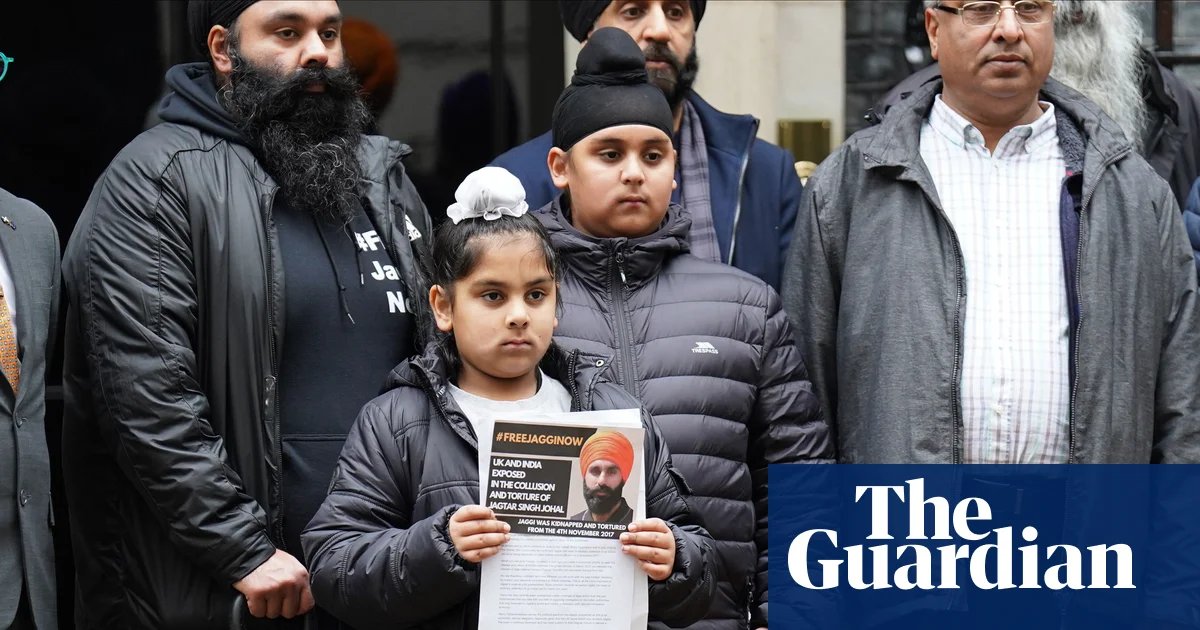
Four senior lawyers, including the former attorney general Dominic Grieve, have written to Keir Starmer urging him to request that Indian prosecutors drop charges against the British national Jagtar Singh Johal on the basis that continued prosecution would be in manifest breach of the double jeopardy rule which prevents someone being tried twice for the same offence.
Johal has been held in an Indian jail for eight years, and in March last year was acquitted of the terrorist charges laid against him in a court in Punjab. The court found the prosecutors had ‘miserably failed’ to present any reliable evidence, despite having had seven years to do so.
Despite his acquittal, Johal faces eight essentially duplicate cases filed by India’s National Investigation Agency (NIA), all based on the same “confession” printed on a sheet of paper that his supporters claim he signed after he was tortured by police with electricity and threatened with being burned alive.
The letter urging Starmer, as a former human rights lawyer, to recognise the legal justice in intervening has also been signed by the distinguished barrister Lady Helena Kennedy, the former Lord Advocate for Scotland, Dame Elish Angiolini, and Geoffrey Robertson KC. It is hoped that the calibre of the letter writers might galvanise Starmer to intervene.
In their letter, the four say it would be “entirely appropriate” for the UK government to ask the Indian government to drop the remaining case since domestic Indian proceedings would have acquitted Johal of all charges against him.
The double jeopardy rule, they say, “reflects a basic and intuitive principle that in a just system, no one should be repeatedly prosecuted, tried or punished for crimes of which they have already been convicted or acquitted. The prohibition of double jeopardy exists across multiple areas of international law, including international human rights law, international criminal law and international humanitarian law. It is generally considered to form part of the right to a fair trial, which itself is part of customary international law, meaning it applies to all states, irrespective of whether they are party to a particular treaty or agreement.”
They further point out that “the basic protection against double jeopardy is recognised in over 50 national constitutions, and is firmly established in common law jurisdictions, including Canada, Australia, Ireland, Israel, the US and New Zealand, as well as India and the UK.”
They say the rule is also incorporated in Indian domestic law, and so to ask for his release would be showing due deference to the Indian legal system.
They say they understand that “the UK cannot interfere in the legal systems of other countries, however it is vital that the executive and its agencies of every state respect the rule of law and uphold international minimum standards, particularly in cases involving the death penalty.
“United Nations legal experts have found that Johal is arbitrarily detained, having been targeted for his activism exposing human rights abuses against India’s Sikh community.”
Jagtar’s brother Gurpreet, who is based in Dunbarton, said “the prime minister needs to recognise this is not a legitimate legal process – it is a rigged game designed to punish my brother for his human rights activism, and it is endless.
“He and his lawyer get called to the court, the NIA finds a pretext for delay, the Judge agrees to a two-month adjournment … rinse and repeat. Meanwhile, Jagtar’s life is slipping away and the prime minister does nothing. Sir Keir Starmer knows arbitrary detention when he sees it. He knows what double jeopardy is. It’s time for him to show some leadership and bring Jagtar home.”