“Congo Boy” opens with a big setpiece set in a dance club: The camera follows two young men as they walk around searching for someone, the audience immediately thrown into a vibrant milieu of throbbing music and writhing bodies. Before they can settle in, some soldiers enter the club and start firing away, scaring patrons as well as the rapper on stage, who abandons his set. In the ensuing chaos, one of those two young men takes the stage, goaded on by his friend, and soon has the audience dancing to his melodies and words. The scene encapsulates what filmmaker Rafiki Fariala set out to make: an affecting musical drama about a star being born despite all the odds against him.
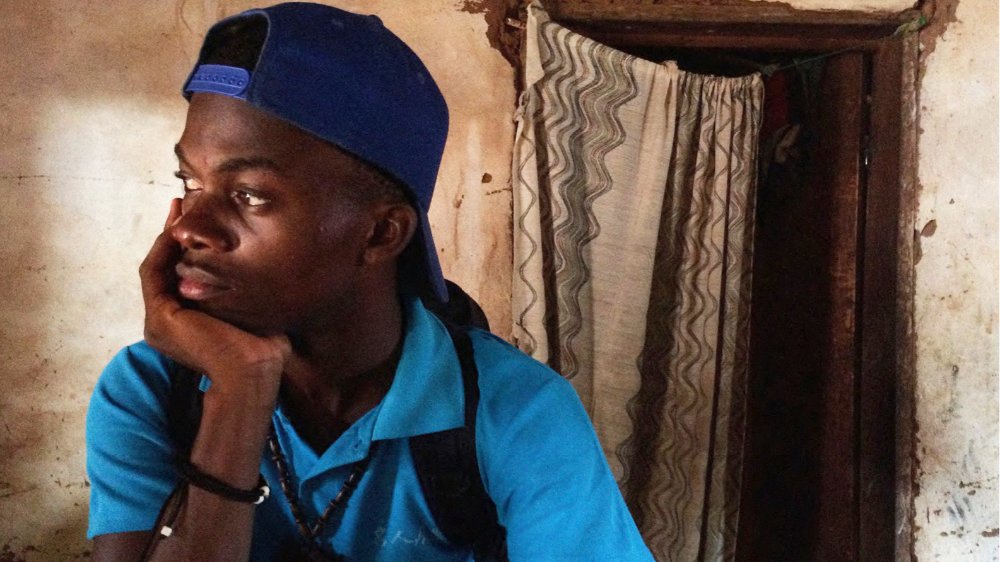
Our hero is Robert (Bradley Fiomona), a Congolese young man displaced by war into neighboring Central African Republic. (“Hero” in this case applies not only because he’s the lead of the film: All his actions are heroic.) Both his parents are in prison for reasons not specifically addressed, though it is implied it’s because of their status as illegal immigrants.
In their absence, Robert takes care of his four younger siblings, tending to all their practical and emotional needs; working many odd jobs to provide for his family, he’s always hustling. He’s also still in high school, hoping to qualify for medical school after graduation, to fulfill his father’s lost dream of becoming a doctor. The relationship between Robert and his siblings is poignantly rendered. “Congo Boy” balances the strife and heartache the family is feeling with the hard daily grind of procuring life’s essentials, as well as the times when they playfully enjoy each other’s company, tenderly taking care of each other’s needs.
Robert is under a lot of pressure, so he escapes into writing poetry and melodies. While there are many club-set rapping scenes, poetry is a big part of “Congo Boy”: Throughout the proceedings Fariala, who also wrote the music and songs, shows Robert reciting his verse straight to the camera, as he’s walking around the streets of Bangui. Whenever an especially emotional moment hits him, he reacts by turning it into a poem. There’s a specific rhythm to these instances that gives “Congo Boy” its distinctive flair. This is not just another rags-to-riches story of a Black rapper on the rise.
Inspired by his own life story, Fariala adds an authentic socioeconomic and political dimension to his screenplay. Though never didactic, “Congo Boy” shows the effect of war displacement on the psyche of the people who had to abandon their lives for safety. In the way Robert manages the lives of his younger siblings, the film allows the audience to witness how growing up in a place that doesn’t really accept you might actually manifest in daily life. Robert hides his Congolese identity for fear of being deported, or not being allowed education or work. That fear governs every move he makes to keep his family intact.
Fariala has a real sense of location, with much of the film is set in the streets of Bangui, where life’s chaos resides. Collaborating with cinematographer Adrien Lallau and editor César Simonot, the filmmaker shows a real command for setting crowd scenes, making them narrative tools that add texture to the story.
However, despite Fariala’s tight control of the tone and the musical elements, the script remains shaggy and unfocused at times. Co-written by the director with Tommy Baron and Boris Lojkine (“Souleymane’s Story”), it introduces too many plot points that are either forgotten or resolved off-camera with an offhand comment. What it does well is to build the journey of Robert’s rising musical success, as he eventually earns the eponymous moniker. The end might be exactly what the audience was expecting, but we arrive at it with a lot of heart.
Anchoring all this is Fiomona’s open-hearted and entertaining performance, deftly moving between emotionally heavy dramatic scenes and others full of gaiety. His face registers Robert’s many dilemmas, while his physicality and singing show why he can be a star. Despite its uneven writing, “Congo Boy” succeeds because of Fariala’s emotional clarity, avoiding many pitfalls of the familiar rise-to-fame musical story. Anchored by its charismatic star, the film ends on an acute, genuinely moving note of hard-earned hope.