Eleven weeks after the start of the Iran war, the Strait of Hormuz has remained closed to naval traffic, bleeding the global economy far beyond the Gulf.
Iran’s Islamic Revolutionary Guard Corps (IRGC) maintains an iron grip over the narrow, strategic waterway, while a corresponding United States naval blockade on Iranian ports has failed to reopen it.
Before the war began, between 120 and 140 ships travelled through the strait each day, about half of them oil tankers carrying some 20 million barrels of oil between them.
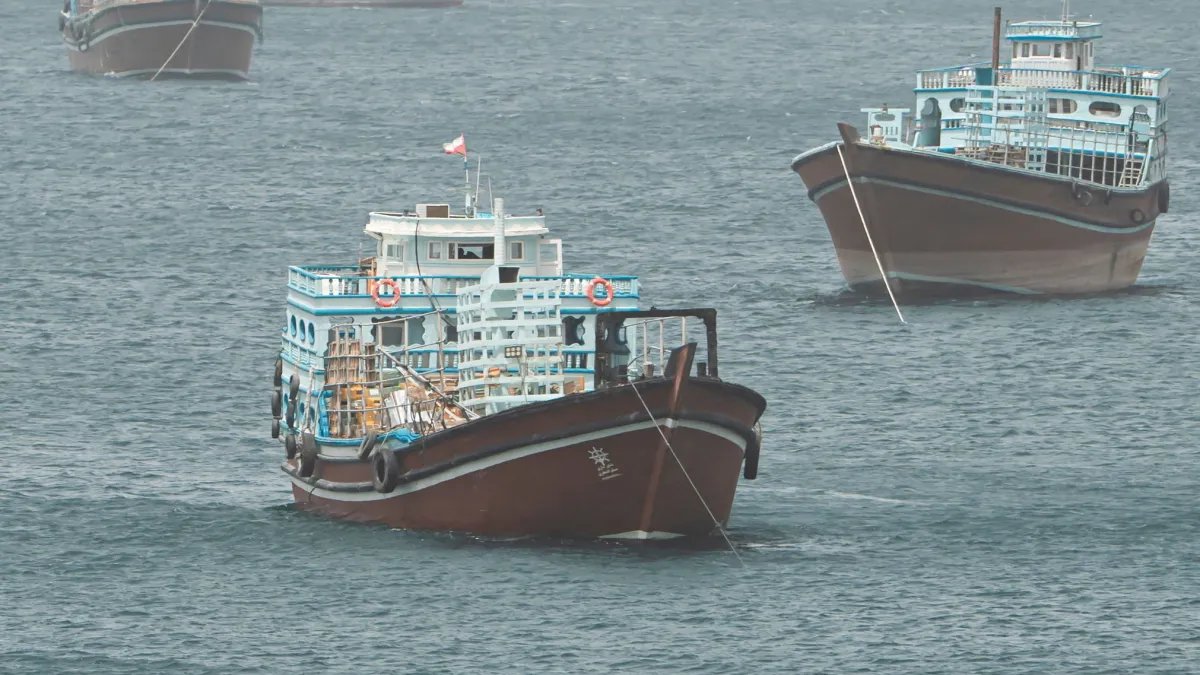
Now, only a few vessels whose owners have negotiated with the IRGC are permitted to pass.
On Wednesday, Iran said it coordinated the transit of 26 vessels through the Strait of Hormuz in 24 hours, two days after announcing the formation of the Persian Gulf Strait Authority (PGSA), a new body to provide “real-time updates” on operations in the strait.
Since the announcement of a temporary ceasefire between the US and Iran in April, Iran has been working on formalising a mechanism to charge a transit fee from ships crossing the critical chokepoint, through which 20 percent of the world’s oil and liquefied natural gas (LNG) are shipped during peacetime.
Tehran has reportedly already charged fees as high as $2m per ship for transit since the war started.
Even though countries opposing Tehran say this is illegal, it may still be less expensive than the overall cost of the closure of the strait each day.
So, is paying Iran cheaper than remaining stranded in the sea? We explore the maths behind tolling the Strait of Hormuz.
What is the closure of the Strait of Hormuz costing?
Nearly one-fifth of global oil and LNG exports were shipped by Gulf producers through the Strait of Hormuz before the US and Israel bombed Iran on February 28, triggering the Iranian closure of the waterway. The strait is the only waterway linking Gulf producers to the open ocean – there is no other route through which they can ship exports.
About 20.3 million barrels per day of oil passed through the Strait of Hormuz in peacetime – nearly 27 percent of global maritime oil trade. The lion’s share of that crude went to Asian markets.
Global LNG trade has been similarly hard hit.
On the day before the war broke out, Brent crude – the global benchmark for oil prices – closed at $72.48 per barrel. After Iran closed the waterway on March 4 and began attacks on vessels attempting to sail through, traffic came to a standstill, stranding about 2,000 ships on either side of the strait.
In terms of lost oil revenues, this amounts to $114.8bn of losses per day. About 10 billion cubic feet of LNG per day also used to pass through the strait, worth a further $7.8bn.
Since the blockade, less than 4 percent of peacetime traffic has passed through the Strait of Hormuz, including those ships that have secured authorisation from Iranian authorities. This does not include the movement of “shadow” fleets, when vessels illegally turn off tracking devices.
“From an economic perspective, a negotiated transit arrangement [with Iran] now makes more sense than continued closure,” said Mohammad Reza Farzanegan, an economist at Germany’s Marburg University. “The geography gives Iran significant leverage, and the recent crisis has shown that Tehran can use control over the Strait of Hormuz in practice.”
Iran is unlikely to give up this leverage without a political or economic arrangement that recognises its strategic position, added Farzanegan.
The economic impact of blockading the Strait of Hormuz also goes beyond traffic flow. The disruption in the flow of oil, gas, fertilisers and maritime traffic in general has left several countries reeling under a rising cost of living.

So, is paying a toll to Iran cheaper?
For hundreds of ships stranded in the Gulf with thousands of sailors on board, the cost of remaining anchored is steep, including crew wages, loan repayments, repair and management, coupled with inflated war risk premiums.
In turn, Iran has reportedly been charging up to $2m for authorisation to pass. Experts say many will see this as worthwhile purely in terms of monetary cost.
“There is no doubt that paying Iran is cheaper than a continuous blockade because a sitting tanker bleeds money,” said Nader Habibi, an Iranian American economist.
There are other factors to consider, however, he told Al Jazeera.
“It makes sense from an economic point of view, but it is not politically feasible,” he said. “The companies are under pressure from the US sanctions and not to make arrangements with Iran.
“This is not just a purely economic cost-benefit analysis,” Habibi continued, “but long-term considerations that are taken into account.”
The nature of the war has also changed since it broke out in February, said Aniseh Tabrizi, an associate fellow on the Middle East and North Africa Programme at think tank Chatham House. “From fighting, to an economic war, trying to strain either party to cave in,” she said.
While it may seem that the economics of the closure of the strait are currently skewed towards Iran, Tabrizi told Al Jazeera, “the economics by itself is not going to be the driver to change calculation or move from the current standpoint.”
She noted that Iran and the US need to reach a “diplomatic compromise, with other calculations linked in to the economic factor”, before there can be an end to the energy supply crisis.
What does international law say about tolls on shipping?
International law protects free transit through strategic waters such as natural straits like Hormuz, barring countries from imposing passage tolls even where the waterways fall entirely into territorial waters, like in the case of Hormuz.
However, services such as security controls, inspections and insurance regimes can be charged for.
Chargeable fees also partly depend on whether a waterway is a man-made passageway or a natural one.
These are three different precedents in maritime traffic flow:
- Panama Canal: An artificial waterway connecting the Atlantic and Pacific oceans. Vessels pass through a unique system of locks that raise and lower vessels across elevated terrain. Since Panama built, maintains and operates the canal, it can charge transit fees based on vessel size, cargo capacity and booking priority. These range from several hundred thousand dollars per transit to some slots sold for millions of dollars.
- Suez Canal: Another artificial canal, linking the Mediterranean and Red seas. Egypt charges transit fees for the use of canal infrastructure, maintenance and traffic management services through the narrow waterway. Container ships and oil tankers pay from several hundred thousand dollars to more than one million dollars per voyage.
- Turkiye’s Bosporus Strait and Dardanelles: These are different because they are natural straits, rather than man-made canals. Turkiye charges for navigation-related services such as lighthouse operations, rescue readiness, medical support and traffic management – and tightly controls ship scheduling and navigation.
Economist Farzanegan said Iran, like Turkiye, could justify a negotiated mechanism for transit fees or service-based contributions through natural straits as payment for maintaining a safe passageway, reducing environmental risks and providing predictability in a waterway that supports global energy, food and technology supply chains.
However, there are differences between Turkiye and Iran, Habibi said.
In Turkiye’s case, the transit passes entirely through Turkish territorial waters, so the waterway belongs only to one country. The Strait of Hormuz passes through the territorial waters of Iran and Oman, with external parts reaching the United Arab Emirates.
“This sort of arrangement is unprecedented, and there would not be such an outcome, unless there is a complete coordination between the GCC countries and Iran, with the approval of major international powers, such as China and the United States,” Habibi told Al Jazeera.

Can there be regional cooperation over the Strait of Hormuz?
Iran’s newly-formed PGSA published a new map of Hormuz, stretching from Kuh-e Mubarak in Iran to south of Fujairah, in the UAE, at the eastern entrance of the strait, and from the tip of Qeshm Island to Umm al-Quwain at the western entrance.
Given how the Iran war has spilled over into the Gulf region – with the UAE taking the brunt of Iranian strikes – economist Farzanegan said “regional cooperation with Iran is the most realistic path to stable transit through the Strait of Hormuz.”
The UAE, Oman, Qatar and Iran will have to work together because their economies require it, he argued.
A workable arrangement could include a joint maritime authority, shared monitoring, emergency coordination, environmental protection and service-based contributions for maintaining safe passage, Farzanegan told Al Jazeera.
“This would give Iran a recognised role in the security of the waterway while giving Persian Gulf economies more predictability,” he added. “Such a framework is also more realistic than relying on external military enforcement, which has been more a source of trouble for these states.”
Nader, the Iranian American economist, however, said he sees a regional arrangement as unlikely, “unless Iran shares the transit fee according to an agreement among all countries involved”.
Farzanegan added that if the world expects stable access to the Strait of Hormuz, then paying Iran could well be accepted as the price of keeping the vital waterway predictable.