These bizarre fossils represent some of the earliest moving, sexually reproducing life ever discovered
New trove of fossils reveals that ancestral animals likely emerged in the deep sea
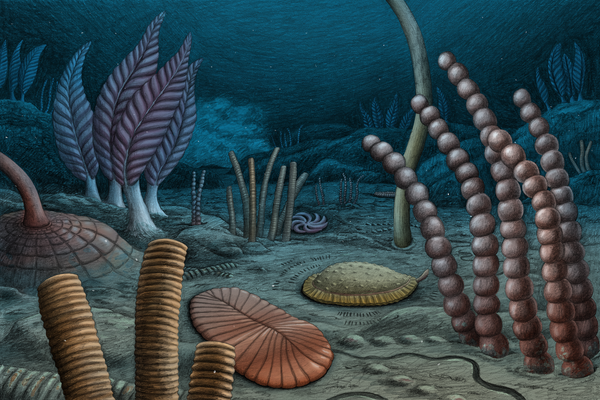
A paleoartist’s interpretation of what a newfound fossil site’s deep-sea ecosystem looked like during the Ediacaran period around 567 million years ago.
Today a stretch of Canada’s remote Northwest Territories is covered in snow-covered peaks. But more than half a billion years ago this wilderness was an ancient seafloor home to the wrinkled pancakes, fleshy fronds and spiral-shaped critters that were among Earth’s earliest complex life-forms.
Researchers recently unearthed a trove of fossils that reset what we know about when these curious creatures scuttled onto the evolutionary scene. The new fossils, described today in the journal Science Advances, also suggest that the deep sea served as an environmental cradle for complex life.
Found in the MacKenzie Mountains in Canada, the new fossils provide a rare window into the Ediacaran, a geological period that precedes the Cambrian explosion of biological diversity. To reach the site, study lead author Scott Evans, a paleontologist at the American Museum of Natural History, and his colleagues embarked on a 14-hour drive and a helicopter flight.
On supporting science journalism
If you’re enjoying this article, consider supporting our award-winning journalism by subscribing. By purchasing a subscription you are helping to ensure the future of impactful stories about the discoveries and ideas shaping our world today.

One of the site’s fossils of Dickinsonia, an early complex organism that absorbed bacteria and algae as it moved along the seafloor.
Scott Evans/American Museum of Natural History
But the fossils, many preserved as detailed imprints on slabs of mud-colored rock, were worth the journey. In total, the team collected more than 100 fossils of strange, soft-bodied creatures that record major milestones in the evolution of life as we know it. Compared with finds from earlier in the Ediacaran, “these fossils look a little more like animals that we’re familiar with,” Evans says. “They move around, and some of them are reproducing sexually.”
Among these early movers were the frisbeelike Dickinsonia, which lacked a mouth and hoovered up algae through its underbelly, and Kimberella, a teardrop-shaped creature that scraped the seafloor and may be related to modern mollusks. The site also yielded fossils of spongelike, tubular organisms known as Funisia, which were among the first creatures to reproduce sexually. Scientists think they sent sperm and eggs into the water column like today’s corals do.

Scott Evans/American Museum of Natural History
The fossils date back 567 million years. This “extends early animals deeper in time,” says Mary Droser, a paleontologist at the University of California, Riverside, who was not involved with the paper but is mentioned in its acknowledgments. She notes that the Ediacaran has long been divided into distinct groupings of animals, beginning with simple stationary species that were replaced by more complex creatures emerging around 559 million years ago. Instead the new fossils reveal that these animal groups lived side by side for millions of years.
The site also provides crucial environmental context to the rise of ancestral animals. Based on the site’s rocks, which do not preserve ripples or other signs of waves, the team posits that this area was once the ocean floor.

Scott Evans/American Museum of Natural History
As a result, the new site provides compelling fossil evidence that the earliest animals first emerged in deep-sea environments, says Lidya Tarhan, a paleontologist at Yale University, who was not involved in the new study. She says the fossils support previous hypotheses that proposed that early life gradually moved from the deep to the shallows, a trajectory that is “unusual in the evolutionary history of animals.”
While the ocean’s perpetually cold and dark depths may seem inhospitable, Evans notes that the deep sea has less variation in temperatures and available oxygen than shallow environments. “That stability might have been a really great place for animals to first show up and evolve,” Evans says. “If you can figure out one temperature, you’re good to go.”
It’s Time to Stand Up for Science
If you enjoyed this article, I’d like to ask for your support. Scientific American has served as an advocate for science and industry for 180 years, and right now may be the most critical moment in that two-century history.
I’ve been a Scientific American subscriber since I was 12 years old, and it helped shape the way I look at the world. SciAm always educates and delights me, and inspires a sense of awe for our vast, beautiful universe. I hope it does that for you, too.
If you subscribe to Scientific American, you help ensure that our coverage is centered on meaningful research and discovery; that we have the resources to report on the decisions that threaten labs across the U.S.; and that we support both budding and working scientists at a time when the value of science itself too often goes unrecognized.
In return, you get essential news, captivating podcasts, brilliant infographics, can’t-miss newsletters, must-watch videos, challenging games, and the science world’s best writing and reporting. You can even gift someone a subscription.
There has never been a more important time for us to stand up and show why science matters. I hope you’ll support us in that mission.