The European exchange student, so often a cheaply targeted figure of fun in American high school comedies, gets the leading point of view in “I’ll Be Gone in June,” an intelligent, vividly evocative coming-of-age portrait from promising German freshman director Katharina Rivilis. Following the perspective-shifting travails of a 16-year-old from small-town Germany as she’s deposited in even smaller-town New Mexico for a year, the film covers much expected territory as she grapples with first love, first sex and adolescent social hierarchies — but it’s most compelling on more political matters, given that its protagonist’s year away happens to begin in the summer of 2021, shortly before the 9/11 attacks.
As such, “I’ll Be Gone in June” deftly transcends its personal end-of-innocence framework to capture a whole country in shellshocked, sometimes ugly transition — with the prickliest aspects of patriotism and American exceptionalism suddenly exposed to the European outsider. Rivilis’ film loses its grip slightly when its focus drifts, less interestingly, to an all-consuming, heart-bruising romance, depicted in heavily lyrical, lilac-hued strokes. But it’s an auspicious and impressively particular debut, among the most distribution-ready standouts in this year’s Cannes Un Certain Regard program. Its seductive, semi-stylized dreaminess recalls two other German snapshots of the great American nowhere, Percy Adlon’s “Bagdad Café” and Wim Wenders‘ “Paris, Texas” — the latter filmmaker’s influence especially palpable, given his involvement here as a producer.
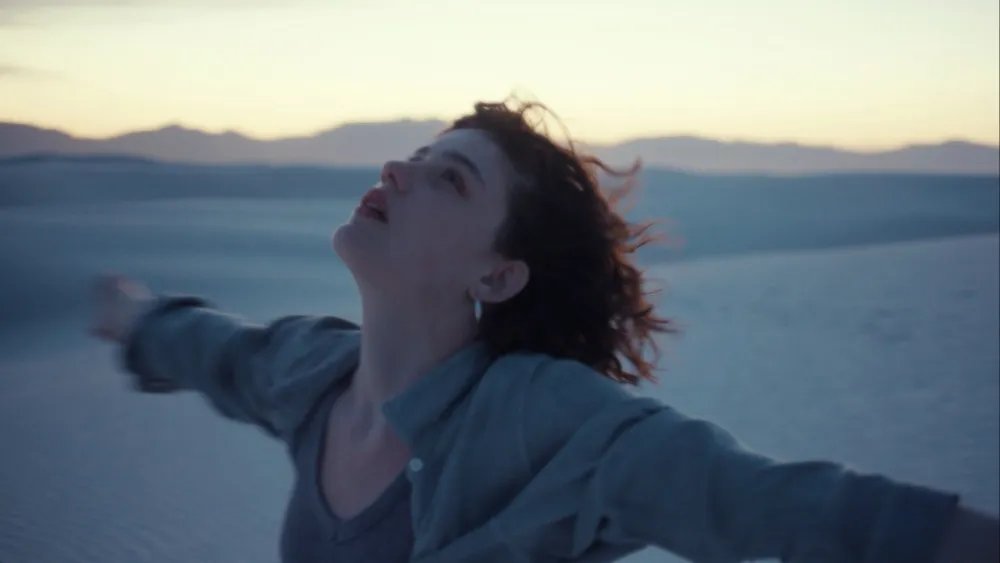
The film opens on a plane-window view of the New Mexico desert that is almost surreal in its scorched, arid minimalism — from above, the region’s dry mountains fold and wrinkle like bare, sun-reddened flesh. It’s a suitably otherworldly introduction to the U.S. for young Franny (Naomi Cosma, a striking newcomer with something of the young Nastassja Kinski about her), who’s rather more accustomed to the lush forests of her north German home in Brandenburg, but is eager to embrace all that is new to her.
Her host family doesn’t make that altogether easy. Initially cheery, her God-fearing homestay mom proves increasingly parochial and hostile, glancing with disapproval at Franny’s secular books and snapping when she chats in German to a fellow exchange student. The situation only worsens after 9/11, the immediate, unreal impact of which Rivilis sharply captures with a steady pan across a classroom of stunned students, their faces in various states of stricken disbelief, if not simply in their hands. The panicked inadequacy of a “thoughts and prayers” school intercom announcement strikes a poignantly banal note, as does — from Franny’s non-participating perspective — the eerily formal ritual of a standing Pledge of Allegiance immediately afterwards.
The catastrophe certainly alters Franny’s view of a country she’s trying to belong in: Bad jokes like an oafish fellow student calling her “Nazi girl” land even more awkwardly in this ruptured social landscape, and as America collectively closes ranks, she feels, more than ever, on the outside looking in. But, as the title plainly states, she has another nine months there, and all is not lost: She’s 16, after all, and times of crisis are hardly going to stop 16-year-olds from doing what they do, and should. She befriends hard-partying cool girl Sam (Bianca Dumais) and soon enough finds a loyal social group who aren’t fazed by her otherness.
Whether her characters are out drinking or hanging at home, Rivilis has a keen ear for the loose, giddy, sometimes very earnest rhythms of girl talk, and a crucial awareness of cultural difference beyond the superficial or linguistic: Franny gradually realizes that her very sense of selfhood is not American, and her vision of her future very different, and considerably more ordered, than that of her new friends.
That rift is evident, too, in the heady, obsessive relationship she forms with depressive young musician Elliott (David Flores), whom others try to warn her off, and which can only end in a necessary but less exciting rite of passage: first disillusioned heartbreak. If this strand of her narrative isn’t as affecting as it might be, that’s in part because Flores, appropriately moody but somewhat stiff, is no match for Cosma, whose coltish, funny, feeling-all-kinds-of-ways-at-once performance is right in line with the film’s mercurial tonal variety.
Franny herself keeps a record of her conflicting experiences and rolling emotions via a turn-of-the-century camcorder, and the film deftly blends that scuzzy, roving video aesthetic — as perfectly in period as the dead-on, navel-skimming costumes, or a key P.J. Harvey karaoke selection — with the more extravagant poetry of DP Giulia Schelhas’ surprisingly lush digital lensing. The film’s images find a saturated romanticism in the sunset hues and midnight blues of the surrounding, seemingly infinite and defiantly waterless landscape, and thus an apt visual language for the big, inchoate emotions that our heroine feels but can’t always wrangle or articulate. They’re a reminder, too, that America is far bigger than its smallest people: a land of eternal adventure and discovery, for residents and outside explorers alike, even at its lowest ebb.