By now, you’ve likely heard the often-repeated fact that the NBA has not had an American MVP since James Harden in 2018. Since then, Giannis Antetokounmpo (Greece) has won twice, Nikola Jokić (Serbia) has won three times, Joel Embiid (Cameroon) won once, and in the past two seasons, Shai Gilgeous-Alexander (Canada) has picked up back-to-back trophies. That streak alone doesn’t quite do the American drought justice.
There are five active American players who have won MVP awards: LeBron James has won four, Stephen Curry has won two and both Kevin Durant, James Harden and Russell Westbrook have won one apiece. All four of those players are at least 36 years old. How much longer are any of them going to play?
James won his first MVP award in his age-24 season. Victor Wembanyama will be 23 next year. If he starts winning his trophies next year — and, right at this moment, it seems like he will — there is a feasible scenario in which those four American winners all retire before a new American MVP emerges. We might one day soon live in an NBA without a single active American-born MVP.
So all of this raises two interesting questions: how long will we have to wait for an American MVP, and who will that player be? Is he even in the NBA yet? Let’s take a stab at answering those questions.
So… is Wembanyama going to sweep the next decade of MVPs?
This is a tempting narrative. History says it’s enormously unlikely, even if he is among the most talented players in NBA history.
Remember, Michael Jordan only won five MVPs. James won four. Kareem Abdul-Jabbar won six. Let’s put those numbers in a bit more perspective. Jordan won his first MVP in 1988. Between 1988 and 1998, he played nine full seasons and won MVP in five of them. So even peak Michael Jordan, exclusively in the window in which he won his MVPs, only had a 55% or so chance of winning MVP in a given year. Perform this exercise with Abdul-Jabbar and you get a 60% hit rate. No player in NBA history has ever been a guaranteed MVP winner, even at his best.
There are a number of reasons for that. Voter fatigue is one of them, and its effects are relatively proven. Team circumstances, bad shooting variance, luck, all of these things can swing an MVP race even away from the NBA’s best player. In Wembanyama’s case, there’s a more concrete barrier: the 65-game rule.
Victor Wembanyama leads Spurs to Game 1 win vs. OKC: Ranking Wemby’s top five plays from 2OT masterpiece
Jack Maloney
Forget about how likely Wembanyama, specifically, is to play 65 games in a given season. How likely is any player to play 65 games? It depends on your definition, but the answer is less than you think. Of the 569 players to appear in a game in the 2024-25 season, only 169 played 65 games. Even if you filter out the 10-day players and the back-of-the-rotation non-factors, the numbers are still sparse. A total of 271 players last year started at least 10 games. If you’re starting 10 games in a season, odds are, you’re a legitimate NBA player. Within that group, around half, 140, got to 65 games. It’s a toss-up for almost anybody. For someone at Wembanyama’s size, the odds probably get worse.
Wembanyama has thus far been more durable than skeptics have expected, but it just isn’t that hard to fall short of the 65-game threshold. When you put all of this together, Wembanyama’s best-case MVP outcome during his prime is probably winning the trophy around half of the time, and since so few players even got there, it’s probably likelier that he wins it a handful of times, but doesn’t completely own it for the foreseeable future.
If not Wembanyama, what are we looking for in MVP winners?
The MVP award has grown somewhat formulaic in recent years. Since James won his third trophy in 2012, every winner has checked two boxes. The first is age: he is always between his age-24 and age-28 season. The second is prior stature. Every MVP in this window was either a First- or Second-Team All-NBA selection in the prior year. Essentially, you have to already be a top-10 player before you become an MVP, and the load-management era is so unkind to older players that the window in which players can win it is limited to their mid-20s.
Those are the biggest indicators, but they’re not the only ones:
- MVPs need to score. Every winner in this window has averaged at least 25 points per game except for 2015 Stephen Curry, who only failed to do so because his team blew opponents out so frequently that he rested most fourth quarters.
- Winning is no longer an absolute, but it still holds quite a bit of sway. This century, we’ve had 18 MVPs from No. 1 seeds, five from No. 2 seeds, two from No. 3 seeds and two from No. 6 seeds. You can win without being a high seed, but it usually takes extenuating circumstances. Russell Westbrook defied 50 years of NBA history by becoming the first player since Oscar Robertson to average a triple-double. Jokić led his team to the playoffs without its second- and third-best players.
- Even beyond the 65-game rule, availability tends to factor into these races prominently. Since the media took over voting duties from the players in 1981, only two MVPs have missed more than 11 games: Joel Embiid three years ago and Gilgeous-Alexander this season.
So which American players fit the bill?
Well, for starters, you could argue that next year’s window is wide open. Wembanyama will still be a year shy of our ideal age window of 24-28. Gilgeous-Alexander will still be within that window in his age-28 season… but nobody has won three straight MVPs since Larry Bird, and that has become a somewhat sacred bit of history. Three-peat candidates are always held to a higher standard simply because Jordan and James never got to do it. However, even if you eliminated both from contention, you’d probably still land on an internationally born favorite: Luka Dončić, going into his age-27 season, just finished in fourth place behind three of his international contemporaries.
If you’re looking for an American candidate next season, it’s Cade Cunningham. He just entered the age-window this season. He has the advantage of playing in the Eastern Conference, making it easier to earn a top seed (which he just did). The only notable mark against him was his scoring volume. At 23.9 points per game, he fell below our benchmark of 25. However, he played on an offense without another 20-point scorer that ranked 29th in 3-point attempt rate. Get him some help and better spacing and he can probably cross that line. He averaged over 26 points in the 2024-25 season.
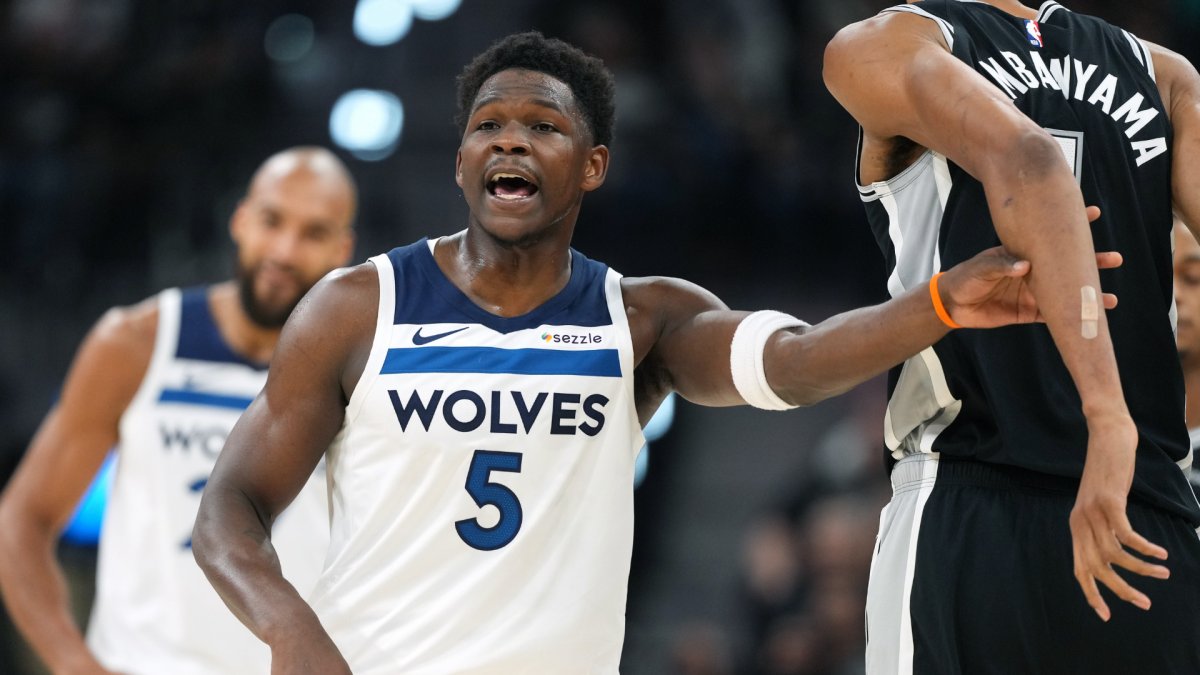
Anthony Edwards checks the scoring box and the age box. He almost certainly won’t check the seed box or the extenuating circumstances mini box. Minnesota was a No. 6 seed this season. You can probably therefore cross him off for now, but I think he specifically becomes an interesting far-out candidate for the 2029 MVP award.
Why? Two reasons. First, if you believe Wembanyama is the favorite in 2027 and 2028, he runs into the Larry Bird wall in 2029. Second, and more importantly, if the NBA votes to expand this summer, the plan would presumably be for two new potential teams to join the NBA for the 2028-29 campaign, and if those teams play in Seattle and Las Vegas, they will be in the Western Conference. That opens the door for a Western Conference team to move East, and given Minnesota’s proximity to the entire Central Division, they’re a likely candidate here. While the West’s superiority over the East is overstated as a whole, the mere presence of the Thunder and Spurs makes a top seed in the West difficult for Minnesota. In the East, depending on roster construction, Minnesota could get there.
Let’s jump forward a bit. Wembanyama’s historical age window closes with the 2032-33 season. We know next to nothing about what the NBA will look like at that point… but we do have an idea of who some of the best players between the ages of 24 and 28 will be by then. Essentially, you’re looking at the best players from the 2024 and 2025 draft classes. No one in that 2024 class beyond Wembanyama has flashed MVP potential, save perhaps Stephon Castle, who’s hamstrung by the fact that he plays with Wembanyama himself. The same goes for Dylan Harper a year later. But Cooper Flagg will be in that age window, and we’ll see who else develops in those classes.
2026 NBA Mock Draft: Clippers take a huge swing at No. 5, Darius Acuff falls to Kings at pick No. 7
Cameron Salerno
And then there are the players who aren’t even in the league yet. The widespread belief going into the 2026 NBA Draft is that four players have All-NBA upside: AJ Dybantsa, Darryn Peterson, Cameron Boozer and Caleb Wilson. All four are American. Three of the teams drafting in that range, the Wizards, Jazz and Grizzlies, are operating with substantial enough asset surpluses to pretty believably build a financially sustainable contender quickly. The Wizards, being in the East, have the cleanest path to a high seed, so their pick has the best chance of entering the fray.
And on top of all of this, we have yet to acknowledge a critical point: MVPs are rarely surprises by the time they win, but they usually are along with the way. Antetokounmpo was the No. 15 pick. Gilgeous-Alexander went No. 11. Jokić was picked in the second round. These were not players the world expected to win MVP trophies. They developed into MVPs fairly surprisingly. There’s a good chance the next American MVP falls into that bucket. Some player we don’t see coming will grow steadily over the years before eventually mounting a case. Whether that happens soon enough to avoid an NBA without an American MVP, we can’t say.