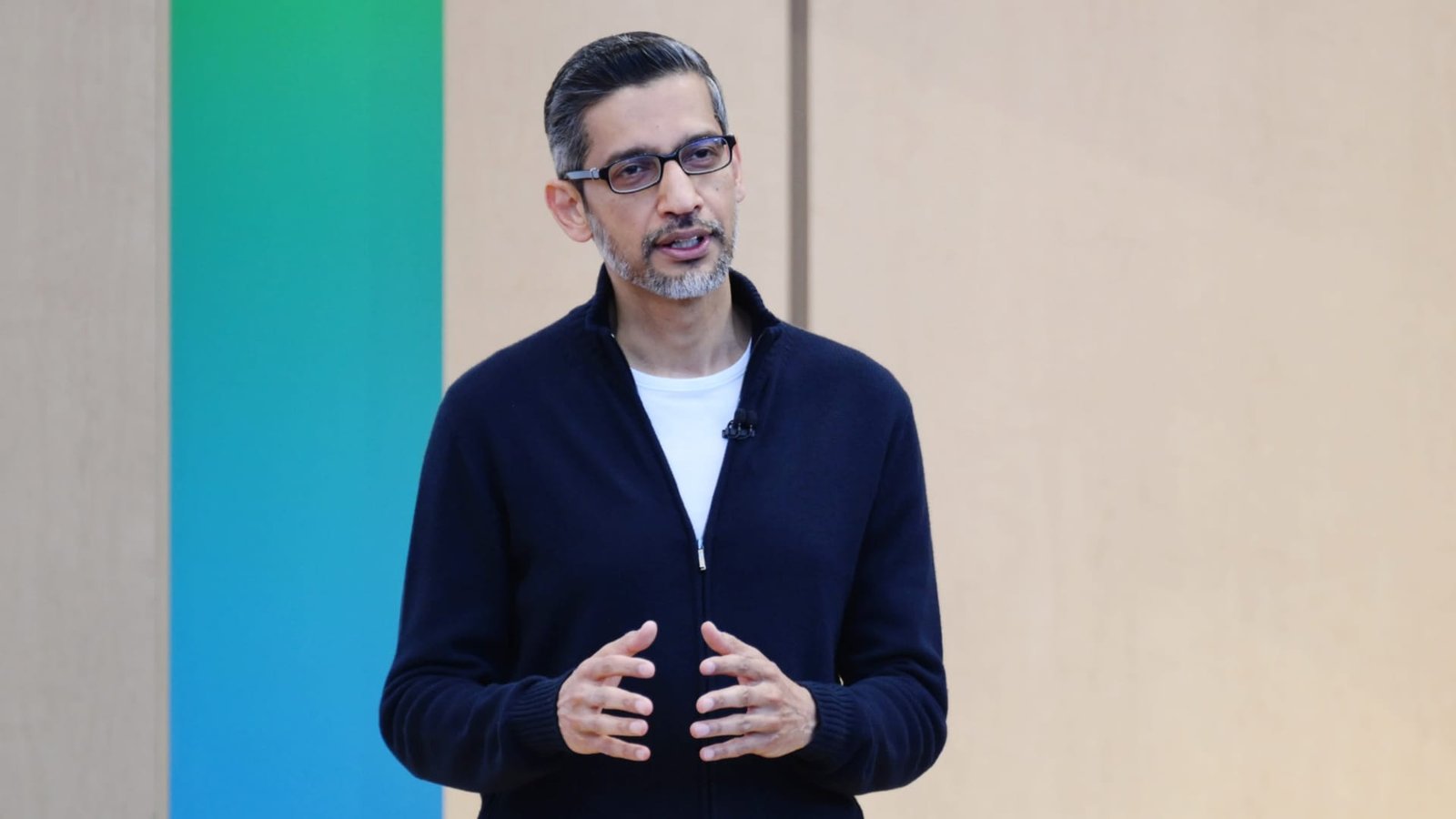
Sundar Pichai, chief executive officer of Alphabet Inc., during the Google I/O Developers Conference in Mountain View, California, US, on Tuesday, May 19, 2026.
David Paul Morris | Bloomberg | Getty Images
Google is rolling out its latest version of Gemini and a new artificial intelligence model designed to simulate the physical world, as the search giant races to keep pace in model development while also providing more agentic services to its massive user base.
The company made the announcements at its annual Google I/O developer conference on Tuesday, gaining an audience for new product debuts at a time when the market has been focused on the soaring valuations of OpenAI and Anthropic, which are both gearing up for IPOs as soon as this year.
The centerpiece of Google’s AI strategy is Gemini, its family of models and tools. The company is showcasing Gemini 3.5 Flash, a lighter-weight addition to its suite that offers cutting-edge capabilities at half, or in some cases close to one-third, the price of comparable frontier models, according to CEO Sundar Pichai.
In a news briefing with reporters ahead of Tuesday’s event, Pichai said Gemini 3.5 Flash is “remarkably fast.” The company said 3.5 Flash will now be the default model for the Gemini app and AI mode in search globally.
“You no longer have to trade quality for latency,” Google said in a blog post. The company said that it’s strengthened the cybersecurity defenses for Gemini 3.5 Flash, so it’s “less likely to generate harmful content and mistakenly refuse to answer safe queries.”
Google said Gemini 3.5 Pro, its heavier-weight version, is being used internally, but won’t be ready for wider distribution until next month.
On the agentic AI front, Google announced Gemini Spark, a new general purpose AI agent in the Gemini app that can reason across information in connected apps. Google said it wants to help users navigate their digital lives by taking “action on your behalf while under your direction.” Gemini Spark is in beta and will be available first to trusted testers and Google AI Ultra subscribers, starting next week.
With more internet users gravitating to chatbots, Google is trying to convince traditional search users that it can be trusted to help them with tasks involving minimal input. Following the company’s skyrocketing capital spending, Wall Street is looking for Google to show it can create deeper integrations across its products, and agents could be a way to do that.
Expectations for AI companies continue to grow, particularly in light of Anthropic’s recently released Mythos model, which was said to be so powerful that it’s found thousands of previously unknown vulnerabilities in the world’s software infrastructure.
Google’s AI portfolio now includes Omni, a world model designed to simulate physical environments, predicting what happens next based on a user’s actions. World models are often used in robotics and gaming and have been heavily researched by DeepMind through the years.
Omni will work in Flash, the Gemini App, Google Flow and YouTube shorts, supporting image and audio, the company said, adding in a separate blog post that users can make Omni edit videos and create more realistic imagery.
“Take a video you shot and just ask Omni to change what’s happening,” the post says. The AI can “edit the action, add in new characters or objects.”
WATCH: What to expect from Google I/O