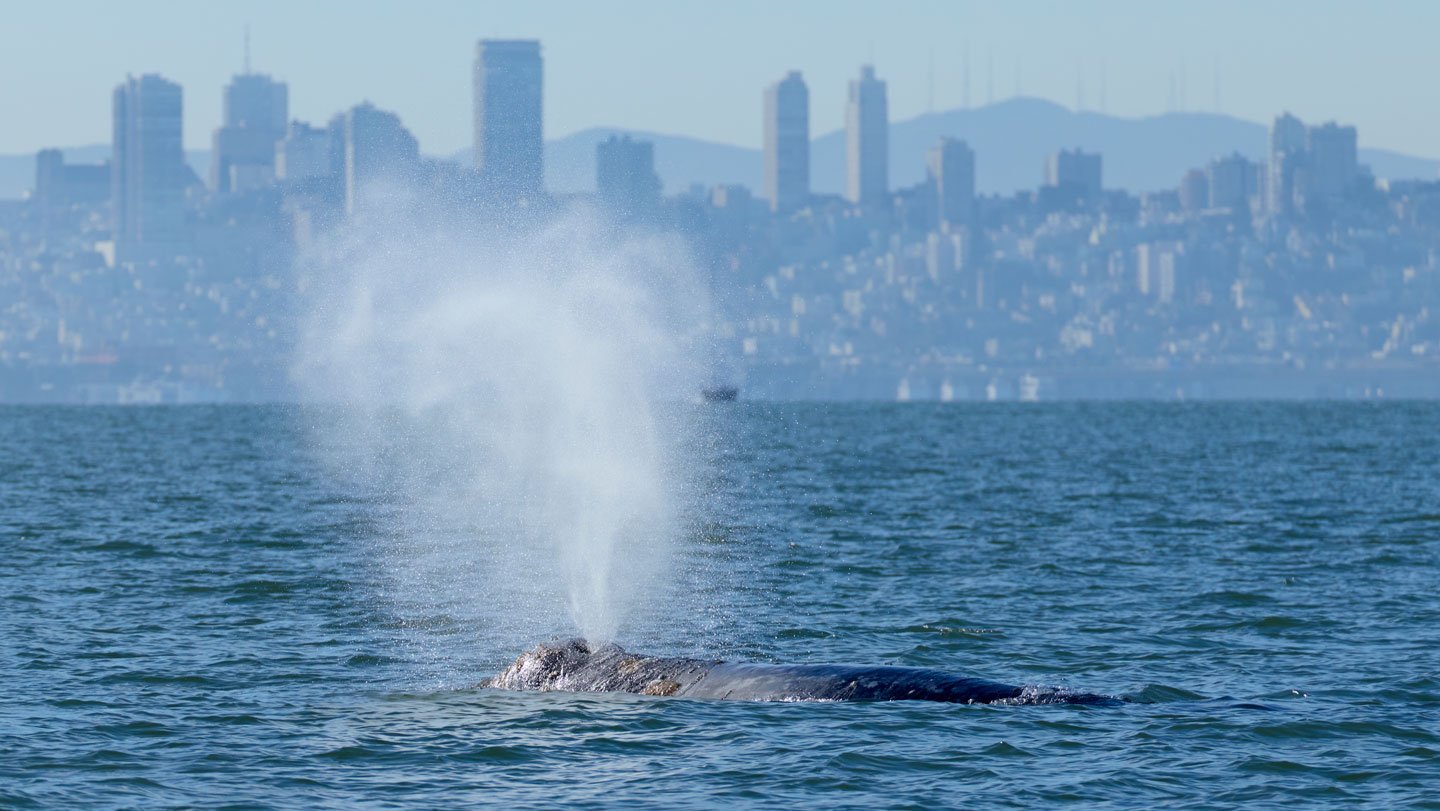
An AI-powered monitoring system could save the lives of gray whales that are increasingly taking a deadly detour into California’s heavily trafficked San Francisco Bay.
The new technology combines round-the-clock thermal cameras deployed at different locations in the bay with AI to detect whales that may be as far as 7 kilometers away. Once the whale detection is confirmed by scientists, an alert goes out to warn vessels in the area to slow down or change course to avoid a collision.
A coalition of ocean scientists, the U.S. Coast Guard, whale tracking experts and local ferry companies unveiled the deployment in the bay on May 19. A camera mounted on a radio tower on Angel Island within the bay will monitor numerous busy shipping routes. A second camera will be installed on a passenger ferry that crosses the bay daily, and future additional camera sites could include the Golden Gate Bridge and Alcatraz.
The whale-detecting AI-powered tech is the brainchild of researchers at the Woods Hole Oceanographic Institution, or WHOI, in Massachusetts, who later created a company called WhaleSpotter to market the tech. “We wanted to be able to detect whales so far out that it would give mariners time to take action,” says Daniel Zitterbart, a physicist at WHOI and the chief scientist of WhaleSpotter. That’s particularly important for large ships, such as container vessels, that have a great deal of inertia and can’t quickly change course.
Developing a reliable whale detection system took about 15 years, Zitterbart says. Water emitted from whales’ blowholes, or the whales’ bodies themselves, is warmer than the ambient water by about 2 degrees Celsius. So the researchers used hundreds of thousands of thermal images to train the AI to recognize those relative temperature differences as signifying a whale. Then, when there’s a detection, a WhaleSpotter researcher will verify the data, to minimize false positives. Once verified, an alert is sent to any vessels nearby.
“We want as many deployments as possible, because that ultimately means we have better eyes on the ocean,” Zitterbart says. “Shipping is not going to disappear. We need to have a tech that allows us to use the ocean, but also allows the whales to go about their lives.”
In 2025, 21 gray whales (Eschrichtius robustus) were found dead in and around San Francisco Bay; two-fifths of those deaths were due to ship strikes, researchers say. The deaths are part of a disturbing trend that researchers first observed in 2018: The whales were increasingly making a pit stop in the bay along their 16,000-kilometer-long migration southward from their feeding grounds off Alaska’s coast to their mating grounds near Mexico.
The whales were likely hungry. In the Arctic, they feed on tiny crustaceans called amphipods in ocean sediments; those amphipods, in turn, are nourished by algae that grows on the underside of sea ice. Climate change is rapidly melting that sea ice, disrupting the food chain.
Gray whale populations declined dramatically from about 20,500 in 2018 to about 14,500 in 2023. Hundreds of whales were found stranded along the North American west coast. Many of those whales were suffering from malnutrition. So, to sustain themselves for the rest of their migration, they have been heading into the bay looking for food.
“It is heartbreaking to see these starving whales stumbling around in the middle of the hustle and bustle of San Francisco Bay,” University of California, Santa Barbara marine ecologist Douglas McCauley said May 19 in a news release. McCauley is the director of UCSB’s Benioff Ocean Science Laboratory, one of the coalition partners that developed and is deploying the new technology. “Every day is a nail-biter.… This new system will save whales’ lives.”
Josephine Slaathaug, a whale biologist at Sonoma State University in Rohnert Park, Calif., says she hopes this technology will be a “huge leap in the right direction to protecting whales in San Francisco Bay.”
“I’m cautiously optimistic,” Slaathaug says. “I’m very glad that the vessel strike issue is being taken seriously.” And it’s especially heartening, she adds, to see so many different organizations and partners — including the shipping industry — working together to develop a science-based, long-term solution.