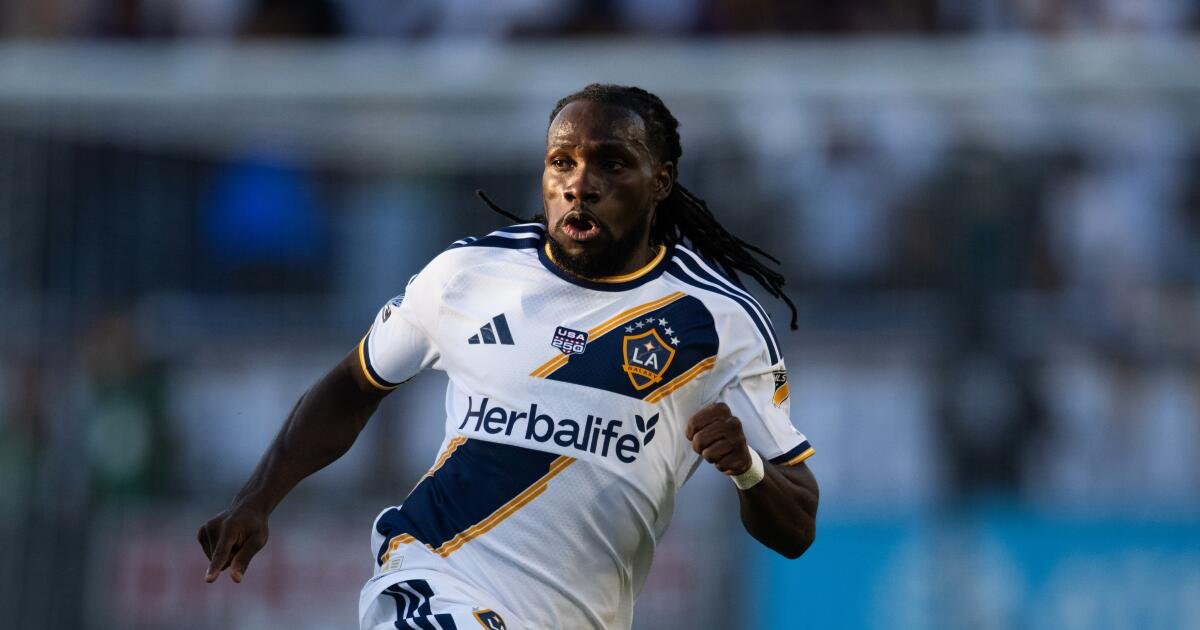
Joseph Paintsil is still hopeful he’ll get the phone call he’s always dreamed of this week, the one telling him he’s made Ghana’s World Cup team.
That looks like a long shot at this point, though it would be a just reward for the sacrifice, for the blood, sweat and tears the Galaxy winger has put into becoming one of his country’s best players, one good enough to play in World Cup qualifiers and start in the Africa Cup of Nations.
But the cheers would probably be loudest at the residential soccer academy Paintsil founded in Ghana last summer. There, about 50 boys, aged 7 through 18, not only get soccer training, but are fed and go to school — all the things Paintsil often went without as a child growing up in Accra, the tightly packed capital of a country where much of the population lives on $2 a day.
“The reason why I want to give back is all about what I passed through, what I faced growing up,” he said. “I did this because I want [to help] those people who are really in need, those people who are really suffering and people who don’t have that ability. There are some families that, it’s really difficult for them.”
Making the World Cup team will help in that effort by significantly raising Paintsil’s profile, which could open the door to more funding and allow him to expand the project.
“It’s just an independent thing that I made, like a foundation,” he said. “Going forward, we’ll add some women also to it, to make it a great thing. So everything is on its way and everything is coming together.”
For the time being, Paintsil is funding much of the academy’s work on his $4.5-million salary with the Galaxy, although Herbalife, the team’s longtime shirt sponsor, is helping with a sports nutrition program. The staff includes three coaches, an athletic trainer and a trustee to manage the place, Paintsil said. In addition to soccer training, the children are also required to attend classes at a local school.
“It’s not only about football,” Paintsil said. “It’s also about the education. We put them in schools and we make sure that they focus on school and not only on football.”
Paintsil’s academy is part of a long tradition of African soccer players generously giving back to the communities that produced them. Liverpool star Mohamed Salah has built a water treatment plant and funded an ambulance unit in his Egyptian hometown of Basyoun, while Nigerian international Ahmed Musa built multi-million-dollar sports complexes in two cities in his homeland.
Nwankwo Kanu, a two-time African player of the year and UNICEF goodwill ambassador, provided hundreds of free open-heart surgeries for children across Africa while Didier Drogba, also a two-time continental player of the year and a U.N. goodwill ambassador, has built hospitals and medical clinics in his native Ivory Coast, where he has also raised significant money for healthcare through his foundation.
Drogba is so well-respected at home that after he helped Ivory Coast qualify for the 2006 World Cup, he went on TV and asked the combatants in the country’s bloody civil war to lay down their arms — and they did.
And that’s just the top of a giant pyramid of charitable work built by African players. But the continent’s greatest soccer humanitarian, the true GOAT, is Sadio Mané of Senegal, who has funded a hospital, a secondary school, a gas station and a post office in his tiny hometown of Bambali, where he grew up hungry and poor. Since becoming a professional athlete, Mané has also supplied the school with free laptops and internet service and paid a monthly stipend equal to Senegal’s minimum wage to each family in the town.
But perhaps the biggest contribution he made is simply the inspiration he’s provided others.
“He made a comment that I don’t want to be recognized as a football player. I want to be recognized by helping the people,” Paintsil said. “That’s the same philosophy that I have. Even if it’s small, I’m still putting smiles on people’s faces.”
Paintsil, 28, has been putting smiles on people’s faces in Southern California too. Since joining the Galaxy on a $9-million transfer from Genk of Belgium’s Pro League, he has twice scored 10 goals in a season, helping lead the Galaxy to their sixth MLS Cup in his first season.
“What he gives us is he’s fast as hell, and he can run behind anybody from anywhere at any moment,” said Galaxy coach Greg Vanney, who has used Paintsil as a winger and a center forward. “It gives the opposition something they have to respect at all times.
“With his pace and direct running, he creates chances nobody else can.”
But Paintsil has also battled injuries that forced him to miss 18 games in 2½ seasons, injuries that have also limited Paintsil’s opportunities with Ghana’s national team. His last call-up was for October’s World Cup qualifier with Comoros, in which he played the final 16 minutes off the bench.
Paintsil was unsure how his status would be affected by Ghana’s decision to replace longtime coach Otto Addo with Portuguese manager Carlos Queiroz last month, just 60 days from the start of the World Cup. The best course of action, he decided, was to keep his head down and play hard.
“My job is to just stay the same and show up ready, especially in my club. It’s always my dream to be on the World Cup [team],” said Paintsil, who felt he was snubbed when he was left off Ghana’s roster four years ago in Qatar. “I’m preparing like I will be on that plane.”
That dream appears unlikely to be realized in this World Cup as well since Paintsil was not included in the roster Queiroz summoned for Friday’s friendly with Mexico, the only game Queiroz will manage before his World Cup roster must be set. The Galaxy also have a match this weekend and the club isn’t required to release players to their national teams until Monday.
Missing the tournament once again would be crushing, but if that happens, he’ll get over it, he promised. Because playing in the World Cup isn’t the achievement he wants to be remembered for anyway.
“Football is not for everyone,” he said. “Some people who play football become doctors. That’s why we need to mix education, nutrition and football, because if football doesn’t help, education is going to help. So we just always do this so that when they reach to the highest level, they can be like, ‘Oh, OK, what Joseph did, what Sadio Mané did, it’s something that I also want to do.’
“So it’s a legacy that I’m trying to leave behind, so that the other children can also look at the legacy and build on it in the future.”