Sara Ishaq’s highly anticipated fiction debut “The Station” is the multi-layered feature we’ve been hoping would follow her impressive 2013 documentary “The Mulberry House.” Much has changed in Yemen — for the worse — over the past decade, and the country’s absence on screen apart from one-dimensional news reports puts extra pressure on any filmmaker looking to humanize its population. Ishaq is aware of this responsibility but not straitjacketed by a need to “explain”: Instead she’s made a film peopled with women and boys who go beyond simple archetypes, setting joyful female solidarity against omnipresent conflict in a way designed to communicate with a broad demographic.
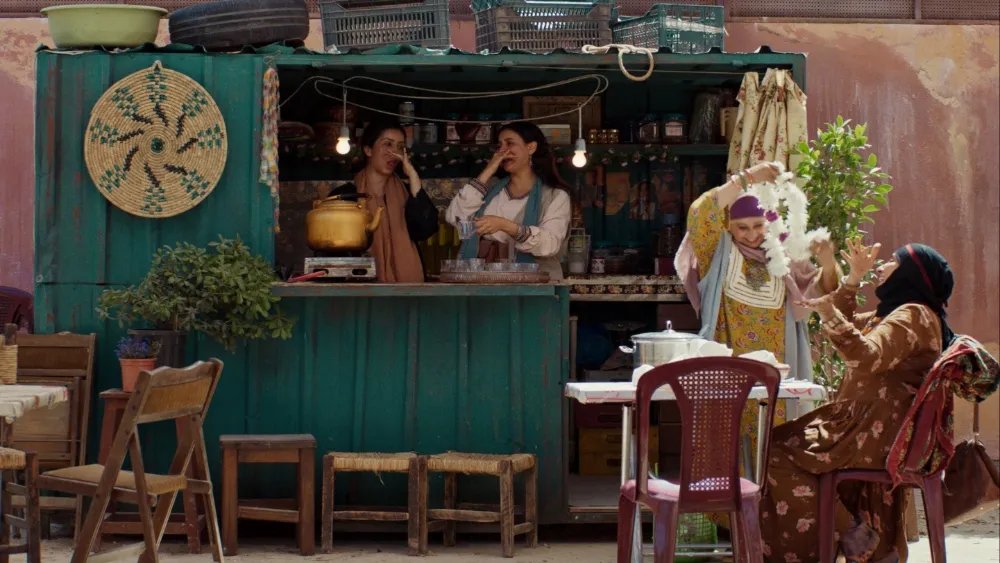
Given the film’s strengths, it’s frustrating to see how Cannes’ main sections once again ignore Arab content (especially this year); their loss, since “The Station” is bound to be one of the buzzier titles in Critics’ Week. The titular locale is a women-only gas station whose resourceful owner Layal (Manal Al-Mulaiki) creates a safe space offering contraband lingerie and girl talk alongside severely rationed gasoline, though it’s the comfort of mutual support away from religion and politics that draws the women back day-by-day.
While the early scenes radiate the relaxed ease of sisterhood escaping a harsh reality, the tone shifts to a darker register, both emotionally and visually. We’ve seen these sorts of female-only spaces before in films set in Muslim-majority countries (“Caramel” is but one of many examples), and though there is a familiarity in the emotional warmth, “The Station” has a specificity that ensures it doesn’t feel derivative.
A masterful brief tracking shot opens the film as women dressed in the long black sharshaf and niqab walk into town or line up in their cars, offering a rapid introduction to an environment devoid of men, where the loud whoosh of fighter jets invade the soundscape and walls are plastered with flyers of adolescent boys proclaimed martyrs. “No men, no weapons, no politics” is the sign outside the station, making it a liberating space where temporary escape from the civil war feels possible. Inside, Layla gets things ready with the help of her 12-year-old brother Laith (Rashad Khaled), who unthinkingly sings along to the jingle-like propaganda song coming from the radio while some of his peers outside play at being soldiers.
To gain entry to the station’s courtyard, the women must remove their niqabs and the armbands identifying which side they’re on in the conflict. Inside is another world, of laughter, softness and friendship: Some women smoke sheesha, while sassy older Jamila (Fariha Hassan) sells wigs and makeup. The lightness abruptly ends with the arrival of Umm Abdallah (Shorooq Mohammed), conservative wife of the local sheikh, come to inform Layla that she needs to pay a significant fee to keep Laith at home; otherwise, he’ll be sent to fight like all boys when they reach his age. In desperation, Layla calls her estranged sister Shams (Abeer Mohammed), living in territory governed by the other side. Controlling forces insist she be accompanied by a male chaperone, in this case 13-year-old Ahmed (Saleh Al-Marshahi), tall as an adult but still very much a boy.
The script, by Ishaq and Nadia Eliewat (Sophie Boutros’ “Solitaire”), offers a satisfying duality in the pairing of the sisters alongside the two boys. In a society where the men are either fighting or dead, the women are forced to assume the role of protectors — even though it’s Laith and Ahmed, for all intents and purposes still children, who are expected to fight. Layla and Shams have become canny in learning how to survive, but Shams wasn’t able to save their other brother Tareq or her husband, both of whom were killed. That’s the source of tension between the sisters, and Layla is determined, at all costs, to ensure Laith doesn’t meet the same fate.
While the taut relationship between the sisters is an effective, time-tested plot device, more surprising is the way the script fleshes out the two boys. Laith is starved for playmates and nurturing male company, self-conscious of his awkward position as the sole male in an otherwise all-female environment. The friendship that quickly develops between him and the initially ambiguous, ungainly Ahmed is completely natural and yet its very normalcy highlights the disrupted world around them, where childhood’s customary development is strangled and boys are forced to be “men.”
“The Station” subtly weaves in such quietly effective moments, including a stand-out scene towards the end when the women use their hijabs to protect their space against angry (and unseen) men. Its satisfying resolution reminds us just how rare it is to see a film acknowledging the power women can derive from an item of clothing almost exclusively seen in the Global North as a sign of oppression.
So well-cast are all the performers that viewers will forget they’re almost entirely non-professionals. That couldn’t have been easy for such a long-gestating project, requiring a significant amount of workshopping in a country that wasn’t their own: For obvious reasons, “The Station” was shot in Jordan. Yet the ease of the dialogue, the sense of spontaneity and warmth, equally natural in the most strained moments, never falters. Cinematographer Amine Berrada proved he knows a thing or two about light in the 2023 Cannes competition entry “Banel & Adama,” and here he works with honeyed tonalities at the start — appropriate, given that Yemen’s honey is arguably the best in the world. His fluid camera, observational without being intrusive, expertly delineates the safe space of Layla’s courtyard, shifting registers as things get darker until near the end, when jumbled night reinforces the tense uncertainty.