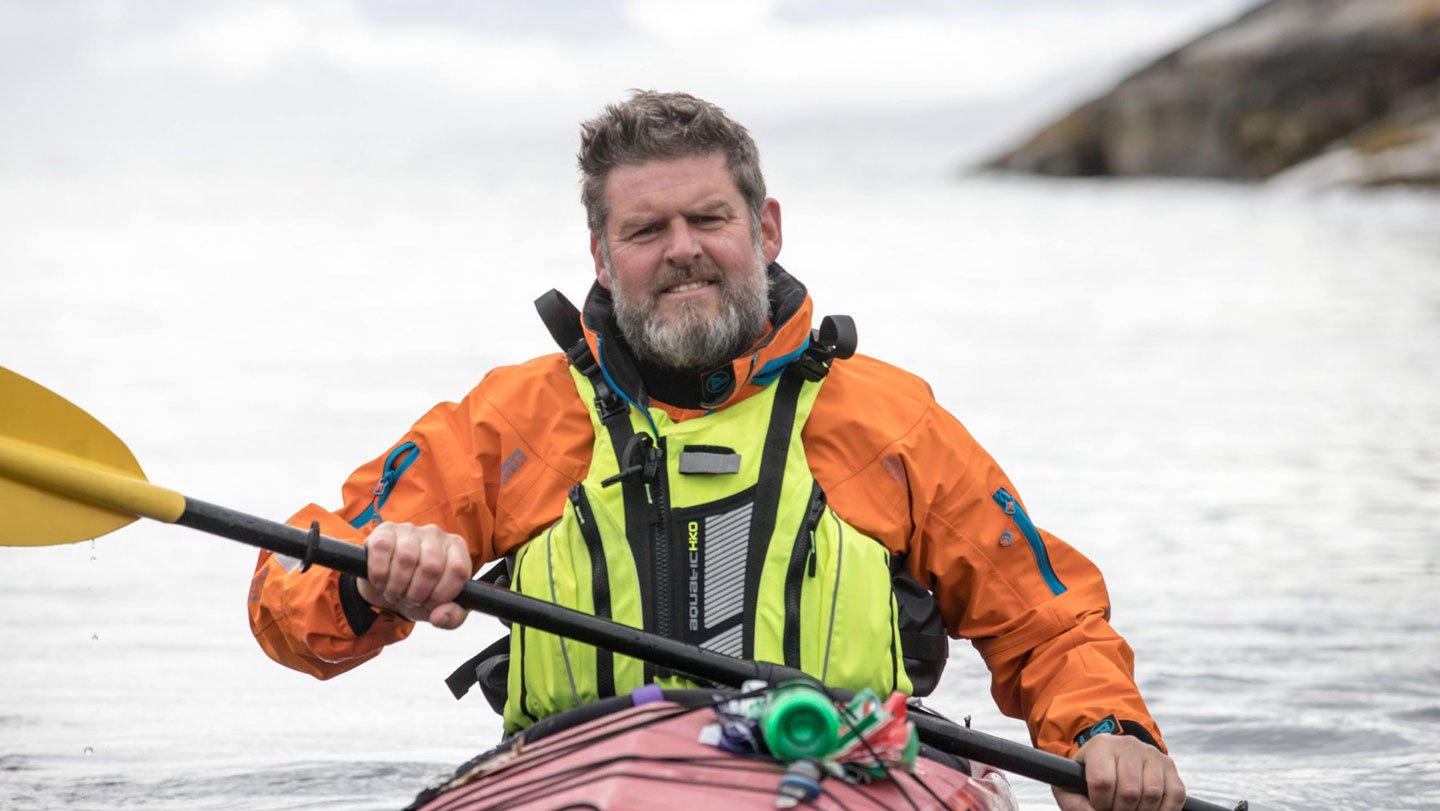
This spring, British explorer and chef Mike Keen will spend roughly a month skiing across Greenland with a sled dog. Along the way, the duo will subsist entirely on slowly decomposing seal meat.
Keen’s roughly 320-kilometer ski across the country’s icy north serves as a loose proxy for how past Inuit and other arctic peoples might have survived similar treks across barren landscapes.
The journey is part renegade chef experiment – “Is there a line between … fermented or rotten?” wonders Keen, who lives in Suffolk – and part scientific endeavor. For the latter, he’s collecting fecal samples from himself and the dog throughout the journey. That way, researchers can see how shifting from a Western diet to a traditional Inuit diet alters the microbes in his gut, or gut microbiome.
Western diets are high in processed foods and fresh fruits and vegetables that can’t grow in the frigid Arctic. By comparison, the traditional Inuit diet consists of 98 percent meat, says Inuit microbiologist Aviâja Lyberth Hauptmann of the University of Greenland in Nuuk. Today, high-meat diets have been linked with cancers, digestive disorders and heart disease. But before a few decades ago, when food imports from Denmark became commonplace, Inuit people ate mostly meat and almost no plants without such issues, Hauptmann says.
Hauptmann’s hypothesis is that the underappreciated practice of fermenting meat, often for months, enhanced the meats’ microbial diversity and, in turn, the gut health of people eating such foods. “There is a way to live healthily off an animal-sourced diet,” she says. “We are missing an understanding of what that looks like.”
A history of fermented meats
This isn’t Keen’s first Greenland rodeo. A few years ago, while working as a professional chef, Keen got interested in making Parma ham, a traditional Italian meat that is uncooked and cured in salt for several months. But his plans ran afoul of health regulations. “How is not safe?” Keen wondered. “Cured meats are big all over the world.”
The question stuck with him. So Keen, an adventurer at heart, planned a 12-week kayaking trip across Greenland. He reached out to Hauptmann, and the two agreed to collaborate to see how eating exclusively traditional Inuit foods, including raw and fermented animal meats, altered his gut microbiome.
“I didn’t eat a single fruit or vegetable,” says Keen, who released a documentary about that expedition, Qajaq Man, earlier this year.
This time around, Hauptmann and Keen are zooming in on fermentation and gut health. Inuit people ferment many meats, including walrus, caribou, reindeer and, of course, seal. Collectively those fermented meats are called igunaq. An Inuit delicacy,kiviak, is made by stuffing small birds inside seal hides and burying them under rocks for months.
Even today, most people assume that the line between fermented and rotten is clear. Fermented foods are those that microbes broke down in a gradual, controlled way. Rotting, spoiled foods have become too dangerous to eat due to runaway microbial growth. But people the world over have long eaten fermented meats, often to the edge of safety, archaeologist John Speth reported in 2022 in PaleoAnthropology.
Fermented meats and other foods probably served an evolutionary purpose, research suggests. Like cooking, the process frees up nutrients in foods, making them easier to digest, researchers wrote in 2023 in Communications Biology. But fermentation, which lets microbes do all the work, requires much less labor.
One would assume that our ancestors regularly got sick from eating such foods, says Speth, of the University of Michigan in Ann Arbor. But he has unearthed few references to botulism or other foodborne illnesses. Indigenous practices fine-tuned over centuries or millennia protected communities, Speth and others suspect.
Researchers worry that as Indigenous dietary practices are now disappearing, so too are ancient food safety practices. For instance, for reasons that aren’t entirely clear, cases of botulism began to appear in Alaskan health records several decades ago, as people shifted from fermenting meats below ground to fermenting them above ground in containers, Speth says.
Keen has a plan for how to keep dangerous pathogens at bay. After deboning seals procured for him by area hunters, he will wrap the seal meat back in their skins. He will then place those bundles atop an insulated blanket to keep the meat’s temperature just above freezing. “If it [ferments] too fast … you’ve got the risk of botulism,” Keen says.
Case study
After every bowel movement during his trek, Keen will collect stool samples from himself and the dog. He will also slice off a sliver of seal meat. He will then send all those samples to Hauptmann, so she can compare changes to microbial DNA in the seal as it decomposes to those in the human and dog samples.
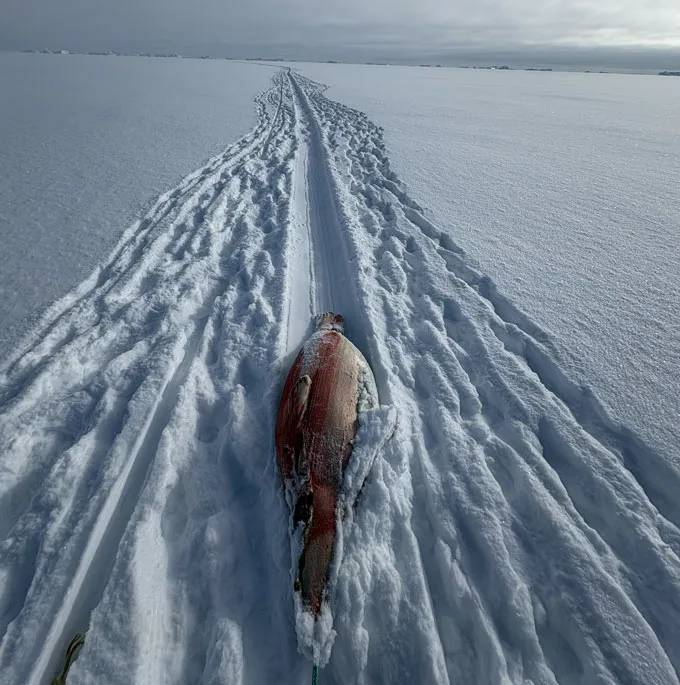
“What types of microbes develop [on the seal meat] through the fermentation process that Mike then eats through the journey?” Hauptmann wonders.
Some experts, however, caution against drawing any conclusions from a case study. Focusing on the shifting microbiomes of native Greenlanders “would be much more interesting than [findings from] an Englishman and a dog,” says Patrick Mullie, a nutritionist and epidemiologist with the Belgian Defence in Brussels.
But zooming in on an outsider serves a purpose, Hauptmann says. Indigenous people have evolved alongside their native environs. The Greenland Inuit, for instance, have genetic adaptations to help them contend with such a fat-heavy diet, researchers reported in 2015 in Science.
Genetic change, however, takes generations. How, then, did our ancestors adapt to rapidly changing environmental conditions, such as when they migrated long distances? Microbes probably played a key role in that process, Hauptmann’s research suggests. In Qajaq Man, Keen describes experiencing diarrhea followed by about six days without a bowel movement. But then things settled. Microbial changes in his gut could explain why.
“There was a significant change in strains of microbes that like to eat plants and fibers,” says Hauptmann, whose findings are forthcoming in Frontiers in Microbiomes. “Those disappeared out of his gut microbiome, and then he got microbes that are much more adapted to eating high-fat, high-protein diets.”
Keen’s earlier trek also proved enormously popular with Greenlanders. The documentary shows residents of remote towns cheering along the waterfront to welcome Keen or bid him farewell. His journey provides a proof of concept that eating the traditional way is still doable, even desirable, Hauptmann says.
And that’s important in a country where people have become increasingly reliant on imported foods, a shift that has coincided with a rise in health problems once seen mostly in Western populations. Health officials often vilify the Inuit diet because it violates conventional wisdom conflating plant-based diets with health, Hauptmann says. “We … have a right to our own diet.”