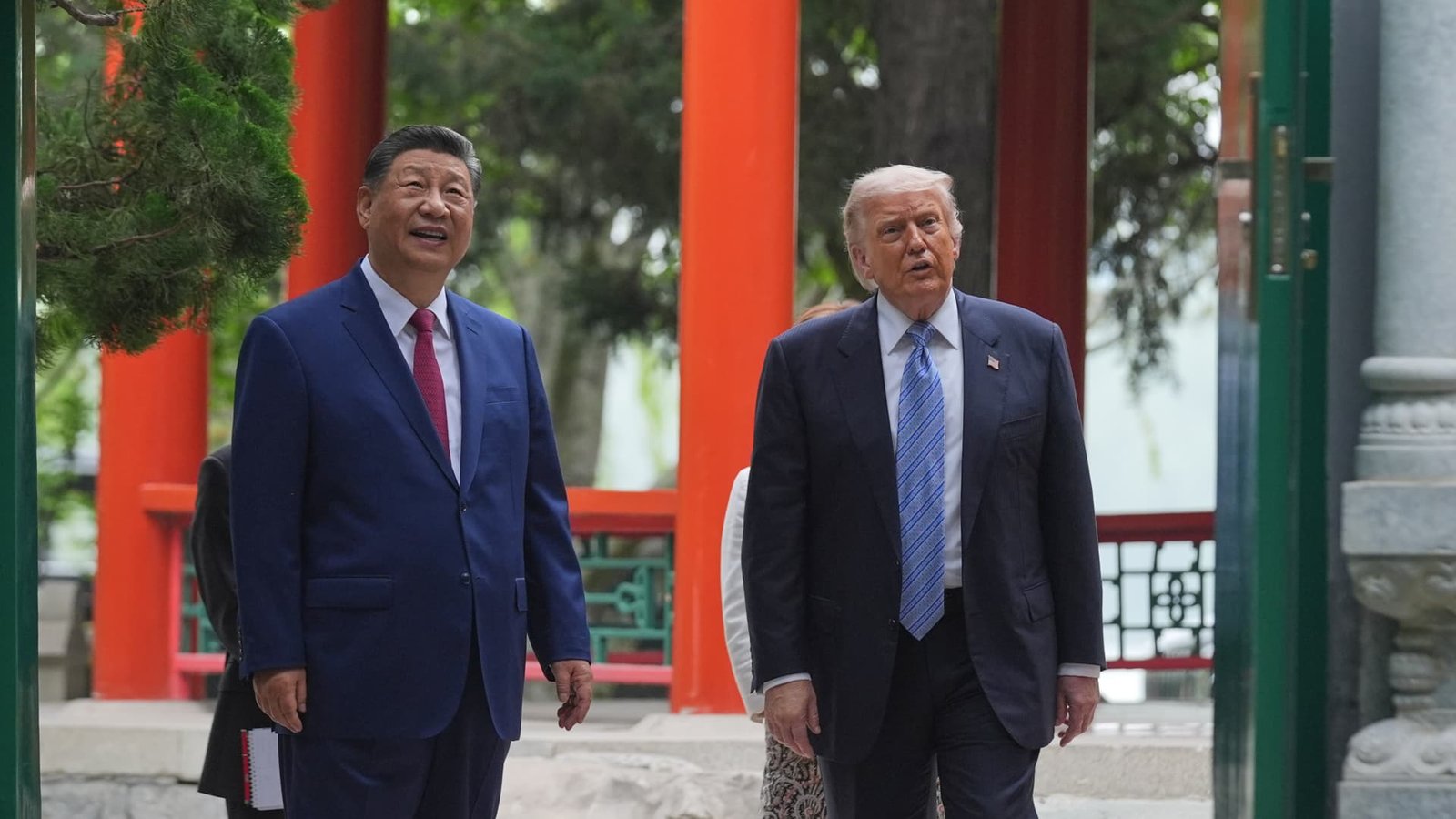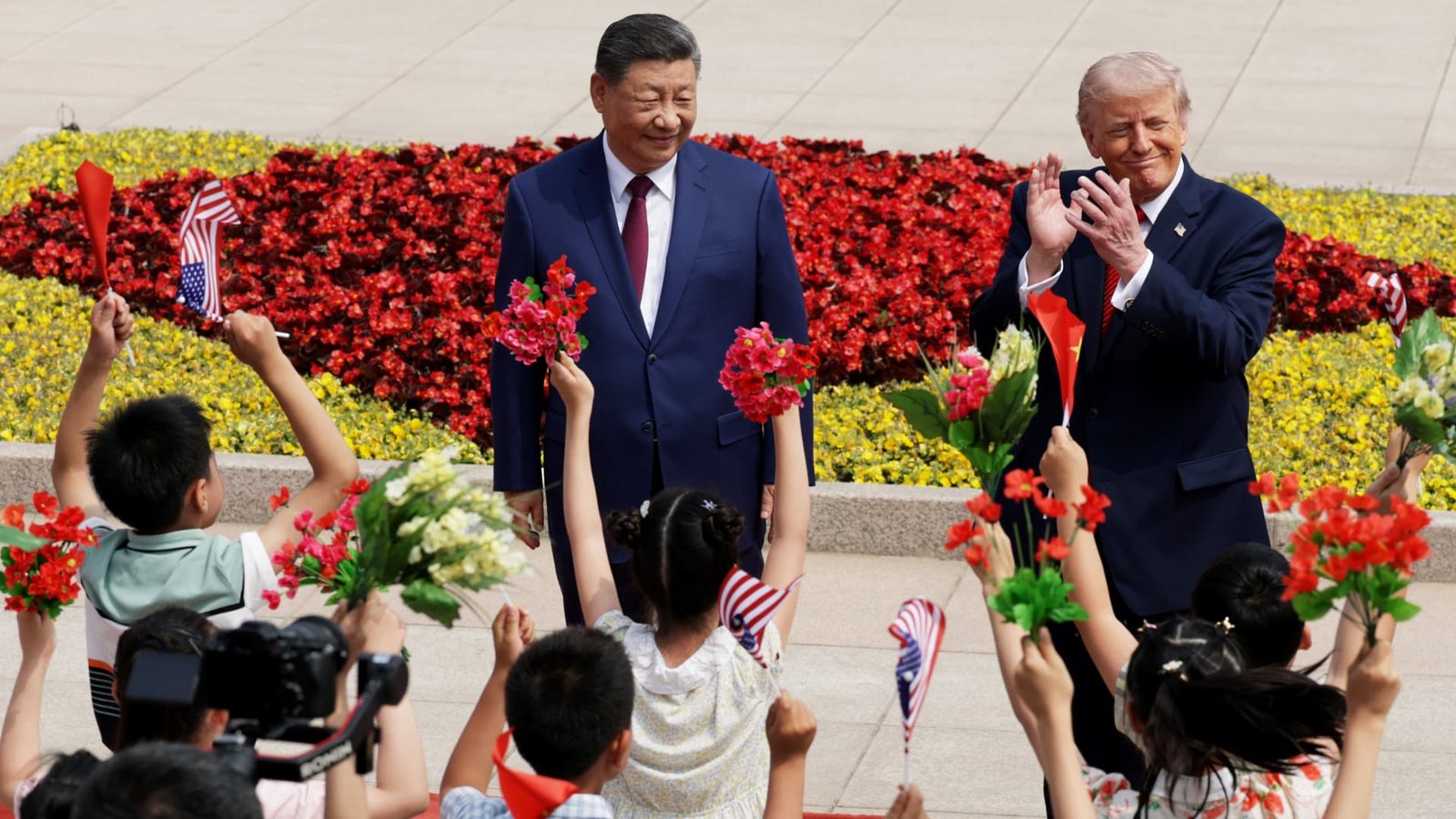
BEIJING, CHINA – MAY 14: U.S. President Donald Trump and Chinese President Xi Jinping attend a welcome ceremony at the Great Hall of the People on May 14, 2026 in Beijing, China.
Alex Wong | Getty Images News | Getty Images
BEIJING — U.S. President Donald Trump’s closely watched visit to China this week has gone a long way toward strengthening a fragile trade truce with Beijing and stabilizing the bilateral relationship.
While the visit was delayed by more than a month due to the Iran war, Trump’s two-day summit with Chinese President Xi Jinping wrapped up Friday with plans for another meeting this fall.
Here’s what’s changed since the leaders met:
U.S.-China geopolitical alignment
Xi’s warning to Trump that mishandling Taiwan would put the U.S.-China relationship into “great jeopardy,” according to official English-language state media, dominated headlines at the start of talks.
Oil prices also rose after Trump told Fox News in a prerecorded interview that China has agreed to buy U.S. oil and would help with Iran negotiations. He did not reveal when purchases would begin or at what volume.
China has yet to confirm plans to buy U.S. oil, while Washington has yet to say anything on Taiwan.
“I do think each side has delivered. There was no substantive discussion on Taiwan, though, which is not surprising,” said Yue Su, principal economist, China, at the Economist Intelligence Unit. “More discussion on Iran highlighted that they do have common ground. The fact that both sides want to describe the meeting as a win shows goodwill, at least.”
“There are limits to what China can realistically do, as the Iranian regime is operating in survival mode and will prioritize its own interests and agenda above all else,” she said.
Trade truce holds
The U.S. and Chinese sides have not yet released details on specific agreements. But Trump’s invitation to Xi to visit the U.S. on Sept. 24 means the two leaders can talk in person again before the expiration of the one-year trade truce set in October 2025.
The agreement lowered tariffs and rolled back rare earths restrictions after an escalation in tensions between the two countries earlier in 2025.
Xi said the U.S. and China agreed to constructive “strategic stability” as a framework for the next three years, according to state media.
“Strategically, Beijing appears to be trying to turn Trump’s transactional willingness to stabilize ties into a longer-term operating framework for U.S.-China relations,” said Jack Lee, analyst at China Macro Group, noting the framework could become a baseline on dealing with Beijing for the next U.S. president.
Wins for business
Trump told Fox News that China will order 200 Boeing jets, which he said was more than the 150 units the company had expected. But that was less than half the 500 planes that many initially anticipated.
Nvidia also reportedly got the green light from the U.S. to sell its H200 chips to major Chinese companies, sending tech stocks higher.
Both Boeing CEO Kelly Ortberg and Nvidia CEO Jensen Huang accompanied Trump to Beijing. The executives and more than a dozen U.S. business leaders — including Apple CEO Tim Cook and Tesla‘s Elon Musk — participated in a meeting Thursday with Chinese Premier Li Qiang.
Opening remarks and readouts offered no details beyond China’s pledge to open up its market further to foreign business, which has occurred gradually over recent decades.
The U.S. business delegation was far smaller than the more than 30 leaders who joined Trump on his trip to Saudi Arabia last year.
“I don’t think the purpose was to have every CEO sign a deal,” said Gary Dvorchak, managing director at Blueshirt Group. “I think the purpose was just to kind of flex America’s muscles and just show from an economic standpoint what a powerhouse we are.”
“It also shows a high level of unity amongst the American government and private sectors,” he said.