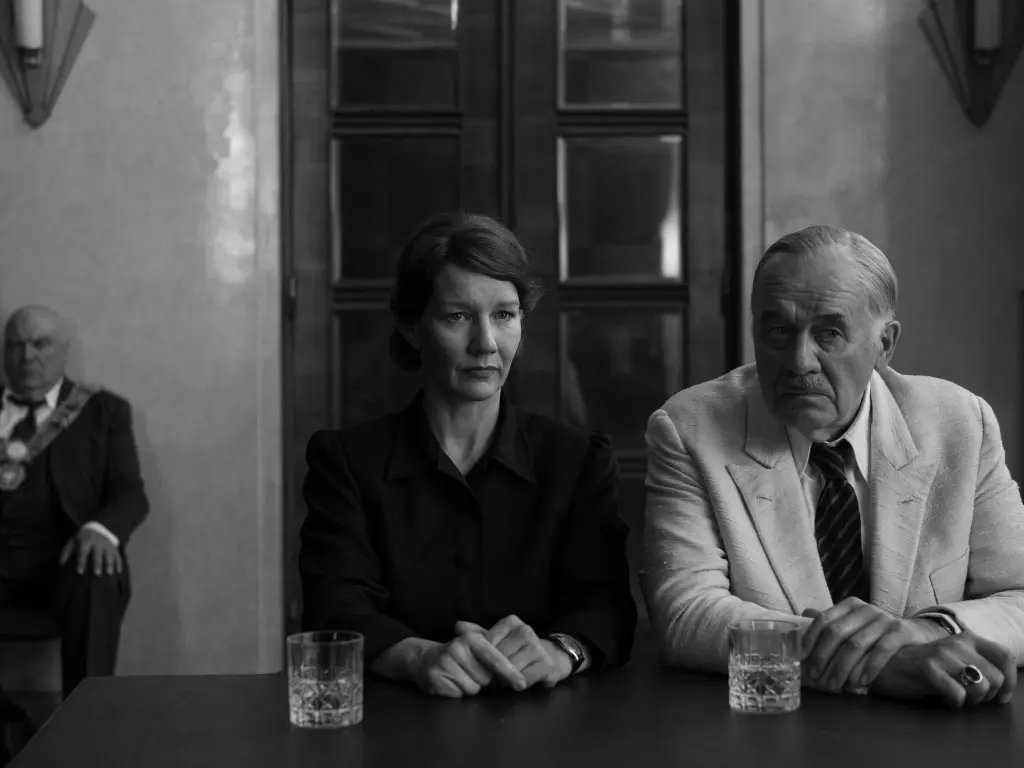
In an era of prolix cinema sprawl, Pawel Pawlikowski is a maestro of precision-cut film-making: give him a bouquet of big themes and he’ll rigorously prune them until they fit perfectly into a specimen vase. Fatherland, having its premiere in competition in Cannes, is peak Pawlikowski. In 82 studiously controlled minutes, it follows the elderly Nobel-Prize winning writer Thomas Mann on a journey through Germany, cutting a swathe through all of post-war history. It is a masterclass in artistic discipline.
The year is 1949. Mann, played with a weary dignity by Hanns Zischler, shuttles back and forth across what will soon be the Berlin Wall along with his loyal daughter Erika, a writer herself who is serving here as his companion, assistant and translator, embodied by the magnificent Sandra Hüller. Mann has been invited to commemorate the 200th anniversary of the birth of Goethe, Germany’s greatest man of letters. Both sides of the new border want to claim both Goethe — and — Mann as their own.
Or do they? Mann left for America with his wife and now middle-aged children in 1933. He ascends each lecture podium as a beacon of liberal humanism. His audiences stare back at him, dully hostile. A journalist accuses him of running out on them in Germany’s darkest hour. How quickly they forget what the stakes were; how bitterly they remember. “If I’d stayed,” he says wryly, “I wouldn’t be talking to you now.”
An opening scene in a French hotel room serves as a prologue to the tour itself. Erika’s brother, Klaus (August Diehl), sits naked by a rumpled bed with last night’s conquest still muddled up with his sheets, talking on the phone to his sister. The screen is a sum of exacting aesthetic choices: a square frame, a misty black and white film stock, a fixed camera and a room that is unmistakably a two-star hotel in the south of France. Palm trees whip in a storm outside the window; the light catches on the hypodermic on the bedside table.
Much of Fatherland is set in similarly liminal spaces: hotel rooms where the characters will spend just a few hours, foyers full of people just passing through, borderlands and bombed-out ruins. The Riviera room is the film’s vestibule. Next stop: Frankfurt. In every scene, the large is contained within the incidental; Pawlikowski’s story of the Mann family is an intimate one, his square images boxing every scene like a diorama, but this intimacy always sits within the context of broader themes: the legacy of war, the wounds of exile and the burden of public life. Just the title, with its three abrupt syllables, becomes the echo of a century’s rattling sabres.
It’s an ambitious undertaking, as you’d expect from the director of Ida and the equally diamond-sharp Cold War, but Pawlikowski has an ideal screen partner in Hüller, who can convey four emotions at once with no more than a sideways glance. Actually, Hüller can do anything. Erika Mann manages her father’s daily doings with aplomb; she filters the poison pen letters from his mail, sorts out border guards, chooses his next tie and extracts him from fans’ attentions with such patient unflappability that when she hits a man at a bar, we all but feel the shock of her firm hand’s sting ourselves.
We know exactly why she hits him, of course. There are collaborators everywhere, like this weasel actor who found it remarkably easy to dance the Nazis’ tune to keep his job. An actor, he bleats feebly, needs his mother tongue. It’s true, says Erika to a woman from Associated Press who is clearly an old lover, that she had said she would never set foot in Germany again. Like her father, she lives in the United States. Unlike him, she has been refused citizenship three times. Two wars, including the current cold one, have left her a citizen of nowhere.
There are plenty of current resonances here, not least in Mann’s rather lordly pronouncements that interleaf the family’s chamber drama. A good society, he tells a journalist from the East, should be shaped for men, not the other way around. Yes, he says to a West German official, he will be visiting the East; literature has no zones. Modern parallels are just a bonus, however; the story is complete unto itself. It will be a hell of a movie that stands between Fatherland and the festival’s Palme d’Or.
Title: Fatherland
Festival: Cannes (Competition)
Director/screenwriter: Pawel Pawlikowski
Cast: Sandra Hüller, Hanns Zischler, August Diehl, Anna Madeley
Distributor: MUBI
Running time: 1 hr 22 mins