Football clubs across the world, at all levels, invest heavily in player recruitment. They assemble entire teams of backroom scouts and analysts — some, like Chelsea, even employ multiple sporting directors — who work around the year to produce transfer shortlists for every position.
But when it comes to hiring a new manager or head coach, there is no such framework. Decisions on those appointments are often made by a handful of people at the top of a club: an example is Manchester United’s leadership duo of Omar Berrada and Jason Wilcox, who picked Rúben Amorim to succeed Erik ten Hag and are now mulling the prospect of giving Michael Carrick the job full time.
Meanwhile, Real Madrid take things to an even greater extreme: There are voices that carry weight in their selection process, but ultimately what president Florentino Pérez wants ends up being the outcome. Yet more teams across the leagues and around the world are embracing data and analytics as part of their searches — much like they would for players.
“In the last 10 years, player recruitment has been through an evolution to better balance out combining data and expertise,” Edward Sulley, Hudl’s Director of Customer Solutions, tells ESPN. “The head coach and manager recruitment space is going through that same kind of evolution right now.”
There’s a problem, though: It’s seriously expensive. Sulley, who worked for Manchester City for 11 years across performance analysis, research and innovation, lays it bare: “If you’re hiring data engineers, you’re talking perhaps $200,000 per person, plus all the infrastructure, software and data sources … it racks up fast; you’re talking well in excess of $2 million per year in operational costs.”
Some clubs want to embrace analytics in their managerial searches, but baulk at the price. That’s led to several companies stepping into that void and creating services to help. ESPN spoke to three of those at the heart of this boom — Hudl, Analytics FC and MRKT Insights — to get a feel for how this kind of work is changing the sport.
What is the process?
It starts with a conversation. Ideally, that conversation is held with a club who are quietly and efficiently planning for the future in case their beloved manager decides to leave or, better yet, actively maintaining a shortlist of appropriate hires just in case anything happens.
But this is football. How often does that happen?
“Most of the time it’s ‘we have just, or are just about, to sack our coach — and we need help on who to replace them with,'” Alex Stewart, CEO of Analytics FC, says.
That creates a week or two of frenzied activity, as a club that are probably nosediving in the table are now searching for answers, fast.
“There is a lot of pressure on decision makers, and often that is the owners, who end up with all sorts of people in their ear — agents, friends of friends,” Sulley adds. “A lot of football is still highly relationship-based, so whoever has the owner’s ear can have a direct impact on the decisions made.”
These kinds of situations require quick solutions, and that’s where these companies have built their businesses. Each one leverages data to assist clubs in identifying who the next hire could be.
Analytics FC and MRKT Insights meet with the club and ask questions, starting off with something simple: Do you prefer younger or more experienced candidates? Do they have to be able to speak a particular language? Do they need to have experience managing in specific countries or cultures?
“If you’re doing it for players, why aren’t you doing it for managers?” — Alex Stewart, CEO of Analytics FC
Those may sound blindingly obvious, but even the best make mistakes as simple as this. For example, Bayern Munich rarely deviate from German-speaking coaches, and after employing Pep Guardiola and Carlo Ancelotti between 2013-2017, were eager to get back to a more fluent line of communication.
After that, the questions become more complex.
“We have a checklist we go through,” says Tim Keech, co-founder of MRKT Insights. “Have they coached the right style of play before? Are they the right personality fit with the owners? Have they worked within this type of organization and structure, or are they demanding full control? Do they need experience working in an elite environment? And so on.”
Hudl offers the same conversation with select clubs, but gives most of them access to a dashboard they can use themselves. There, they effectively upload their own search brief into it via a series of questions and sliders that are designed to narrow down the field and present the best candidates. They can then engage in conversation with Hudl for more help making the right choice if required.
How is it personalized?
“One of the things that’s really interesting to me is that some clubs are starting to think about team playing style in the context of overall club identity,” Stewart adds. “They’re starting to develop a sense of the club’s brand and identity as a whole, and how playing style is an element of that, reflecting wider values that the club may have.”
The most in-your-face example of this is the multi-club Red Bull organization — six clubs across the globe — which has long demanded high-pressing, fizzing football to complement its energy drink. But this could also be Man United embracing the attacking tactics that fans at Old Trafford demand or, at the other end of the scale, Stoke City priding themselves on being aggressive, physical and difficult to beat.
All of these answers form the search criteria and from there, a longlist is generated. These can be big — as many as 50 names strong in some cases, says Stewart — and it then gets whittled down to a shortlist — ideally 5-10 names in the eyes of Sulley, but Stewart and Keech often still have at least 15 left by this stage. Even then, more names can be added.
“Word often gets out [that the club might be looking to change] and suddenly agents are putting candidates forward, the Sporting Director is getting calls, so they’ll ask us to run this guy or that guy through the process just in case,” Stewart says. “In some cases, they’re almost asking us to give them a reason to turn someone down — a bad style fit, or they failed the impact criteria — but sometimes you can to go back and say: ‘actually, they meet everything that you’re looking for; you should speak to them.'”
So how does this work?
“Listen to any manager talk about how they want to play, and it’s always the same,” Keech says. “Play a 4-3-3 formation, pass through the lines, dominate all phases of play, win the ball high, midfield rotations. They describe a hybrid of peak Barcelona and Paris Saint-Germain sides.”
Smiling wryly, Sulley agrees: “Having sat in many coach interview processes over the years, especially at Manchester City and Hudl, and I would attest exactly to the point.”
How, then, do you cut through the noise, the outside interference and — to put it frankly — the often delusional claims of managerial candidates? The answer may lie in the data. All three companies manipulate it differently, but with the same goal in mind: Provide an objective solution to the problem.
Case study 1: Analytics FC
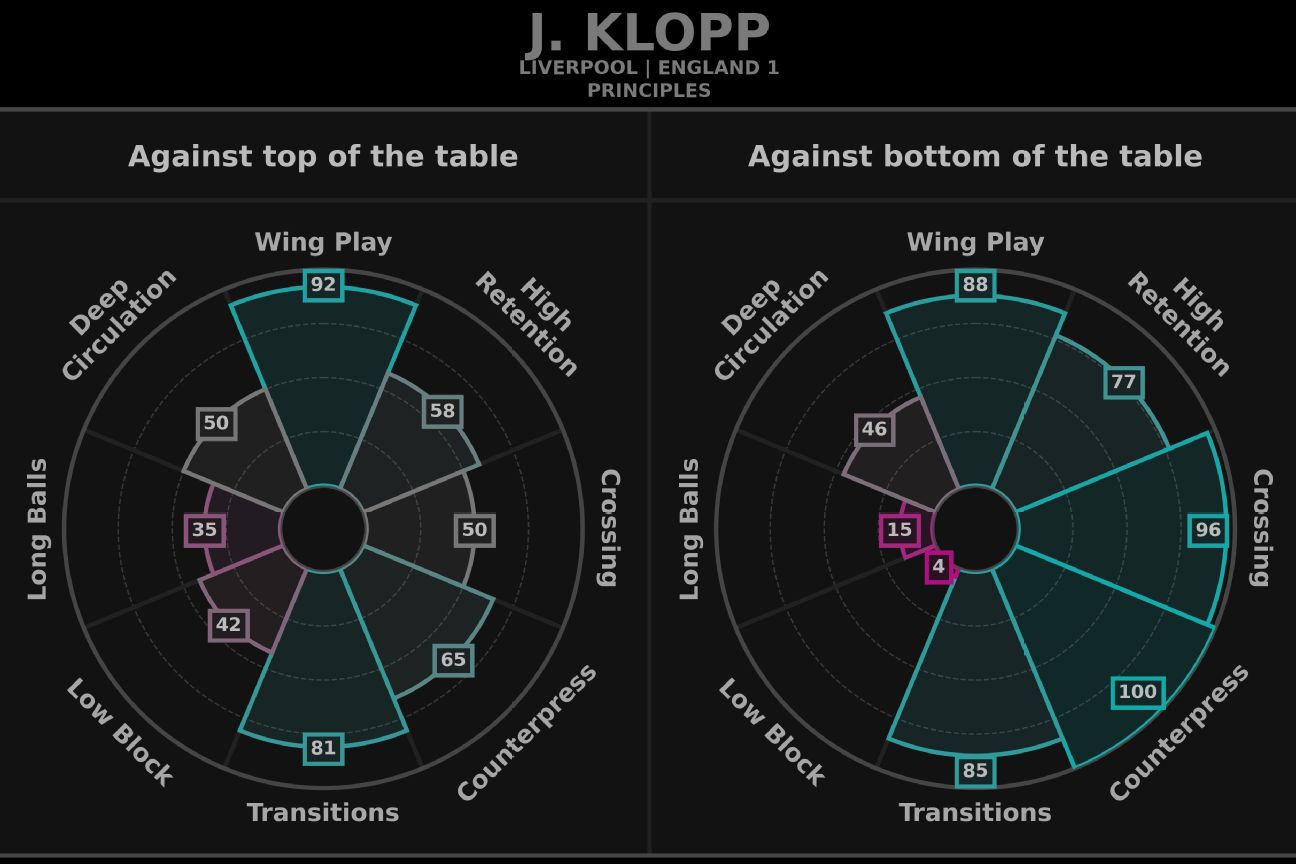
Analytics FC has worked with a range of teams in the men’s game across England and Scotland, Scandinavia and central Europe, plus international federations too. It has also worked with elite women’s teams in the USA and England.
For each manager, it produces a segmented wheel showcasing eight key characteristics, measuring the most and least prominent parts of a manager’s style. Each is scored out of 100; specific statistics underpin each characteristic.
A high score in deep circulation may signal patience in moving the ball through the thirds of the pitch; one of the metrics used here is the volume or duration of passes in the defensive third. While a low score in counter pressing might suggest a more passive defensive approach; how quickly — and how intensely — teams try to win the ball back in certain areas of the pitch is among those measured for this one.
The scores don’t necessarily measure how effectively a team does these things, more that they do them a lot — although some metrics, like “High Retention,” do imply quality because keeping the ball in the opponent’s half is desirable.
Intriguingly, the profiles split into two: How they perform tactically against top opponents vs. how they perform against weaker sides. That nuance has proven valuable for many of Analytics FC’s clients.
“Let’s say you need to be able to play counterattacking, defensive football against two or three good teams, and then be ball-dominant against everyone else,” says Stewart. “We can create a coach profile to reflect that.”
That could apply to a mid-table Scottish club who are worse than Celtic and Rangers, but better than everyone else. It could also apply to Croatian champions Dinamo Zagreb, who dominate their league, but frequently come up against bigger fish in European competition.
Case study 2: Hudl
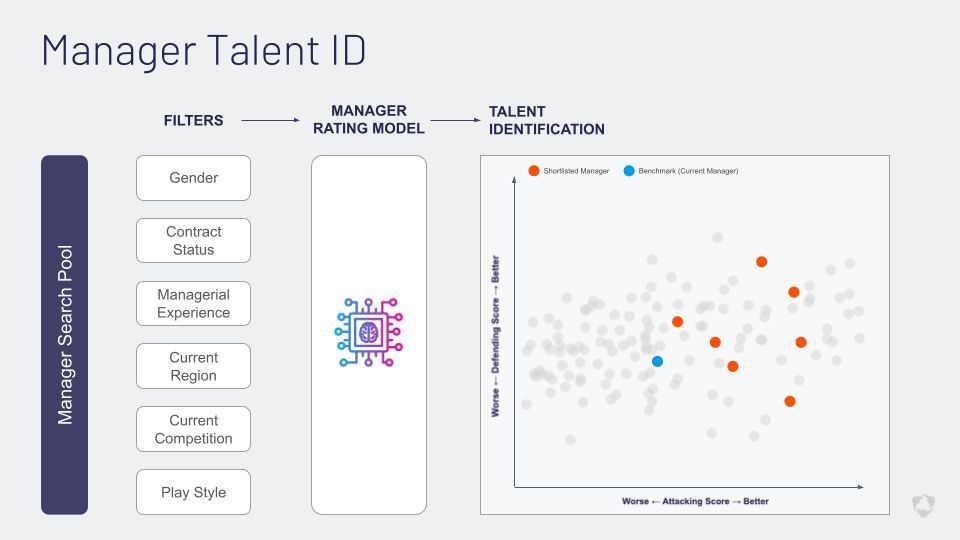
Hudl’s dashboard takes the answers clubs feed into it, analyses thousands of active managers, and then picks out the best matches. Coaches are assigned a defending score and an attacking score, which are formed using a series of specialist metrics.
Some of those metrics are unique to Hudl or created from scratch. For example, it considers aerial duel win percentages far too basic, so it developed HOPS — Header Oriented Performance System — to measure a player’s ability to win headers. That takes into account the identity of the players in an aerial duel and hands out appropriate credit, so if the 5-foot-7 Lionel Messi beats 6-foot-5 Virgil van Dijk in the air, he’d receive his dues.
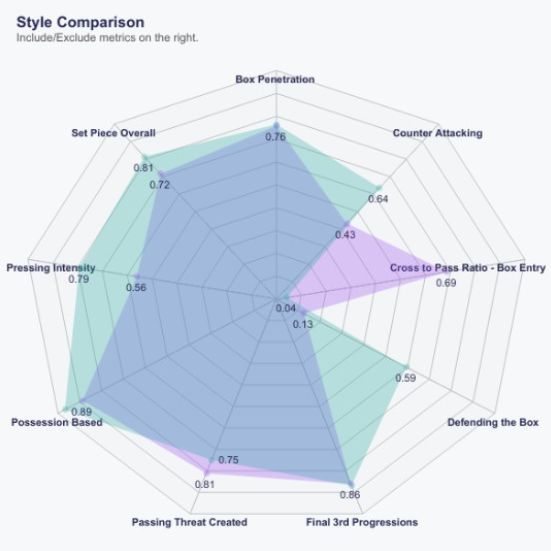
OBV (On Ball Value) is also incorporated — “That’s a value associated to players based on how much they’ve contributed to positive actions on the pitch, like creating goals,” Sulley explains — plus things like Expected Goals (xG), chances created and pass-success rate, among many others, combine to form the manager profile. The dashboard can identify how much of an impact the manager in question has had on these metrics, adjust for both team and opposition quality, then present the data in the form of a radar.
Inside that dashboard, you can spend time carefully adjusting and tweaking your search criteria to find exactly what you want. Or, if you only had a rough idea of what you wanted, you could set a manager as a reference point — say, Pep Guardiola — and ask for coaches who show stylistic similarities.
Many clubs and nations use this dashboard to aid their decisions, from lower-league to bottom-half Premier League sides. A whole range of countries use it too; emerging nations use it to find unknown gems, while the heavyweights use it to consistently monitor their own national pool of managers.
Case study 3: MRKT Insights
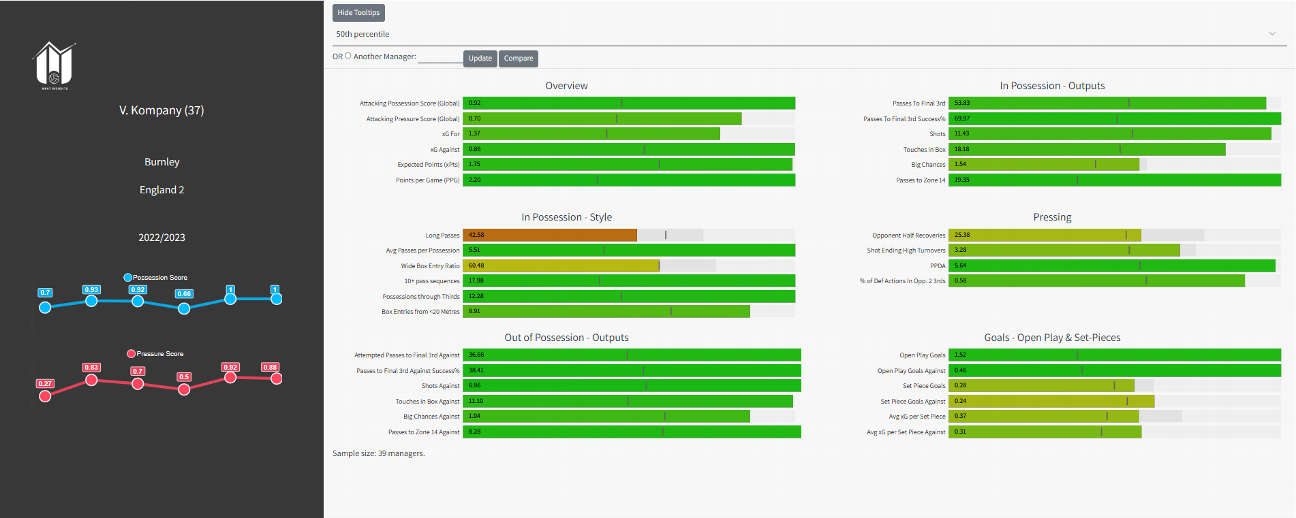
MRKT Insights does the bulk of its work in the English Championship and Football League, but has also assisted Champions League clubs and consulted with Premier League and Serie A sides. At face value, the profiles which it produces are simpler.
“There are lots of ways to group different styles of managers,” Keech says. “We’ve boiled it down to two ways: One is attacking pressure, the other is attacking possession. The best managers play both.”
MRKT Insights grades every manager out of 100 on those two principles. Peek under the hood of how those scores are determined, though, and you’re presented with another complex weave of statistics.
“We have a basket of metrics for each,” Keech explains. “For the attacking possession score, we’ll look at things like length of pass sequences, or possessions through the thirds (where your possessions start and end).
“And if you’re a manager scoring highly on attacking pressure, you’re getting more balls into the opposition box and you’re getting more high turnovers. You’re able to keep the ball away from your own goal and keep it near theirs. ‘Field tilt’ measures your ratio of touches in the final third — that’s quite an interesting one.”
An epic volume of data is crunched and every manager in the database is given two scores. Keech says his team figured out which statistics correlate to future success, and there are particular statistics that can elevate a manager’s score significantly, such as volume of cut backs and through balls.
1:04
How Vincent Kompany has ‘reinforced’ Bayern Munich’s identity
Ale Moreno discusses Vincent Kompany’s impact on Bayern Munich after beating Köln and equalling Pep Guardiola’s Bundesliga record.
Spotting good coaches in bad situations
One of the most difficult things to assess with managers is their true impact on a team. Trophies won, league position, points per game are all clues at best, but can often seem more like red herrings.
“When we set up this service, the only real way to find managers was to go on to Transfermarkt, look at the ones who are out of work and sort them by points per match,” Stewart says. “We realized that didn’t really work, because points per match generally only tells you who coached the wealthiest or most successful clubs. So we built a model to find the coaches who were adding value — even if their teams weren’t the best.”
That value can be found in a number of different ways. In its most basic form, it’s an improvement in the underlying numbers, measured from before the manager took over to after.
“We see managers improve a team’s score from, say, the bottom 20th centile to the 50th centile,” Keech says. “For example, [current Everton boss] David Moyes has always been really good at that; just improving teams. He never gets them to a level of real dominance, but he shows up really well for making teams better.”
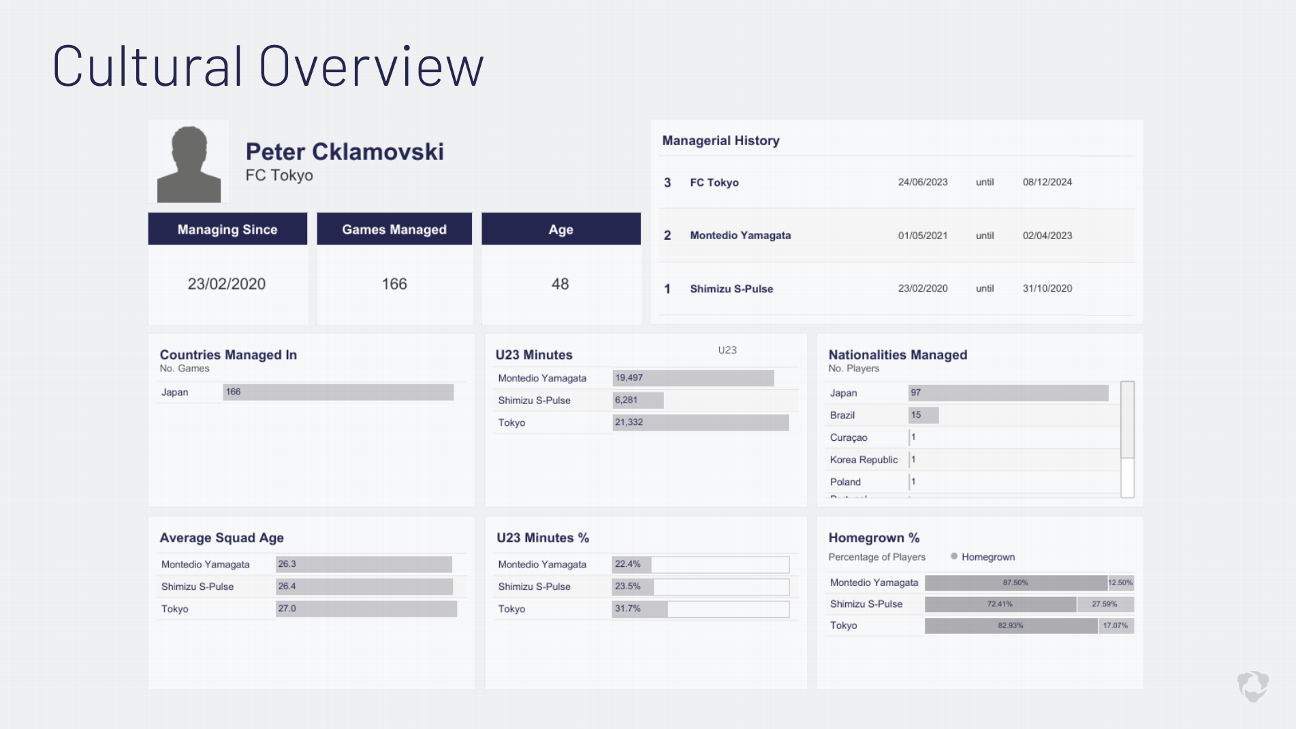
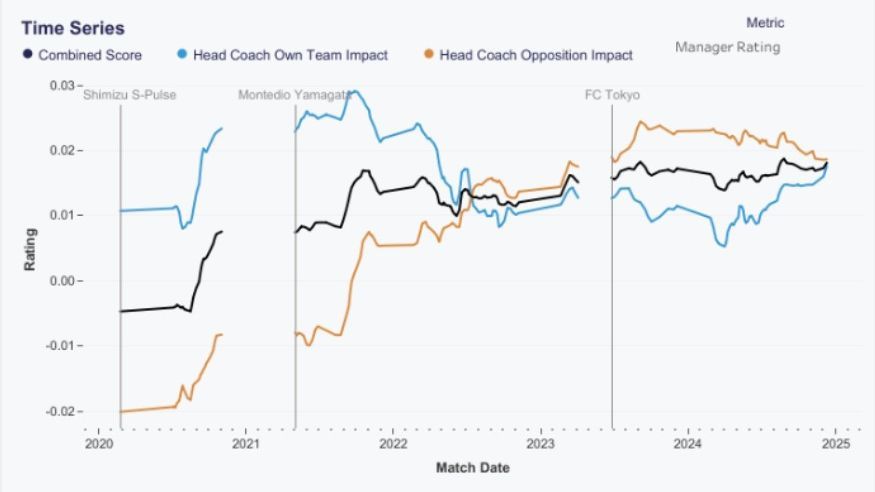
Hudl’s reports can measure a manager’s impact over a span of several years and several clubs. Pictured is Peter Cklamovski, who spent four years coaching in Japan’s top tier before taking over the Malaysia national team. The graph below shows a broadly positive impact across three teams.
You can measure it in other ways, too. Market valuation changes of the players a manager has coached is a strong indicator of improvement, while Analytics FC has a substitution success metric. But there are also situations where managers get relegated when playing plainly unsuitable football for a relegation scrap, yet stick to their attacking principles. Their record will show a failure, but the data will show something more interesting.
“The best example of that is someone like Vincent Kompany,” Stewart says. “He got Burnley promoted to the Premier League in 2022-23 with a high squad quality relative to the Championship, played some really lovely football, but then, because of a combination of factors, wasn’t able to bring an adaptation to the play style that would allow Burnley to compete successfully in the Premier League.”
Kompany did not budge on his playing style, and perhaps that was with an eye on securing a top job in the future. Despite relegation, his team registered relatively well on the key metrics MRKT Insights looks for when projecting future success. Burnley played possession football, passed the ball into dangerous areas consistently and utilized cutbacks.
“For the very elite clubs, you’re looking for playstyle domination and a couple of distinct skills on top of being a great coach, like how you present yourself in the media, or can you handle stress?” Keech says. “Kompany captained Manchester City to four Premier League titles, is multilingual, is seen as a winner by his peers and has been under the media spotlight for 20 years.”
It was a shock to many when the Belgian was unveiled as Bayern Munich manager in 2024 off the back of relegation with Burnley — and admittedly, he wasn’t their first, second or even third choice — but it wasn’t a shock to those who have made it their business to advise clubs on how to navigate managerial hires in much more modern ways.