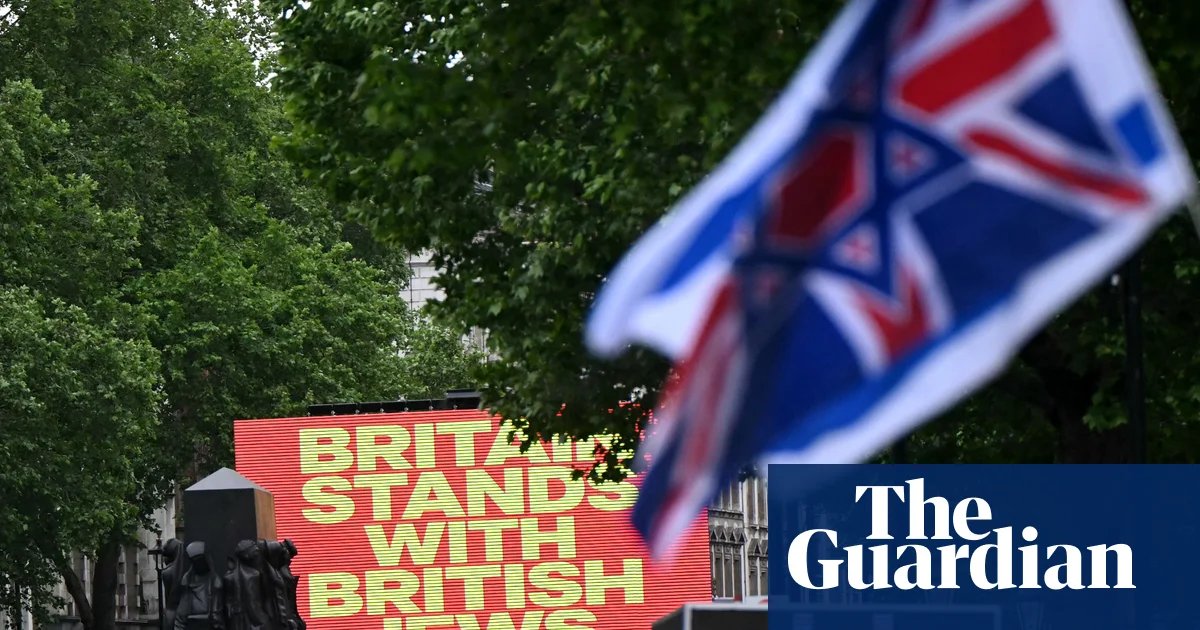
Rabbi Charley Baginsky, the co-leader of Progressive Judaism, admitted she felt apprehensive before speaking at last weekend’s central London rally against antisemitism.
As she addressed the crowd, there were some boos. It wasn’t the first time – last year, on a similar stage outside Downing Street, Baginsky and her fellow co-lead, Rabbi Josh Levy, were jeered off stage.
While even some who disagreed understood the booing of the government minister Pat McFadden as the product of a view that Labour had not done enough to take on antisemitism, some of the same attenders were dismayed by the same treatment for the Liberal Democrats’ Ed Davey before the event’s MC intervened.
Meanwhile, Reform UK’s deputy leader, Richard Tice, was warmly received by parts of the crowd, as was the Conservative leader, Kemi Badenoch.
The moment was a reflection of how some liberal and leftwing British Jews are feeling isolated as figures on the right seize the initiative in condemning antisemitism and robustly defending Israel.
For some, antisemitism can only be confronted through broad alliances with other minority communities and anti-racist movements. But others increasingly view parts of those same spaces with suspicion, arguing hostility towards Jews has been minimised or tolerated within them.
The most recent research into the voting preferences of British Jews found support for the Greens was higher than support for Reform in 2025. But among community leaders at the forefront of the fight against anti-Jewish racism, there is a belief that the right is increasingly benefiting from fading trust in the left.
Raphi Bloom, of the Jewish Representative Council, said Labour had long been seen as a “natural home” for Jewish values of social responsibility.
But he said the Jeremy Corbyn era had weakened the bond, while attacks and abuse since the 7 October 2023 attacks in Israel had pushed “a number of Jewish people” further to the right politically, or led them to prioritise safety over ideology.
“More and more people are being drawn to Reform,” Bloom said, adding that Reform “has definitely had its issues with anti-Jewish racism” – but had “dealt with them swiftly” at a time when parties were being judged by speed of action.
Meanwhile, he said Reform had brought over “genuine allies” of the Jewish community from the Conservatives – including Suella Braverman, Robert Jenrick and Nadhim Zahawi – at a time when many felt “betrayed and abandoned” by Labour over the pace of action against anti-Jewish racism and Islamist extremism.
Baginsky believes antisemitism must be placed within the wider context of tackling all forms of hate, saying “until we are a society that tackles antisemitism, Islamophobia, racism, misogyny, and says ‘this is not the sort of Britain we want’, then we won’t be living in a Britain that’s safe for any of us.”
But, she added, “That’s a really hard message to give when, for some people, the answer is drawing the walls up.”
Nonetheless, the 2,000 people who signed a letter urging organisers to withdraw an invitation to the Reform leader, Nigel Farage – and ensure the demonstration reflected values of “inclusion and solidarity” – reflected levels of sympathy for Baginsky’s argument among some in the community. To many Jewish signatories, allegations of teenage antisemitism reported by the Guardian – and denied by Farage – should have meant he was excluded from the event.
But that concern is not confined to claims of antisemitism in isolation. Tice’s appearance at this weekend’s rally came shortly after he declined to criticise a newly elected Reform councillor accused of saying Nigerians should be “melted into potholes” – the type of moral inconsistency that makes Andrew Walters, an Independent councillor in Salford, uneasy.
Walters, a British Orthodox Jew, said: “I think it’s a naivety [to align too closely with the right]. Any party that has based their principles on despising other groups has got to be considered as a minimum with a lot of scepticism.
“I think the far right are using their anti-Muslim and anti-immigrant agenda to try to attract those Jews who feel that this issue has become polarised and, unfortunately, this idea that it’s Jews against Muslims – this agenda is something which is capitalised on by both the far left and the far right. But it’s a short-term fallacy to say ‘my enemy’s enemy is my friend’.”
As politics in the UK polarises, support for the two main parties among British Jews is declining, according to research from the Institute for Jewish Policy Research (JPR) likely driven by “a combination of disillusionment with both the Labour government and the Conservative party, and growing concerns about antisemitism in the UK.”
JPR found support for the two main parties in 2025 was “just 58% – the lowest level we have ever recorded by some distance”, when historically it was “around 75% to 80%”.
Meanwhile, JPR found 18% of Jews favoured the Green party – outweighing the 11% of Jews favouring Reform.
David Feldman, co-director of the Birkbeck Institute for the Study of Antisemitism, said there were “two dynamics of polarisation” driving divisions within British Jewish political life: growing disagreement over Israel, particularly among younger Jews who are increasingly less likely to identify as Zionists, and deepening arguments over what is driving antisemitism itself.
“The idea that antisemitism across British society is being driven by the pro-Palestine movement is now widespread,” Feldman said. He added that the most extreme elements of this viewpoint “seem to say that the wellbeing and safety of Jewish people in this country are necessarily opposed to the wellbeing and safety of Palestinians”.
David Davidi-Brown, the chief executive of the New Israel Fund in the UK, said that while he attended the march personally, his organisation withdrew their backing after invitations were sent to political leaders.
“The New Israel Fund has to think about our Palestinian and Muslim partners. The tone and rhetoric we were seeing gave us pause,” he said. “To be clear, we had no issue with the anger itself. The anger and fear after Golders Green were understandable. What concerned us was how some of that anger was being expressed.”
Davidi-Brown said that while he recognises the profound failures in progressive and anti-racist spaces when it comes to Jews and Israelis, he was opposed to sweeping generalisations that treat the entire movement as inherently hostile to Jews. By comparison, he said he often challenges the same sweeping generations or hostility people have about Zionists.
“We need to stop flattening everyone into hostile caricatures,” Davidi-Brown added.
There was also growing unease about rising hostility towards immigrants within parts of the community. Alan Mendoza, Reform UK’s chief adviser on global affairs, posted an image of the Golders Green attacker and wrote that Britain had “imported alien values”, adding that people subscribing to an “alien religious ideology” should be “removed from this country”.
Rabbi David Mason, executive director of the Jewish refugee charity Hias+Jcore, who previously served as rabbi of an Orthodox synagogue, said that while many British Jews have seen solidarity with migrants and minority communities as closely tied to Jewish history in this country, there were worries that that connection is fraying.
“When there’s growing fear – and fear is being stirred up against refugees and migrants – we need to be careful. We need to stick to understanding the historical narrative that when Jewish people came here, they found barriers. They found it difficult. They weren’t always treated with trust. And yet they made a go of it,” Mason said.
But Mason was keen to stress there was widespread work being done in synagogues across the country in support of migrants and refugees. “Jewish communities do really positive work. There’s no way we are giving up on society.”
Walters also rejected the idea that British Jews were moving decisively rightward. “Judaism is a spectrum. There’s the old joke about if you have two Jews, you’ll have three opinions.
“I don’t think there’s any particular gain in support for Farage – I think it’s more a case that people are more scared of what the extreme left is going to do, because there are those that use anti-Zionism as a euphemism for antisemitism because it’s more politically palatable.”
Bloom warned that “the small minority of Jews who gravitate towards Tommy Robinson” – who has cultivated links with British and Israeli Jewish activists – were “playing a very dangerous game”, adding that it was “absolutely wrong” for progressive rabbis to be booed at the rally.
Regardless of their political persuasion, communal leaders also spoke of their admiration and respect for the Jewish Leadership Council and the Board of Deputies for attempting to bring different sections of the community together.
“It’s a difficult path for the Jewish community to navigate,” Bloom added. “But we’re not running away. We’re not Jews on trembling knees. We are gonna fight. You know, we believe we have a strong future here, but we need allyship from many, people in wider society.”