No one paid attention to the gunshots that echoed through the convention center. They were real enough, and so were the screams that accompanied them, in the sense that they were recordings of real people who, like guest stars on Law and Order, reenacted scenarios that had clearly been plucked from the headlines: a kidnapping, a mass shooting in a church, a riot on a city street. The auditory terror punctured the otherwise banal din of an industry conference. This terror was, in fact, one of the products on display: the V-300 S-Screen Simulator, developed by VirTra, one of the 193 vendors at the annual Border Security Expo in Phoenix, Arizona.
For more than a decade, vendors and government representatives have mingled at the Border Security Expo, an annual trade show at which the former hawk their goods to the latter, promising that this camera or that sensor are the key to locking down the border once and for all. A smattering of protesters greeted us outside the convention center that morning, and some speakers — including border czar Tom Homan, who lambasted the “hateful rhetoric” of the fake news media — alluded to unfavorable public sentiment. But the feeling inside was convivial. This year’s expo was a victory lap for the men and women of the Department of Homeland Security and their many friends in the “vendor community.”
The relationships were perhaps a little too chummy. Homan had, after all, allegedly accepted $50,000 in bribes from undercover FBI agents posing as business executives hoping to land a government contract. The bureau quashed the investigation after Trump’s return to office, and a Justice Department appointee called it a “deep state” attempt to discredit Trump’s valiant border czar. Even members of Congress, Homan fumed, had the gall to call ICE and Border Patrol agents “Nazis” and “racists.” Such vile epithets had no place at the expo, where attendees celebrated the past year’s record-low border crossings and record-high interior arrests. Trump, whom Homan called “the greatest president in my lifetime,” had allowed ICE and CBP to finally do their jobs. And the contractors, too, would reap the rewards, perhaps finding their jobs a little easier under an administration that has taken a maximalist approach to immigration enforcement.
On the final morning of the convention, I sat next to a jovial, hulking man who told me he had been a Border Patrol agent for decades. Now he was on the other side, trying to sell AI software to his former employer. Throughout the expo floor, pot-bellied men in their business casual best exchanged handshakes and pleasantries with military men-turned-government contractors, their career history betrayed by their branded polos and ramrod postures. Carla Provost, who served as Border Patrol chief for two years during Trump’s first term, fluttered about the room like an ever-attentive hostess. Though DHS had the most money to blow, representatives from local police departments and sheriff’s offices — which have increasingly agreed to work with ICE through partnerships known as 287(g) agreements since Trump’s reelection — milled about. Vendors eagerly showed off their wares, hoping to benefit from the unprecedented funding DHS had received under Trump’s signature One Big Beautiful Bill Act. But was it possible that the border security industry was suffering from too much success?


“We own the border now,” Customs and Border Protection commissioner Rodney Scott said during the opening day of the conference. This was, speaker after speaker assured us, the most secure southwest border in history. When the border was more porous, when hundreds of thousands of people were spilling across it every single day, one could argue that the government did indeed need more equipment to monitor and prevent the flow of people. But things had changed. There were a mere 8,268 apprehensions at the southwest border in March, compared to 137,473 two years earlier. That drop in encounters, however, isn’t because of tech but because of policy. The overwhelming majority of people who crossed the border under Biden turned themselves in immediately, because their goal was to ask for asylum, which can only be done once someone is on US soil. But Trump effectively eliminated asylum at the border — a move a federal appeals court recently said was illegal — and so the number of people crossing the border plummeted.
“We’re dang close to pretty much knowing everything that comes across,” John Morris, the chief patrol agent for the Tucson Sector, said. “In my 30 years of being in the Border Patrol, I never thought we could get here. It’s not that we didn’t know we couldn’t do it. All that it took was an administration that said, ‘Hey, go do it.’”
So what was the point of all of this? If the cameras, sensors, and drones already scattered throughout the desert were already doing their job, what was the need for more?

The border was so locked down, Scott said, that the focus was now on securing the interior of the country — and each and every one of the dwindling apprehensions at the border could help lead to arrests of immigrants further afield. After arresting and interrogating someone, Border Patrol and CBP agents can, “within minutes,” pass along any information gleaned from these interviews to ICE agents. “In many cases now, we’re doing follow-up arrests in houses way away from the southwest border,” Scott said. Because people migrating to the United States often have family or friends already living in the country, border apprehension has a ripple effect well into the interior of the country. “We’re putting that thing on steroids. That’s why we’ll have the deportations Tom talked about, and we’ll have a secure border, and we’ll finally give America what we’ve been promising for a long, long time.”
Proponents of immigration restriction have long said that every state is a border state. Under Trump, that adage is more true than ever. The border is everywhere now. The “homeland” must be protected not only against incursions from unwanted foreigners but from their presence in our cities and towns, not to mention the civil unrest that follows ICE’s raid in American cities, which DHS has attempted to quell through mass surveillance of protesters. When I asked purveyors of border surveillance technology if they were worried that the administration’s emphasis on interior enforcement meant there was less appetite for tools designed to police the deserts and rivers that separate Mexico and the United States, they were unfazed. “There’s always going to be a need,” said a representative of a company that provides “high reliability Electro-Optical solutions” to DHS. I thought of the TSA, another agency under the DHS umbrella. For decades, critics have pointed out that airport security theater doesn’t prevent terrorist attacks, and yet TSA receives billions in funding each year, not only to pay personnel but also to buy new, improved baggage and body scanners. If TSA was any indication, there would always be funds for new surveillance tools regardless of the actual need for said tools, Another vendor I spoke to was more candid: “Welcome to government contracting.”
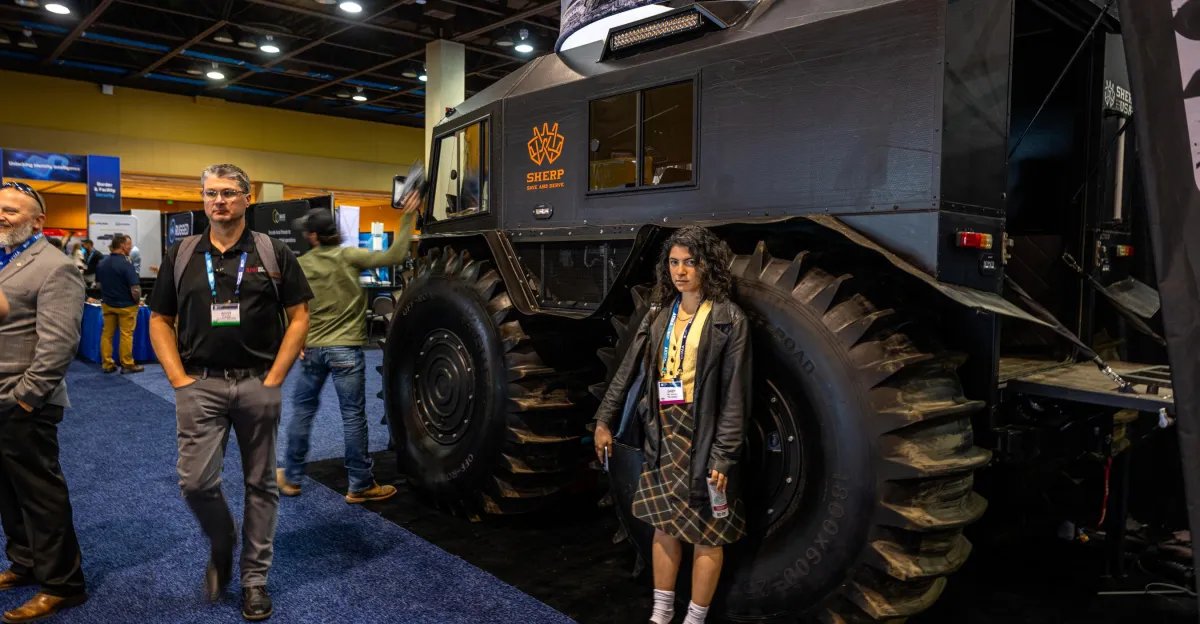
The expo floor was littered with the tools of border enforcement: cameras and watchtowers made by Anduril and its many competitors, lifted trucks with tires taller than the average middle schooler, drones and counter-drone systems, and a large orange sphere, divorced from its original context. The orb was out of place against the drab carpet and the harsh fluorescent lighting of the convention center, but a sign explained its purpose: “Cochrane USA’s Marine Floating Barrier has proved its worth on the nation’s southern border with Mexico. Deployed along the Rio Grande, the connected buoys encourage would-be border crossers to keep to established crossings.” Except when they don’t. Coupled with more aggressive enforcement by the Texas Rangers, the “floating wall” in the Rio Grande, first installed under the purview of Texas governor Greg Abbott, contributed to several migrant drownings in 2023. At least one body was found stuck to the buoys. Since the 1990s, the proliferation of surveillance technology along the US-Mexico border — itself part of a broader policy known as “prevention through deterrence” — has contributed to untold numbers of migrant deaths.


For years, this theoretically migrant-deterring technology has crept up from the border into the interior of the country. After a few laps around the convention center I began to realize that the most insidious tools were the ones I couldn’t see. The cameras and sensors in the desert are designed to be imperceptible, or something close to it, though there’s always a chance someone could stumble upon them. But Rodney Scott made it clear that the focus was no longer on the border. To track people deep in the country, people with lives and homes and jobs, ICE needs a different, even more invisible form of surveillance.
That’s where companies like Babel Street come in. I got to the Babel Street booth as they were shutting down, but I had been told there had been little to see there anyway. It was, my photographer told me, “three dudes sitting around a table.” I suppose this lack of visible product was in fact the product; the best surveillance tools, after all, are those you cannot see. The three dudes packing up the flyers and corporate swag I assumed once littered the table described the company to me only in the vaguest terms — “software,” “analytics” — and encouraged me to reach out to their communications department. CBP’s own descriptions are far more revealing. Babel Street’s Babel X platform, according to one internal document obtained by the Electronic Privacy Information Center, “can handle requests across more than 52+ social media platforms and millions of URLs and deep/dark web data. Babel X can perform cross-lingual searches across more than 200 languages, allowing users to enter terms in English and return foreign language results.” Perhaps most importantly, the platform “allows for networks discovery with social media link analysis.” Get the phone number or Instagram handle of one would-be border crosser and, after a quick search, you can figure out where to find his friends, family, and other associates.
CBP began awarding contracts to Babel Street in 2015, according to the Brennan Center for Justice, and used its tools to build out its Analytical Framework for Intelligence, a database that analyzes “non-obvious relationships” between individuals. Another Babel Street tool tracks people’s locations. In 2022, the ACLU found that DHS was buying location data from Babel Street and other private brokers to circumvent the typical warrant process. To obtain this data, Babel Street pays other developers to include its own code in their mobile apps. That code is then transmitted to Babel Street’s servers and shared with its customers. More recently, Amnesty International has warned that Babel Street’s technology has likely been used to target pro-Palestine student protesters. DHS has awarded more than $21 million to Babel Street since 2015, according to federal spending data. Babel Street did not respond to The Verge’s request for comment.


There’s a slim but growing possibility that the Trump administration will use these tools to target US citizens. Acting Attorney General Todd Blanche, who spoke at the expo — the first attorney general to do so — highlighted the administration’s efforts to strip some immigrants of citizenship. “We are on track to surpass the number of denaturalization filings the Biden administration submitted in four years,” Blanche told the audience. “We’re going to pass that, I think, in about a week.” As of late April, the Department of Justice had identified foreign-born Americans whose citizenship it sought to revoke, according to The New York Times. The department has directed civil litigators in 39 regional offices to file cases that would revert individuals’ citizenship, and the administration has ordered DHS to refer at least 200 people a month to the DOJ for denaturalization. For Blanche, this, too, is a form of border security. “We’re trying to protect the integrity of the naturalization process.”
“We’re not limiting ourselves to anybody in particular,” Blanche told CBS News, “except to say that unfortunately, and I think you’re going to hear more about this in the coming days and weeks, there are a lot of individuals who are citizens who shouldn’t be.” Blanche said only those who committed fraud to obtain their citizenship should be worried, but nativist groups like the Center for Immigration Studies have called on the government to “utilize evidence of post-naturalization behavior/beliefs” as proof of fraud. Membership in the Communist Party, for example, disqualifies an immigrant from obtaining US citizenship. Because of this stipulation, as well as the bar on naturalization for people engaged in “terrorism-related activities,” Rep. Andrew Ogles (R-TN) has urged the DOJ to strip New York City mayor Zohran Mamdani of his citizenship, given his criticisms of Israel and connection to the Democratic Socialists of America.


Under Trump, there is “an all-government approach to combating illegal immigration,” Blanche said on stage. The renewed focus on enemies within, however, does not mean the government has stopped worrying about threats beyond the border. “We do not view this as ‘mission accomplished.’ We do not view this as ‘We’ll move on to the next thing.’ We continue to view illegal immigration and border security as a top priority in the department,” Blanche said. Though migration was under control, the specter of the cartels loomed large in attendees’ minds. Luckily, the tools needed to stop the cartels were all here, for sale. The cartels have drones, so the government needs newer, better drones, not to mention jammers and other counter-unmanned aircraft systems technologies. And Trump, in designating drug cartels as foreign terrorist organizations, had allowed federal agencies to treat the drug war like an actual military conflict. “For the first time in our history, we’re treating them like terrorists and we’re blowing them up,” Blanche said.
Last fall, the military began bombing boats in the Caribbean and the Pacific Ocean, claiming these vessels are carrying drugs to the United States. A New York Times investigation found that there have been at least 57 strikes since September 2025, killing 192 people. The families of two Trinidadian fishermen killed by one such strike sued the Trump administration in January, alleging that the bombings are not only part of an “unprecedented and manifestly unlawful US military campaign” but also constitute a war crime. Blanche clearly disagreed. These strikes, he said, are “legal” and “right,” and “hopefully will create a disincentive for drug dealers to do what they’re doing.”
I entered the simulation and saw a protest. CBP officers, their backs to me, faced off against a hostile crowd. The officers wore tactical gear. The demonstrators, dressed in all black, shouted taunts and jeers. A fire blazed in the distance. It could have been Minneapolis or Los Angeles or downtown Phoenix. None of it was real, except that I had seen it before, in the flesh, and now it was happening again on a series of screens that surrounded me. This was one of more than hundreds of scenarios offered as part of VirTra’s deescalation training. This was not the scenario I would get to act out.
The operator put me in a shooting range and told me to shoot. The pistol he handed me was real, though the magazine had been taken out and replaced with an air cartridge; the CO₂ allowed for realistic recoil, and the way I was holding the gun, he said, would lead to the skin of my thumb being ripped clean off. I adjusted my hands and shot at the target in front of me, a white rectangle no one had informed me was a “hostage.” I’m a decent enough shot that the “hostage” was now dead. Then he put me in a real scenario. I was a police officer responding to a domestic disturbance. I walked into a house and heard screams and cries. A woman strapped to a chair, a man pointing a gun at her head, and then at me. “You can talk to him,” the operator said, and so I did. I said things like: “Put the gun down.” The man did not put the gun down. He shot the woman and then he shot me and then the scenario was over.


“Did you hear the baby crying?” the operator asked me. I had not. “You were in what’s called auditory exclusion. So when you get high stress, the body starts to lose sight, hearing. You end up with tunnel vision, and then your vision is black. Your senses, everything, ability to think straight, shut down.” Later, a different representative told me that VirTra made 38 scenarios last year alone. Some are for crowd control, others for deescalation training. Some are custom for CBP. DHS has awarded VirTra more than $34 million in contracts since 2014.
Other crowd-control tools were on display elsewhere on the floor. One booth sold laser-proof hats and modular tactical gear; another advertised riot gear for horses. The representative there wasn’t particularly chatty. Nearly everyone, in fact, tensed up as soon as I identified myself as a reporter. A southern gentleman at the Goldbelt, Inc. booth asked if I was part of the “doctrinaire media.” The gaggle of twenty-somethings representing Anduril told me to email their comms person. One helpful Amazon Web Services employee was all too happy to help me make an AI avatar of myself as a border guard, but his colleagues demurred when I asked about the surveillance cameras displayed at their booth.
A photojournalist told me that the media had initially been banned from the 2025 expo, though the organizers later reversed course. This year, reporters were identifiable by red or pink stripes on our badges, literal scarlet letters warning attendees about our presence. Hundreds of millions of dollars were on the line. No one wanted to get caught talking out of turn.
But everyone was being watched. Every third display or so featured an array of surveillance cameras, many of them operational. At the StrongWatch booth, a laptop played footage from the other side of the convention floor. A gaming controller was attached. Both were connected to a camera hoisted atop a pickup truck. I soon learned how to use the controller to maneuver the camera along the expo floor. I toggled between white-hot, black-hot, and red-hot infrared views. I zoomed in on attendees’ heads, their hands, their faces. The thermal view betrayed their feelings: One man’s nose and ears were a different color from the rest of his face. I suspected that he was cold, and when I flipped the camera back to the full-color spectrum, my suspicions were proven right. His ears and nose were slightly red from the chill of the ever-present air conditioner. He talked to his colleagues, took a sip of his drink. He had no idea I was watching, and I wondered then who might be watching me.