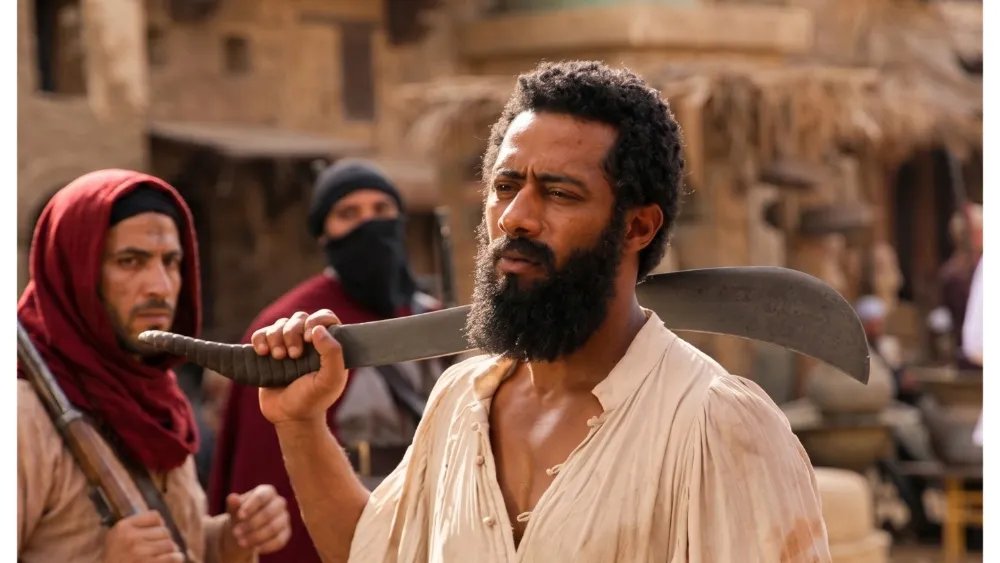
Egyptian director Mohamed Diab, who made a splash at Cannes in 2016 with Islamic fundamentalism-themed thriller “Clash” and more recently helmed Marvel’s “Moon Knight” miniseries, is set for a wide Middle East release of his historical epic “Asad,” toplining Arab megastar Mohamed Ramadan and British-Lebanese star Razane Jammal.
Ramadan, an actor and singer – who last year became the first artist from Egypt to perform at the Coachella Valley Music and Arts Festival – plays the titular character in “Asad,” a role inspired by the Ancient Rome rebel slave Spartacus whose love for a free woman, played by Jammal – who broke out internationally in Netflix’s “The Sandman” – ignites a fierce confrontation with his masters.
Produced by Egyptian producer Moussa Abu Taleb’s Good Fellas Media Production (not to be confused with the French sales company with a similar name) in collaboration with Saudi Arabia’s Big Time Fund and Scoop Egypt, “Asad” will be released in Egypt on May 14 segued by a wide May 21 MENA region rollout via distributor Empire International that is “on the same scale as any big Hollywood movie,” Abu Taleb tells Variety.
Abu Taleb, who is also in talks to sell “Asad” to India and China, has high hopes for this ambitious production conceived as a large scale Arab epic featuring thousands of extras, lavish action scenes, and world class production values.
Variety speaks to Diab about transitioning back from Hollywood to Egypt and his intense collaboration with Mohamed Ramadan that went as far as them splitting the cost of doing a one-day reshoot, which they both thought would crucially improve the movie.
This is your first Arab blockbuster and your first Egyptian film after directing “Moon Knight” in Hollywood. Talk to me about the challenge of tackling a project of this type in the Arab world
I never liked the disconnect between arthouse and audience. But I have Hollywood savvy. So for me, this is a commercial film, yes. But it’s also about an important subject that matters a lot to me: slavery and humans, which is something timely because slavery is still a problem in a different way. So I think everyone can relate to a story like this. Also, I don’t think we’ve ever seen a film about slavery from our part of the world. So the thematic aspect was a big challenge. In terms of the visuals, the challenge was that this film cost around $7 million. But I wanted to show what you can do with $7 million in Egypt. I think it looks like it cost at least $40 million.
Tell me more about the challenges of shooting in Egypt
I was lucky that I came from “Moon Knight,” which combined huge production value with huge money. I learned a lot of things. So, in a way, I used that experience as much as possible with what in comparison was our small production. Shooting in Egypt is very different than shooting in Hollywood. You can do whatever you want. The thing I like the most about it is the chaos, which is also what I hate about it the most. Every day something gets effed up. But I like that a dollar goes a long way. As I told you, $7 million is considered expensive in Egypt but the film feels and looks like a big-budget epic. “Moon Knight” was like $165 million. I could the Pyramids in Egypt with that money!
Talk to me about working with Mohamed Ramadan, among the Arab world’s biggest stars, of course.
Mohamed is the biggest megastar in the Middle East and the Arab world. He’s especially successful when it comes to TV. In fact this is what I consider his first really big [theatrical] movie. And I would say he gave it his all. He’s the biggest star in the in the Arab world, but his level of commitment to the project was exemplary. Shooting a film like this is very demanding. In terms of stunts he had to swim and dive even though he doesn’t know how to swim or dive. He had to do a lot of things himself. And he had to make a commitment for over two years. That was the toughest challenge. Then, even after the film was done, he and I watched it, and I told him: “You know what? We need another day of shooting.” At that point we had completely dried out the producer’s resources. So Mohammed and I decided that we would finance that extra day with our own money. And he immediately said: “Ok.” He partnered with me on everything.
You recently revealed that you have a Netflix film in the works titled “The Note” about your fascination and, as I understand it, disillusion with the American dream. Tell me more.
It’s a passion project about my experience living in the U.S., living in Hollywood, and an actual event that happened that turned my life around. I’m in the process of writing the script. It’s taken me some time to figure out what my next step was in Hollywood. In a way, it’s a critique of Hollywood while also critiquing myself and my fascination with the U.S. I speak almost perfect English, which learned from movies and songs, not from school. I remember the first time I went to the U.S. all I wanted to do was hear people speak with an American accent, just like in the movies. You know what I mean? That’s how fascinated I was. I was in love with American culture. And then I lived the height of the American dream, as a director, inside the big Hollywood studios. Which is all I could ever wish for. So now I’ve lived that. This film is about critiquing my own experience and my over-the-top expectations. And the Hollywood dream. Actually above all, the American dream.
Pictured below from left to right: Amr Diab, Moussa Abu Taleb