
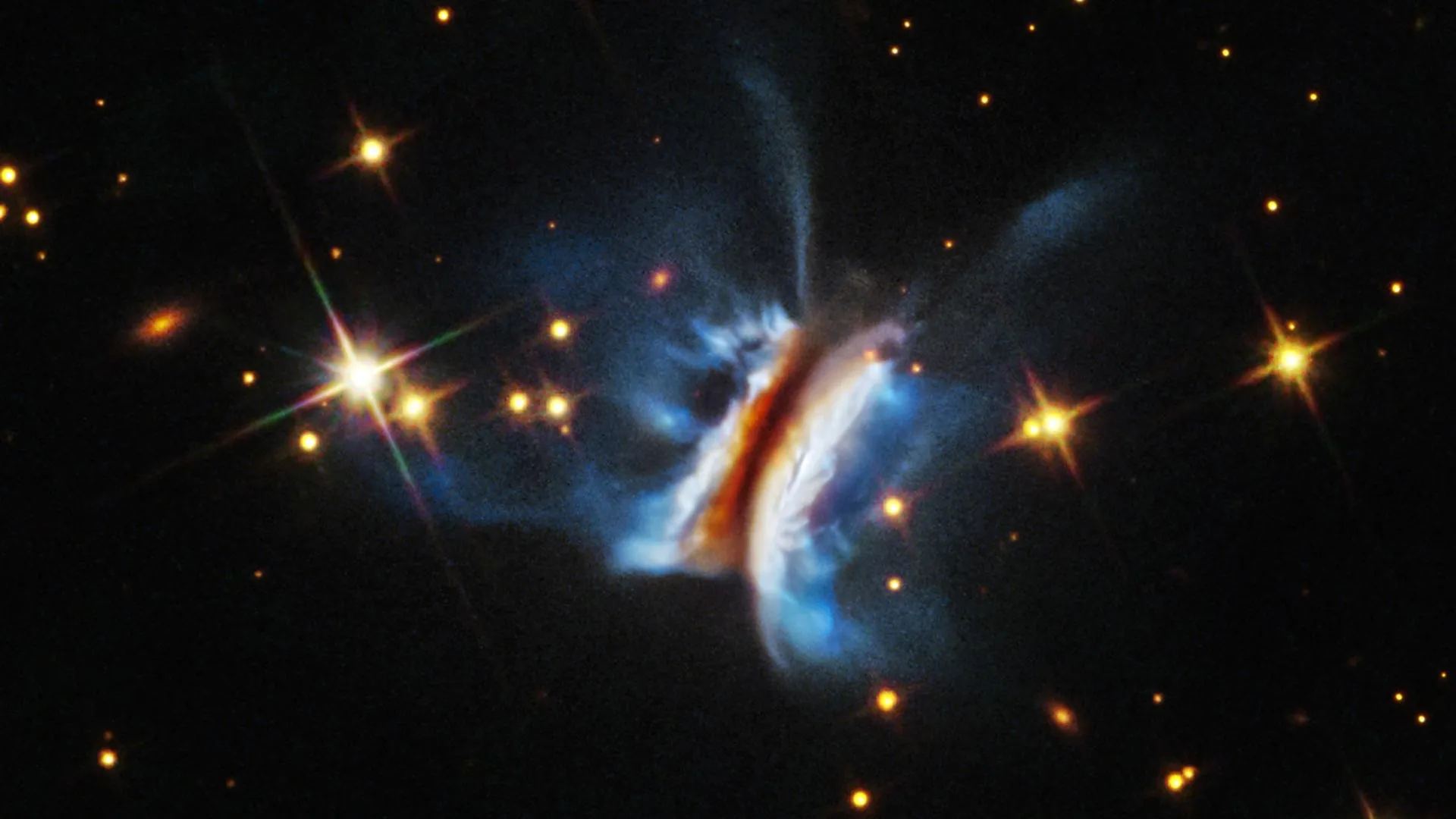
NASA’s Hubble Space Telescope has captured the most detailed visible light images ever taken of the largest known protoplanetary disk surrounding a young star. The enormous structure appears far more chaotic and turbulent than astronomers expected, with huge wisps of gas and dust extending high above and below the disk. Even more unusual, the longest filament-like structures can only be seen on one side.
The discovery, published in The Astrophysical Journal, offers scientists a rare look at how planets may form in extreme cosmic environments and highlights Hubble’s continuing role in exploring the universe.
Giant Planet-Forming Disk Unlike Any Seen Before
The system, known as IRAS 23077+6707 and nicknamed “Dracula’s Chivito,” is located about 1,000 light-years from Earth. The giant disk stretches nearly 400 billion miles across, making it about 40 times wider than our solar system out to the Kuiper Belt.
At the center of the disk is a young star hidden by thick clouds of dust and gas. Researchers think the object may be a single massive star or possibly two stars orbiting each other. Besides being the largest planet-forming disk ever identified, scientists say it may also be one of the strangest.
“The level of detail we’re seeing is rare in protoplanetary disk imaging, and these new Hubble images show that planet nurseries can be much more active and chaotic than we expected,” said lead author Kristina Monsch of the Center for Astrophysics | Harvard & Smithsonian (CfA). “We’re seeing this disk nearly edge-on and its wispy upper layers and asymmetric features are especially striking. Both Hubble and NASA’s James Webb Space Telescope have glimpsed similar structures in other disks, but IRAS 23077+6707 provides us with an exceptional perspective — allowing us to trace its substructures in visible light at an unprecedented level of detail. This makes the system a unique, new laboratory for studying planet formation and the environments where it happens.”
The unusual nickname reflects the backgrounds of the researchers involved. One scientist is from Transylvania, while another is from Uruguay, where a chivito is a popular sandwich. Viewed edge-on, the disk resembles a hamburger with a dark center surrounded by glowing layers of dust and gas above and below it.
Mysterious One-Sided Filaments
Scientists were especially intrigued by the disk’s uneven appearance. Hubble’s images revealed towering filament-like structures extending from only one side of the disk, while the opposite side appears sharply defined and lacks similar features.
Researchers believe this strange asymmetry could be caused by active processes within the system, such as fresh material falling into the disk or interactions with nearby surroundings.
“We were stunned to see how asymmetric this disk is,” said co-investigator Joshua Bennett Lovell, also an astronomer at the CfA. “Hubble has given us a front row seat to the chaotic processes that are shaping disks as they build new planets — processes that we don’t yet fully understand but can now study in a whole new way.”
Clues to How Planetary Systems Form
Planetary systems develop from massive disks of gas and dust surrounding young stars. Over time, some of the material falls into the star while the remaining matter gradually forms planets.
Scientists estimate the mass of IRAS 23077+6707 may equal 10 to 30 times the mass of Jupiter, providing more than enough material to create several giant planets. Researchers say the system could resemble an oversized version of the early solar system.
“In theory, IRAS 23077+6707 could host a vast planetary system,” said Monsch. “While planet formation may differ in such massive environments, the underlying processes are likely similar. Right now, we have more questions than answers, but these new images are a starting point for understanding how planets form over time and in different environments.”
Hubble’s Continuing Discoveries
The Hubble Space Telescope has operated for more than 30 years and continues to deliver major discoveries that expand scientists’ understanding of the cosmos. Hubble is a joint project between NASA and ESA (European Space Agency). NASA’s Goddard Space Flight Center in Greenbelt, Maryland, oversees telescope and mission operations, while Lockheed Martin Space in Denver also supports operations. The Space Telescope Science Institute in Baltimore, operated by the Association of Universities for Research in Astronomy, manages Hubble’s science operations for NASA.


