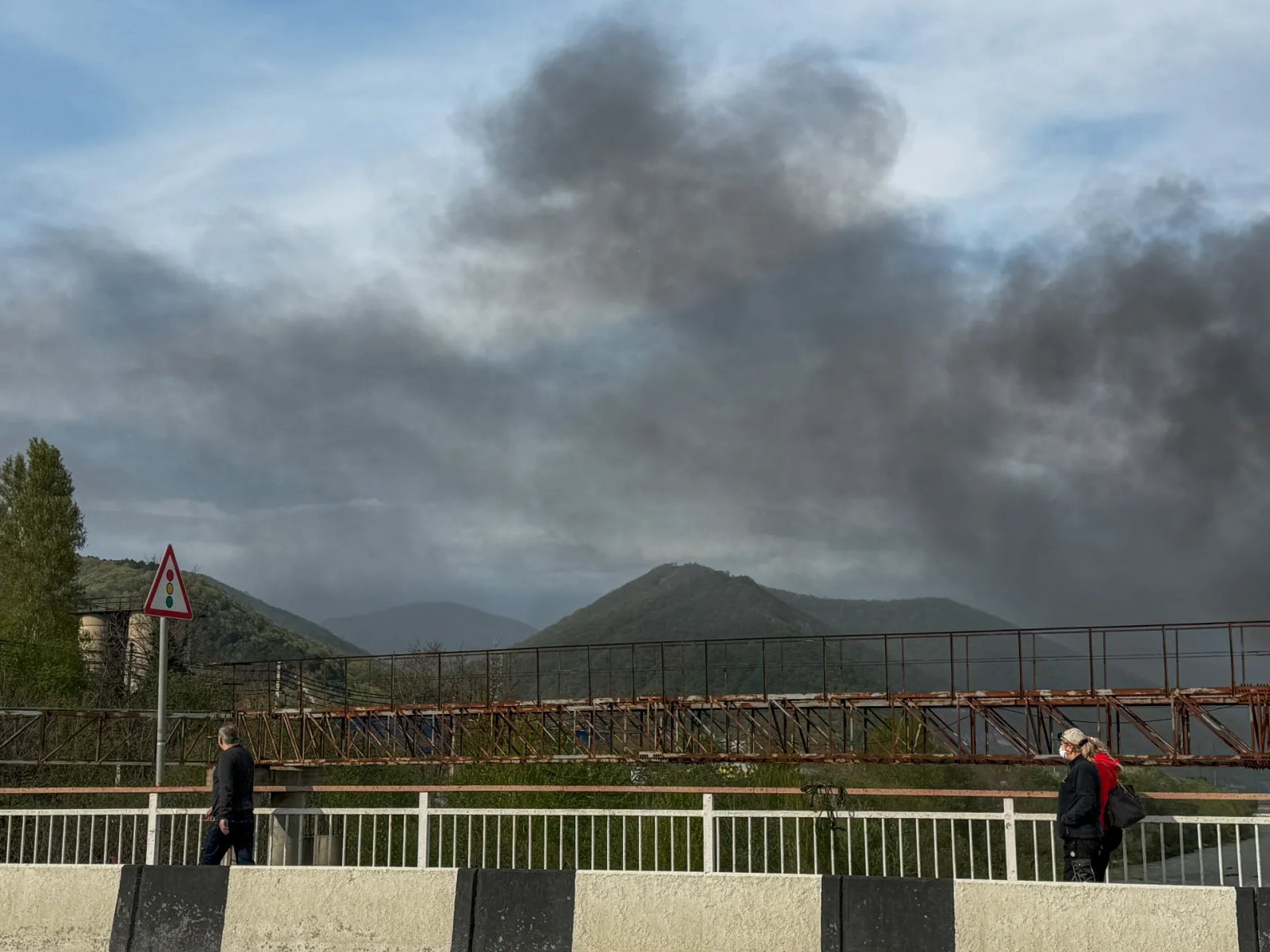
Southern Russia is facing one of the largest environmental disasters in its modern history. In April, repeated Ukrainian strikes on Russian oil infrastructure in Tuapse triggered massive refinery fires and oil spills along the Black Sea coast, including near Sochi. Residents described “black rain” falling from the sky as smoke and petroleum residue spread across the region. Weeks later, wildlife is still dying, beaches remain polluted and volunteers trying to respond say their efforts have often been obstructed. The authorities, meanwhile, have focused less on confronting the scale of the catastrophe than on silencing those speaking out about it. Despite the ongoing environmental damage, officials are already discussing reopening the beaches and launching the tourist season.
The catastrophe raises difficult questions about environmental destruction during wartime. Ukraine, which has experienced countless environmental catastrophes related to Russia’s all-out war, has been among the leading actors advocating for the recognition of ecocide as an international crime, even though the concept has yet to be formally codified in international law. Following the April strikes, however, some environmental activists in Russia and beyond are now also accusing Ukraine of hypocrisy and causing long-term environmental harm through strikes on oil infrastructure. There is a real debate over whether such actions can be justified, even when targeting an aggressor, if their environmental consequences may last for decades.
But focusing exclusively on Ukrainian strikes risks obscuring the deeper structural causes of the disaster. Russia’s oil infrastructure is deeply embedded in its war economy, and environmental damage of this magnitude does not occur in a vacuum. It is shaped by years of deregulation, lack of oversight and the systematic dismantling of environmental protections. These trends have only intensified during the full-scale invasion, as environmental safeguards have increasingly been cancelled in order to sustain the war economy. This includes recent legislative changes affecting the protection of Lake Baikal — a unique ecosystem that contains around 23 percent of the world’s unfrozen freshwater — raising concerns among experts about long-term environmental risks.
For years, environmental organisations in Russia have been labelled “foreign agents” or declared “undesirable”, independent environmental movements have been dismantled and activists forced into exile. The current catastrophe is unfolding in a country where ecological disasters are often silenced rather than addressed.
What is striking in the current situation is not only the scale of the damage but the response of the authorities. Rather than responding with transparency and accountability, Russian officials have largely attempted to silence discussion around the disaster. This recalls earlier patterns, including the initial response to the Chornobyl disaster, where secrecy and delayed disclosure significantly worsened the human and environmental consequences.
In this sense, responsibility does not lie only in the immediate cause of the disaster, but also in the absence of preparedness, regulation and accountability.
This disaster has also triggered an unusual wave of discussion within Russia itself, much of it unfolding online, despite increasing censorship. Volunteers on the ground have reported being obstructed and, in some cases, harassed while trying to rescue wildlife. Journalists attempting to document the situation have faced detention. Even as the catastrophe unfolds, the space to speak about it remains tightly controlled.
Yet the public reaction is telling. Much of it is happening on Instagram, which is banned in Russia, and on other social media platforms, with people still using VPNs to speak out and read real news. Rather than turning primarily into accusations against Ukraine, much of this discussion has been directed at the Russian authorities. The disaster is being used, implicitly and sometimes explicitly, to question the lack of coordination, the absence of transparency and the broader political system that allows such crises to happen.
This is significant. In a country where even calling the war a war is effectively prohibited, environmental catastrophe has become one of the few channels through which criticism can still surface.
The situation also exposes a deeper problem that goes beyond Russia. It highlights a fundamental gap in international law: the lack of effective mechanisms to address large-scale environmental destruction in the context of war.
Recent events illustrate the consequences of this gap. The destruction of the Kakhovka Dam caused massive ecological damage, yet failed to generate sustained legal or political accountability at the international level. Since then, environmental destruction has continued to accompany the war, without clear mechanisms to address it.
More broadly, the issue is being sidelined. The war in Ukraine has become so heavily politicised globally that discussions of its environmental consequences are often reduced, avoided or absorbed into larger geopolitical narratives. From the perspective of an environmental activist from Russia, this creates a deep sense of helplessness. These issues are becoming harder to raise, not because they are less important, but because they are competing with an overwhelming number of global crises.
This frustration is also visible within parts of the Russian antiwar movement, where there is a growing perception that international actors are more focused on the economic consequences of the conflict than on addressing its deeper causes and risks that go beyond military threats.
Meanwhile, environmental destruction across Russia, a country that spans one-10th of the Earth’s land surface, continues with little international attention. This includes not only wartime damage, but also longstanding patterns tied to extractivism, colonial governance in national republics, and the systematic marginalisation of Indigenous communities. These are not separate issues. They are part of the same underlying problem, one that remains largely unaddressed.
Environmental exploitation in Russia’s regions has long been tied to older imperial patterns of control and dispossession. These same southern regions are also the regions where the Russian Empire committed genocide against the Indigenous Circassian people, exterminating and expelling more than 95 percent of the local population in the late 19th century. And now, what the Russian authorities seem to care about is not the environmental devastation itself, but reopening the beaches so the region can continue generating income.
While Europe is preparing to spend hundreds of billions of euros responding to what it sees as a growing Russian military threat, far less attention is being paid to the political and economic structures sustaining environmental destruction inside Russia itself. From the perspective of an environmental activist and someone finishing a master’s degree in international affairs, there is a striking gap in how the root causes of this crisis are being addressed.
Too little attention is paid to the deeper structures that sustain it: Russia’s colonial governance and extractivist economic model in the regions of Russia. These issues remain underexplored not only in political decision-making but also in academia and media coverage. This gap is particularly visible in the missed opportunities to engage with emerging Russian decolonial movements and Indigenous activists from national republics, who have long been raising precisely these concerns. Their perspectives remain marginal, even though they are essential for understanding both environmental destruction and political instability in the region.
Many international organisations and NGOs have also scaled down or abandoned work related to Russia’s internal environmental and human rights issues, as well as broader regional dynamics in Eastern Europe and Central Asia. As a result, entire areas of expertise are disappearing at the very moment they are most needed. Voices that could contribute to a deeper understanding, and potentially to long-term solutions, are increasingly sidelined or ignored.
And when catastrophe comes, people are left asking how it became possible for oil to fall from the sky.
The views expressed in this article are the author’s own and do not necessarily reflect Al Jazeera’s editorial stance.