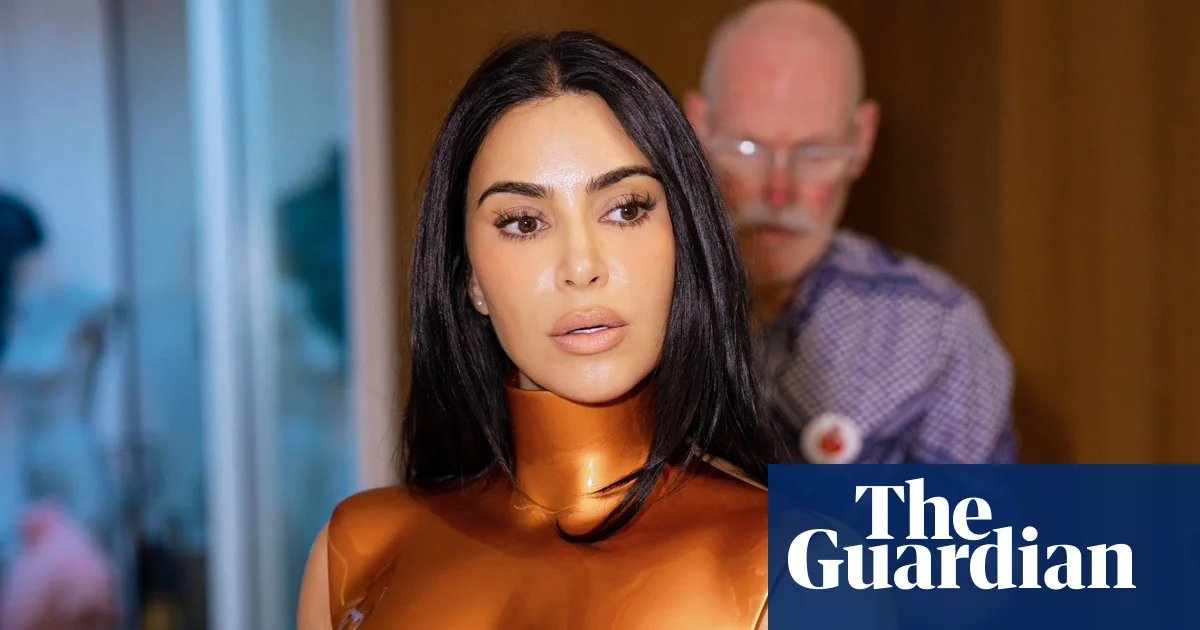
At Monday’s Met Gala, it inevitably fell to Kim Kardashian to deliver the evening’s biggest jolt. One of the few celebrities to straightforwardly interpret the “fashion is art” dress code – which focused on how the dressed and undressed human body is the through-line in most works of art – she decided to forgo her usual role as a walking billboard for a major fashion house and instead arrived in an orange fibreglass breastplate created by a small east London art duo and a car bodyshop in Kent.
“Good art should start conversation, and Kim did exactly that,” says 61-year-old Patrick Whitaker, half of the design practice Whitaker Malem, who made the breastplate just weeks before the gala. “She was very clear on wanting a breastplate, very clear on the car body finish. And I think she was nervous really. She understands the competition.”
She also found out from Anna Wintour that five other people were wearing breastplates, including her half-sisters, Kylie and Kendall Jenner. Soft armour and pert nipples might have been the themes of the night, but for someone that famous, says Whitaker, it’s still a risky proposition to wear it.
Speaking at the home he shares with his partner, Keir Malem, 60, the duo are still recovering from watching the gala live. “We went to bed at 5am. It’s surprisingly tedious, isn’t it? A bit Hunger Games,” says Whitaker.
The breastplate was a three-way collaboration between the pair, the British pop artist Allen Jones and the visual artist Nadia Lee Cohen (a frequent collaborator of Kardashian). On the night, Kardashian attended the gala with Jones.
Jones’s fetishistic furniture made from topless women – made as a continuing series between the early 80s and 2015 – ignited second-wave feminist outrage. Yet it continues to permeate and often influence the fashion industry, from the armoured silhouettes of Thierry Mugler to the Pirelli calendar, and now the steps of the Met Gala.
The collaboration began in early April after Whitaker and Malem received a call from Kardashian directly asking if they would build her something for the gala. During one video call at their seaside home in Kent, he says: “We were just talking about how firm her body was, and she was just showing me her breasts on a video call whilst Keir and his dad were eating their dinner in the background.”
The following week, Kardashian flew to the UK and drove to Allen’s Oxfordshire home “with one of her body dummies chucked in the hold like it was a Volvo”, says Whitaker. The breastplate was cast by Whitaker Malem from an original mould derived from Jones’s 1969 Hatstand sculpture, to which they added a hand-painted leather skirt. She had tried on various fibreglass moulds, and remarkably, her waist and top half fit. “We’d never seen an Allen Jones breastplate fit anyone so well,” says Whitaker. “They aren’t really designed to be worn.” Kardashian made several trips to east London to try on the breastplate.
It was finally sprayed orange by Martyn Smith, who runs a body workshop, MPS Body and Paint, in Lydd, Kent. “It was several layers, so primers and stoppers and the final paint was solvent base, and finished with a gloss lacquer,” he said. “It took all day, but it came out so well. I was worried, though. I’m not a follower of Kim Kardashian or fashion, but I knew it was going to appear at a big event,” he says. “Martyn does our Jag, so we know he’s reliable,” says Whitaker.
Whitaker and Malem founded their design practice Whitaker Malem in 1988. Neither artists nor designers, they prefer the term “pop artisans” and make about 12 garments a year, starting at a few thousand a piece. They primarily work with leather, and have perfected a form of wet-moulding and sculpting it for clothes. Working using block moulds, it is a process highly analogous with footwear and millinery.
The breastplate was actually made from a type of fibreglass called glass-reinforced plastic. The breastplate weighed the same as a bag of flour and Kardashian was naked underneath.
The finished piece was collected a few days before the gala by “some poor flustered man who’d flown first class from Los Angeles to pick the piece up, and then was turning tail, going back to Heathrow, and had a seven o’clock flight to New York”. Unable to book a seat for the outfit itself because “it didn’t have a name”, the breastplate was placed in the overhead locker.
Whitaker was a student at St Martin’s when he met Malem, who was working in theatre at the time. They occasionally showed at fashion week, though it wasn’t until the late 1980s when Bros bought one of their jackets that they were able to focus on their leather work. They have dressed everyone from Cher to Bella Hadid and worked with numerous designers, including Tommy Hilfiger and Burberry.
The designers’ biggest work has been in the film industry. A gilded breastplate and wing bustier created for Lee McQueen at Givenchy led to them making Brad Pitt’s skirt in Troy and Wonder Woman’s suit from the 2009 film, along with several Bond girl costumes, including Halle Berry’s white belt worn in Die Another Day, which now hangs on a wall in their home. Angelina Jolie’s Lara Croft suit was made using materials from nearby Ridley Road in Dalston. The Hollywood segue was lucrative but they rarely got credit. “Some of the costume designers bought these pieces off the rack and were pretending they designed them.”
It was after the complicated task of creating Christian Bale’s batsuit, made from moulded urethane, carbon fibre and mesh, that they discovered “the glorious body scanning game”. To make the form, it is produced by a 3D printer then refined by hand using a sharp knife, before the leather is draped over it using their wet mould process.
Jones received a lot of criticism for his work, says Malem, but with Kardashian he’s cleverly flipped this on its head. “Instead of the usual girl draped across the car, he wanted to put the car on the girl.”