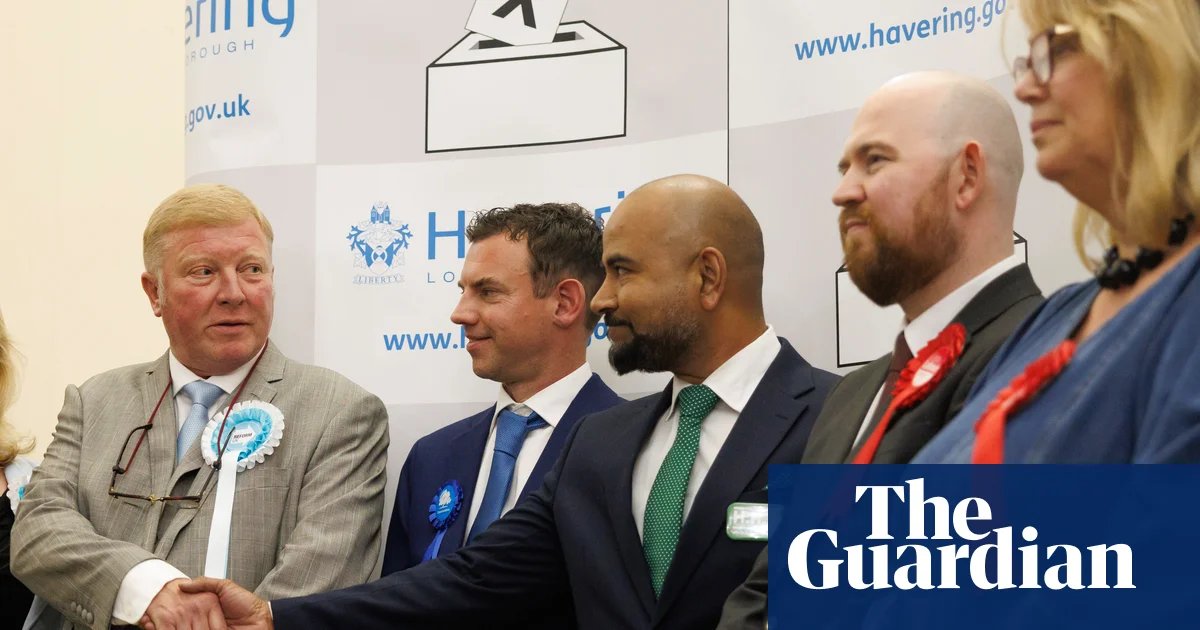
English local election results require careful interpretation. Not all places have them at the same time, a relatively small proportion complete their counts overnight and the early headlines may not reflect outcomes later in the day.
But the headline number on Friday morning – that Labour has lost more than 250 councillors – will only grow as the day progresses. While Labour will want to stress that these “mid-term” elections often go badly for the incumbent Westminster government, they rarely go quite as badly as this.
The main beneficiary has been Reform UK, which began from a standing start, having not contested the previous elections for these councils, and now has almost 400 councillors with undoubtedly many more to come. The size of losses and gains will change, but these early headlines are unlikely to.
However, with results still to come from large parts of England, including many London councils, and with votes for the Scottish parliament and Welsh Senedd still to be counted, further nuance will be added to this picture, if not in terms of the Labour losses, then in terms of who has benefited.
Some caution is required in extrapolating from the headlines to voter behaviour. We cannot assume that because Labour has the most losses and Reform the most gains that voters switched directly from Labour to Reform. Even if Labour has lost a seat directly to Reform this may not be because of direct switching. A split vote on the “left”, for example, Labour losing votes to the Green party, can make the winning threshold lower.
And we have already seen many close contests and low winning shares. Labour held Waltham Cross in Broxbourne with 28.7% of the vote, while Reform came second on 28.1%.
It is not possible from the profile of results to infer how voters moved between parties, or how any particular group of voters cast their votes.
What is striking about these results is not just the poor performance of the government, or the sustained success of Reform UK, but rather the change in the system from a creaking two-party system a year ago to a fully-fledged system of five-party politics in England.
This has been evident in polls of Westminster voting intention for some time, with the combined Labour and Conservative share of the vote rarely above 40%, and the Green party challenging for second place with some pollsters. But it is the first time the full effect of this has been seen at the ballot box.
This fragmentation of the electorate poses challenges for all parties in the first-past-the-post system, though results in Wales may show that these challenges do not disappear even in a fully proportional system. Labour and the Conservatives now have parties positioned on both their flanks, and turning to either one risks losing votes on the other, so finding messages that unite them is key to forging a large enough coalition within the electorate to form a government.
Failing to do so means the coalition building must be done between parties rather than within them, a process that will begin next week in a large number of councils that have moved to no overall control.
The 2024 general election was primarily a story of a highly unpopular incumbent government that lost votes in many different directions. The Labour party is increasingly in the same bind. The Conservatives have so far been unable to shake off that mantle and continue to lose local councillors after two years in opposition. Labour will hope they can find a way to avoid the same fate.