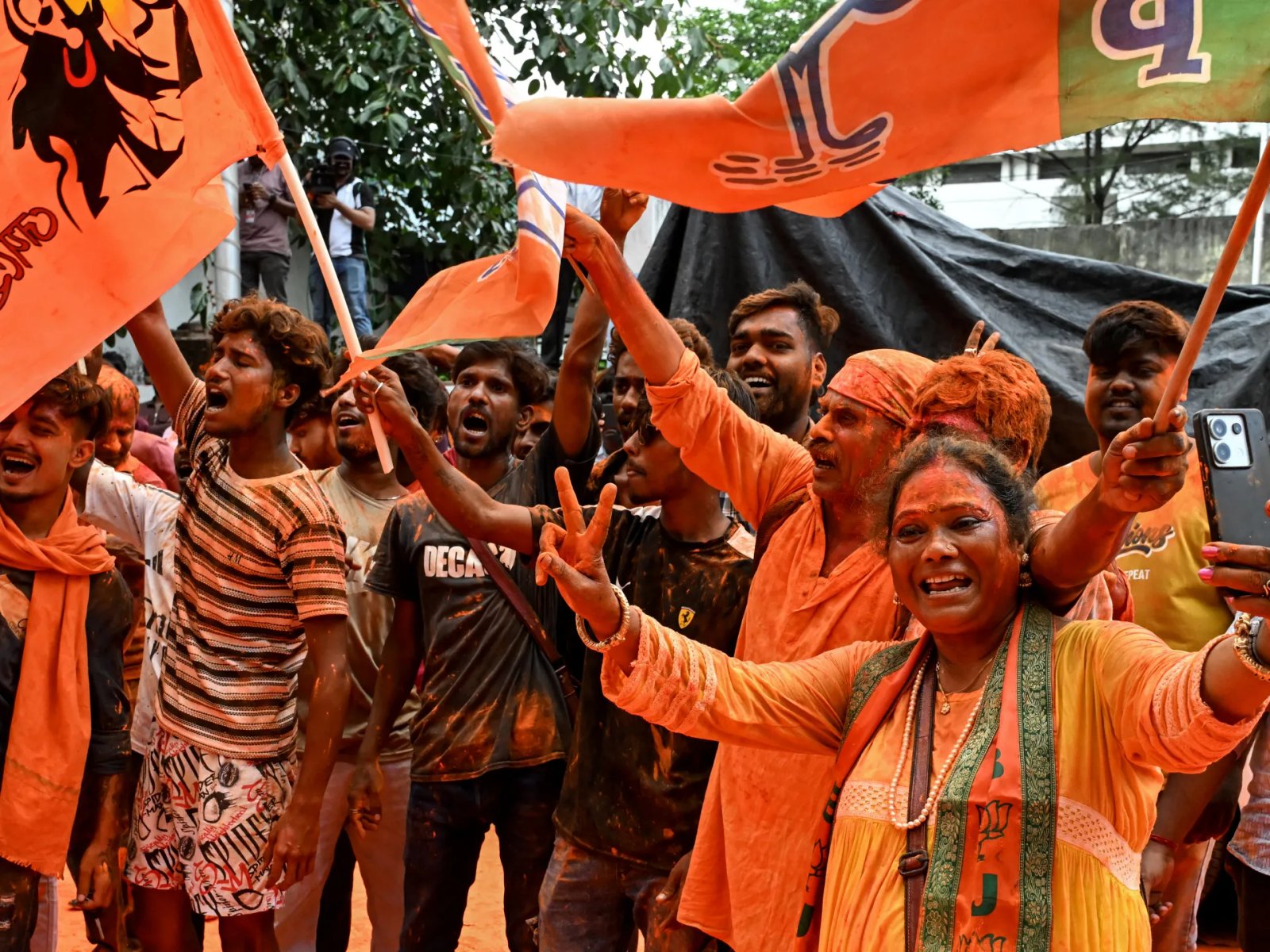
Recent state elections in India have produced one of the most consequential political verdicts in the country’s contemporary history, especially in West Bengal (WB), a border state of more than 100 million people that has long resisted the advance of Prime Minister Narendra Modi’s Bharatiya Janata Party (BJP).
For the first time in history, the BJP has captured power in Bengal, winning 207 of the 293 seats declared so far and reducing the TMC to 80. One seat is due for repolling.
The scale of the BJP’s victory has transformed India’s political map. But the verdict has also triggered profound questions over the integrity of the electoral process itself.
The election took place after an extraordinarily sweeping and deeply controversial “Special Intensive Revision” (SIR) of electoral rolls conducted by the Election Commission of India (ECI), ostensibly to remove duplicate, deceased or “ineligible” voters. Across West Bengal, more than nine million names — nearly 12 percent of the electorate — were initially flagged, removed or subjected to scrutiny during the exercise.
The exercise disproportionately targeted Muslims, migrant workers and poorer voters in districts where the BJP has historically struggled electorally. In many constituencies won by the BJP, the number of deleted or disputed voters exceeded the margin of victory.
The implications are grave. India may have crossed from electoral distortion into mass disenfranchisement.
Bengal is not merely another Indian state. Partitioned in 1947 on religious lines during the violent birth of India and Pakistan, it shares a border of more than 2,200 kilometres with Bangladesh and has long occupied a central place in India’s political imagination. Muslims constitute roughly 27 percent of the state’s population and have historically voted strategically to block the BJP’s rise.
That is precisely why Bengal mattered so much to Modi.
The BJP had expanded rapidly in the state over the past decade but failed to dislodge Chief Minister Mamata Banerjee in 2021. The 2026 election was therefore viewed both as a referendum on Banerjee’s weakening government and as a test of whether Indian elections still retained the institutional credibility they once enjoyed.
The controversy centred on the SIR process, which was first rolled out in Bihar in June 2025 before being expanded to nine states and three Union Territories, including West Bengal.
Under the exercise, Booth Level Officers — local election officials tasked with maintaining voter rolls — conducted house-to-house verification of voters. Citizens were required to re-establish their eligibility through documentary proof within extremely tight deadlines. Failure to do so could result in deletion from the electoral rolls.
For the first time since India adopted universal adult suffrage in its first general election of 1951-52, the burden of proving voting eligibility was effectively shifted to citizens themselves.
This represented a dangerous rupture in the democratic compact.
The process hit migrant workers particularly hard. Bihar and Bengal are among India’s largest sources of migrant labour, with millions working in distant states. Many were unable to return home within the narrow verification windows. Others struggled with inconsistencies in spelling, missing legacy documents, changes of surname after marriage or discrepancies between official records.
These problems were especially acute among Muslims and poorer women.
The ECI insisted the exercise was administrative and necessary to remove duplicate or fraudulent entries. The BJP framed it as an attempt to eliminate “illegal infiltrators”, especially alleged undocumented Muslim migrants from Bangladesh.
But in Bengal, the exercise quickly acquired the character of a political operation.
Districts with large Muslim populations witnessed some of the highest voter deletions. The process lacked transparency, while AI-assisted “logical discrepancy” software disproportionately flagged Muslim names because of transliteration inconsistencies between Urdu, Bengali and English spellings.
The TMC repeatedly alleged that the ECI was functioning less as an independent constitutional body and more as an extension of the ruling party’s political machinery.
The Supreme Court of India intervened several times but ultimately allowed the process to continue. Millions filed appeals after discovering their names had disappeared from the rolls. Yet more than 3.4 million appeals remained pending before polling, with fewer than 2,000 cleared in time. The court ruled that voters whose appeals had not been decided would still be barred from voting in the election, although their names could theoretically be restored later.
That judgement effectively legitimised disenfranchisement on a massive scale.
On a personal level, I experienced the process myself.
My family had to re-establish its eligibility to remain on the voter rolls in Uttar Pradesh, where elections are due next year. Compared with Bengal, deadlines there were longer and the scrutiny somewhat less severe. Yet even navigating the process revealed its harrowing and exclusionary character. Elderly people, migrants, women with inconsistent documents and poorer citizens faced a bureaucratic labyrinth that many simply could not overcome.
Several officials privately admitted that Hindu voters had less reason to fear deletion than Muslims.
Eventually, roughly 2.7 million voters in Bengal were officially struck off the rolls. Millions more remained trapped in unresolved appeals and verification disputes before polling day.
The BJP polled 29,224,804 votes, 3,211,427 more than the TMC’s 26,013,377. Analysts examining constituency-level data argue that in many seats won by the BJP, the number of deleted or disputed voters exceeded the margin of victory.
It is thereby appropriate to contend that there are grounds to suspect the verdict was “stolen” with the assistance of the state machinery, including the ECI, although it is constitutionally mandated to function as an impartial body.
The BJP’s victory was also aided by a Hindu majoritarian campaign that grossly exaggerated the TMC’s supposedly “pro-Muslim” stance and heightened Hindu insecurity.
After the BJP’s setback in the 2024 parliamentary election, when Modi lost his outright majority and became dependent on coalition partners, the party began recalibrating its electoral strategy.
One strand of this effort was the proposed delimitation exercise, under which parliamentary and assembly constituencies would be redrawn in ways likely to favour northern and Hindu-majority regions. In Assam, where the BJP also returned to power comfortably this year, earlier delimitation exercises had already weakened Muslim electoral influence in several constituencies.
The second initiative was the expansion of the SIR process across India, whose political consequences became most dramatically visible in Bengal.
The third is the push for “One Nation, One Election”, a project intended to synchronise all state and national elections. Presented as administrative reform, the proposal would further centralise political power around Modi and weaken the ability of regional parties to resist the BJP’s national machinery.
Taken together, these developments point towards an attempt to permanently reshape the architecture of Indian democracy.
Much of India, now under BJP rule, is under the stranglehold of Hindutva, the party’s Hindu sectarian ideology. Coupled with the erosion of electoral and democratic integrity, the current idea and image of India faces erasure and replacement with a grossly authoritarian and Hindu-majoritarian order.
The views expressed in this article are the author’s own and do not necessarily reflect Al Jazeera’s editorial stance.