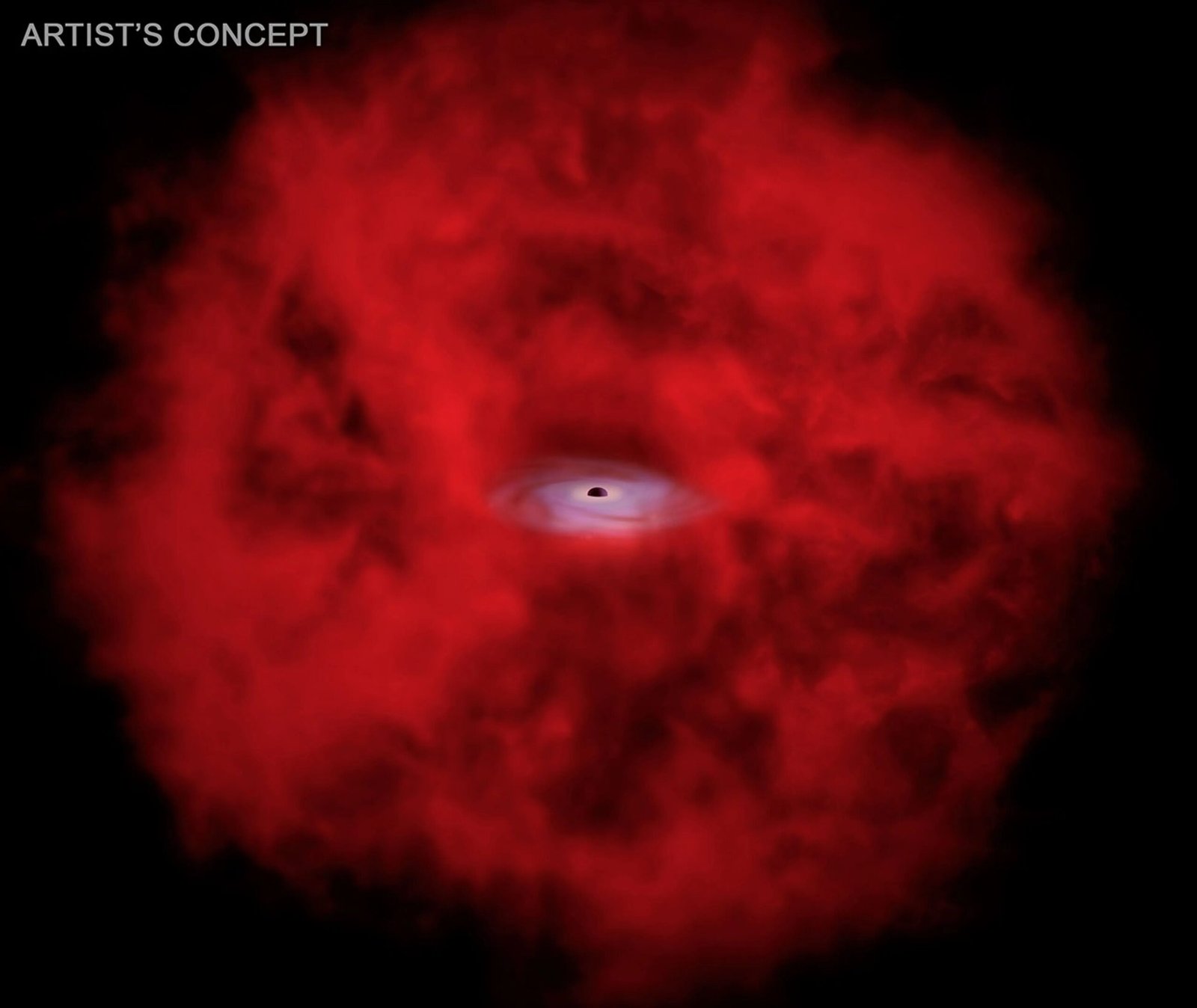
Something invisible holds the universe intact. It outweighs everything you can see—every star, every gas cloud, every galaxy—by a factor of five. We call it dark matter, and for decades, the standard, simple assumption has been that it does exactly one thing: pull.
That is, we have viewed dark matter as involving no pushing, no collisions, no chemistry—just gravity, acting in silence to hold together the cosmos.
That assumption is looking increasingly shaky.
On supporting science journalism
If you’re enjoying this article, consider supporting our award-winning journalism by subscribing. By purchasing a subscription you are helping to ensure the future of impactful stories about the discoveries and ideas shaping our world today.
Three recent preprint papers that arrived within weeks of one another probe the possibility that dark matter is not a mute backdrop but an active participant in cosmic physics. Instead of just imparting a feeling through its gravitational pull, it may touch things via other interactions. Instead of being blandly inert, its properties may change depending on location. And instead of following a rather limited range of possibilities (because astronomers thought they ruled out other options long ago), dark matter may have a much richer set of manifestations than previously suspected.
None of these papers delivers a detection; we are very much still in the dark about dark matter. But together, they may redraw what we’re actually looking for.
Dark Matter That Collides
Let’s start with the most basic heresy: dark matter and ordinary matter may actually collide.
Ordinary matter—the protons, neutrons and electrons that make up everything you’ve ever touched—is governed by forces that dark matter supposedly ignores. But “supposedly” is doing a lot of work in that sentence. We have observational hints that dark matter has minimal, if any, nongravitational interactions with normal matter—the Bullet Cluster is an iconic example—but no experiment has ever directly confirmed that dark matter is purely gravitational. The assumption of inertness is a simplification we adopted because it made the models tractable. Whether it’s true is a separate question.
Connor Hainje and Glennys R. Farrar, both at New York University, decided to take that question seriously. Their new simulation method models notional dark matter interactions with particles called baryons—that is, mainly protons and neutrons—in and around a Milky Way–scale galaxy. They specifically looked at the regime in which dark matter particles would be comparable in mass to, or lighter than, the protons and neutrons they’d be scattering against. That’s a regime where the non-gravitational physics gets interesting—and where previous simulations had little to say.
The result is striking. In standard simulations, a galaxy’s visible matter—gas, dust, stars — sits frozen inside a much larger “halo” of dark matter, like a bug encased in amber. The halo is assumed to be immutable. The two don’t really talk.
But Hainje and Farrar’s simulation opens a communications channel. Just dialing up the rate of dark matter–baryon interactions reshapes the halo from the inside out, redistributing mass in the galaxy’s core in under a billion years. A billion years sounds like a long time, but in galactic terms, it’s a coffee break. And that redistribution matters: it brings the predicted dark matter density at a galaxy’s center into much better agreement with what telescopes actually see, easing a long-standing headache called the “core-cusp problem.”
Lies and Statistics
Here’s another unsettling possibility: some of the constraints we’ve placed on dark matter interactions may be a little premature.
The cosmic microwave background (CMB), which is the faint afterglow from the big bang, is our most sensitive probe of the conditions when the cosmos was just a few hundred thousand years old. If dark matter was scattering against regular matter in those early moments, it would have left a signature: subtle distortions in the CMB’s temperature and polarization pattern. From 2009 to 2013, the European Space Agency’s Planck satellite mapped those patterns with extraordinary precision, producing what remains a canonical dataset for analyzing the CMB. Physicists have used this Planck data to set upper limits on dark matter–proton scattering, and those limits look tight—too tight, possibly.
Maria C. Straight of the University of Texas at Austin and her colleagues found a possible culprit for such flawed assumptions in the statistics themselves. The standard approach—a technique called Bayesian analysis—requires physicists to encode their initial assumptions, or “priors,” about where the answer might lie before the data ever speak. Usually that’s fine—preferable, even—because good data overwhelm weak priors. But when the signal you’re hunting is vanishingly small, the data go so quiet that discriminating against one’s priors gets very gnarly indeed. In that silence, the analysis can cease measuring the universe, instead misleading you by merely echoing your starting assumptions.
The result is what Straight’s team calls “prior-volume effects”: conclusions and constraints that, at first blush, appear statistically robust but that are actually mathematical artifacts. In other words, it may be that, in the case of dark matter, we haven’t ruled out as many possibilities as we’d thought. Maybe we’ve just reinforced our own initial biases.
The team’s solution: instead of asking what the data say given their assumptions, ask what the data say at their absolute best, optimizing the model to give the signal every possible advantage before drawing any conclusions—no priors needed, no thumb on the scale. Run that analysis on the Planck CMB data, and the tight exclusions start to soften. The constraints are less dramatic. But they’re probably more honest. This is the first time this approach, formally called profile-likelihood analysis, has been applied to fractional dark matter–proton scattering from CMB data. And the upshot is real: options we thought were ruled out may still be on the table. Models we were confident we’d eliminated may have been waiting just outside the boundary of our preferred statistical assumptions.
Galactic Annihilation
And finally, nearer to home, dark matter’s murky role in the Milky Way’s core—the so-called galactic center—has been bothering physicists for years.
Observations from NASA’s Fermi Gamma-Ray Space Telescope have detected a diffuse excess of gamma rays emanating from the general vicinity of the galactic center—an excess close enough to often be called, appropriately enough, the Galactic Center Gamma-Ray Excess, or GCE. The excess is real; the debate concerns its origin. One compelling hypothesis is that dark matter particles in the dense central halo are interacting with and annihilating one another, releasing energy as gamma rays.
There’s a problem with this idea, however. If dark matter is annihilating in the galactic center, it should also be annihilating in a subset of the small, dark-matter-rich satellite galaxies of the Milky Way. These satellite galaxies are nearly free of the astrophysical noise that complicates interpretation of the GCE, so we’ve searched them very carefully for a gamma-ray excess. But the signal isn’t there.
Thus, either the GCE isn’t dark matter or dark matter behaves differently depending on where it lives.
Asher Berlin of the Fermi National Accelerator Laboratory in Batavia, Ill., and his colleagues propose the latter. Their “dSphobic Dark Matter” model posits that dark matter exists in two states that are separated by a tiny mass gap—a ground state and a slightly heavier excited state. Gamma rays are produced only when particles from these two states collide and annihilate—which means some of the dark matter must be in the excited state in the first place.
In the dense, chaotic, high-velocity conditions of the galactic center, it’s easy to see how this excitement might happen. Dark matter particles scatter off one another; some get boosted into the excited state, annihilate and produce gamma rays. Presto! You’ve explained the GCE.
But dwarf galaxies are smaller and colder, with more dilute and slower-moving matter. In them, collisions are too gentle, leaving their dark matter unexcited and therefore incapable of annihilation. So the signal is absent, not because dark matter isn’t there but because the environment is different, lacking the galactic center’s gamma-ray-making prerequisities.
Thus, dark matter could be a case of a single particle with two completely different observable behaviors, depending on its surroundings. Suddenly, dark matter seems like it may be much less disconnected from the rest of the universe than most researchers thought likely. Again, that is far from a detection; let’s just call this a potential recalibration, a subtle but consequential shift in what questions we’re even asking.
Simulations that finally let dark matter and ordinary matter collide; statistical tools that actively seek to stop amplifying our assumptions; models in which the same dark matter particle can be noisy in one galaxy and silent in another: each development, taken alone, is incremental. Together, they suggest the working picture of dark matter as a cold, gravity-only phantom was never really more than a useful simplification —and the universe has been under no obligation to honor it.