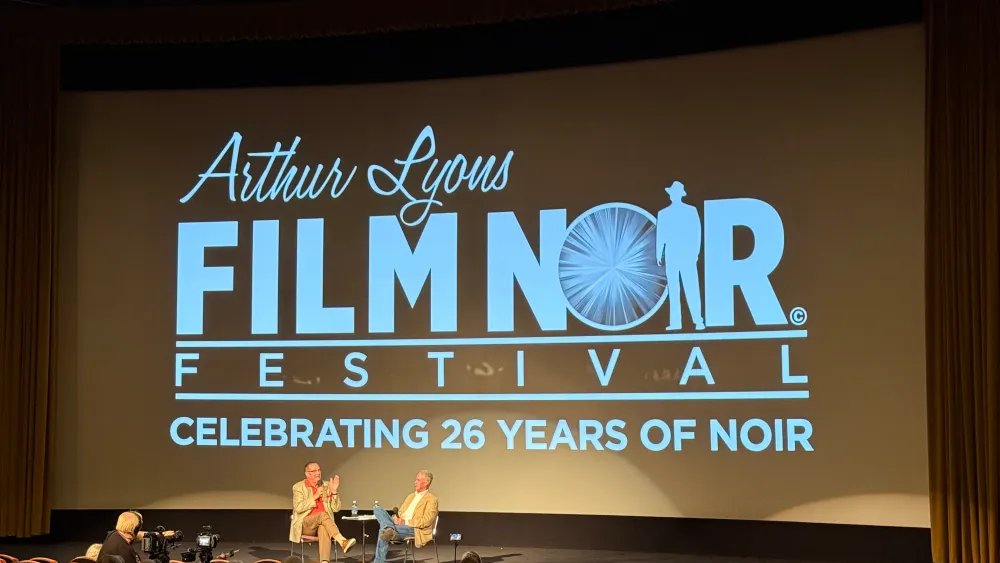
Film fans appreciate “The Lion in Winter,” but a select group of them in Southern California also have a thing for the Arthur Lyons in spring. That is, the Arthur Lyons Film Noir Festival, which takes place each May in Palm Springs. The four-day fest, set to run Thursday night through Sunday afternoon, offers a hefty dose of filmic darkness to the sun-soaked locals but also a good excuse for Los Angeles cineastes to take a drive out for a long weekend, with plenty of hard- or impossible-to-see rarities on tap as a reward.
The 2026 edition of the festival (named after the late crime writer who started it) kicks off Thursday with the digital premiere of a Film Noir Foundation-led restoration of “Slightly Scarlet,” the rare legitimate film noir that is in ‘Scope (not Cinemascope, but a close enough facsimile thereof). There are also premieres of a digital restoration of “Gunn,” Blake Edwards’ feature adaptation of his “Peter Gunn” TV series that has long gone unseen, and of “Manhandled,” a Dorothy Lamour/Dan Duryea/Sterling Hayden vehicle,” neither of which is on streaming or Blu-Ray. The rarities “City Girl” and “The Mob” will be seen in 35mm. If none of these rings a bell, there’s a deliberateness to that, as the festival tends to be programmed for true buffs — although more familiar titles like “No Way Out” do show up among the relative obscurities. (And you may have heard of a little picture called “Bonnie and Clyde,” which is being ushered in under the umbrella of neo-noir.)
“I have hardly ever shown the same movie twice,” says Alan K. Rode, an author, film historian and the treasurer of the Film Noir Foundation. (L.A. residents will also know him as the co-host of the Noir City Hollywood festival, with Eddie Muller. “I showed ‘The Damned Don’t Cry’ [starring Joan Crawford] about 10 or 15 years ago, so that’s a repeat. But I like to bring new movies, and we have a very loyal audience in Palm Springs. This is year 26 for this festival, and it’s my 19th year programming and hosting this event. Sometimes I’ll roll the dice, and it’s been said that my definition of film noir at times has unrivaled elasticity to it. But I’m pleased that the Arthur Lyons Film Noir Festival is known for showing different films and new discoveries, because that’s what makes keeps it fresh for the audience, and it certainly keeps it fresh for me.”
For anyone who went to check out Noir City Hollywood in April at the American Cinematheque, making a trip to Palm Springs is a heck of an encore — with a dozen films in under 72 hours, including four films a day on the middle two days of the festival, rewarding true marathoners. Rode does know a part of the potential audience may feel a little sated from what happened in Hollywood this past weekend. “You’ve got people that are gonna be fatigued from TCM [the TCM Classic Film Festival, where he just handled an introduction himself]. I’ve been telling them, ‘Just come to Palm Springs and relax. You don’t have to valet park. You don’t have traffic. You can lay by the pool before and after you go see movies. What more can you want?”
Rode is as colorful in his descriptions of the films as the movies are usually un-colorful (though there are exceptions to that this year). He led Variety through a brief run-down on all 12 of this year’s picks, as follows…
(Further synopses, details and running times can be found here. Festival passes and tickets for individual films can be purchased in advance here. Screenings will be held in the Historic Camelot Theatre at the Palm Springs Cultural Center, 2300 E. Baristo Rd., Palm Springs, CA 92262.)
Thursday, May 7
7:30 p.m.: SLIGHTLY SCARLET (1956) – World premiere of brand new digital restoration
The latest restoration work of the Film Noir Foundation gets an unveiling in Palm Springs. “Not that I’m casting myself as Captain Ahab, but this really was a white whale that we hunted down for quite a while,” Rode says. “To pin down the rights on it, trying to figure out what family it belonged to and so forth, was kind of like finding a new dinosaur skeleton in Montana or something, and then getting the elements over from England to the Library of Congress… But it was really a joy working with the Library of Congress and our partners at the UCLA Film and Television Archive, and Roundabout Entertainment, which actually did the restoration.” A lesser print was shown decades ago at a Noir City festival in San Francisco, and it played at this Palm Springs noir festival 22 years ago with star Rhonda Fleming in attendance. But “it certainly has not been shown looking like this probably since its original release in 1956. The color and the sound really, really pop.”
Did he say color? For film noir? Not a misprint; neither is the aspect ratio. “This is the first widescreen and Technicolor film that the Film Noir Foundation has restored, so we’re very happy about that. It was filmed in SuperScope, which was the lower-budgeted way of stretching the screen, so to speak, used in movies like ‘Invasion of the Body Snatchers’ in 1956, the same year, when widescreen became all the rage.”
The film is a loose adaptation of James M. Cain’s novel “Love’s Lovely Counterfeit,” and Rose says “it’s about all of the elements of noir — municipal corruption, greed, double crossing, sex, kleptomania; it’s got everything… plus Rhonda Fleming and Arlene Dahl in Technicolor, wearing shorts. I think they put a lot of the money into both of the female stars’ wardrobes, because their clothing matches the color of the convertible, the color of the house, the colors of the set.”
‘Slightly Scarlet’
Courtesy the Arthur Lyons Film Noir Festival
Another star of the movie, for anyone into noir: the legendary John Alton as director of photography. “I watched a scene where Ted de Corsia and John Paynewalk into a room, and again, it’s in the dark until they turn a light on, and then the faces are lit, and it’s John Alton, as we know him —the same noir style of minimal lighting — just in Technicolor widescreen.” At the re-premiere, Roundabout VP Vincent Pirozzi will participate in a conversation about restoration.
Friday, May 8
10 a.m.: HELL DRIVERS (1957)
Director Cy Endfeld, known for other noir festival staples like “Try and Get Me,” traveled to England “and then got named by someone to UAC, and America revoked his passport,” Rode says. “It was freaking ridiculous. But he ended up forging a whole new career as a film director in England… ‘Hell Drivers’ is a real rip-snorter, and it’s almost a who’s who of British cinema as far as the cast goes, where you have Stanley Baker in the lead, Herbert Lom, the great Peggy Cummings, David McCallum, Sean Connery and just a host of actors starting out their career in Great Britain that would become very, very prominent. And Patrick McGoohan in particular is an absolutely repugnant heavy in this movie. The title ‘Hell Drivers’ aptly describes the pace of the film. It definitely gets your blood flowing with the stuff that they do driving these trucks. So I put it at 10 a.m. because I think it’s going to get everyone’s adrenaline going early.”

Craig Stevens as Peter Gunn in ‘Gunn’ (1967)
Courtesy the Arthur Lyons Film Noir Festival
1 p.m.: GUNN (1967) – World premiere of brand new digital restoration, not on streaming or Blu-Ray
Yes, as in Peter. “One of the things I always like to do with Palm Springs is bring forth new discoveries, and certainly ‘Gunn’ is one of them. This is a film that I don’t think has been shown theatrically since it was released,” Rode says. “I have to thank Charlotte Barker at Paramount, who’s the vice president of the archive there and in charge of restoration. ‘Gunn’ was directed, as was the TV series ‘Peter Gunn,’ by Blake Edwards. ‘Peter Gunn’ on TV was really a template for the film noir migrating to the small screen, from the Henry Mancini theme to the super cool Craig Stevens hanging out in a nightclub run by Hope Emerson. This movie is kind of updated: It’s really kind of a travelogue of ‘60s L.A. locations, and instead of having Herschel Bernardi as the cop, you have young Ed Asner. It was also written by William Peter Blatty, who wrote ‘The Exorcist.’ It’s a very solid film that just hasn’t been shown.”
4 p.m.: CITY GIRL (1938) – In 35mm, not on streaming or Blu-Ray
Possibly the rarest film of the festival. “It’s this wacky movie that I happened to see at Cinecon, and it is a 67-minute, hell-bent-for-leather program picture. You have Phyllis Brooks as a hash slinger who is tired of living with her mother, Marjorie Maine and a bunch of kids and a lazy-ass dad scrounging for dimes during the Depression. She gets sucked in by two gangsters and involved in a holdup, then ends up becoming the girlfriend of the big cheese in town, modeled off Lucky Luciano, played with oily presence by Ricardo Cortez. There’s this wild plot of car accidents, plastic surgery, undercover police work… it’s absolutely a breakneck, wild kind of a proto-noir. There is no DVD or DCP — nothing other than an archival print, from Disney, because this was a Fox film — so we’re very fortunate to be able to show this film, because it’s a real rarity and a lot of fun.”
7:30 p.m.: BONNIE AND CLYDE (1967)
This might be the first time anyone has programmed Arthur Penn’s groundbreaking film with Warren Beatty and Faye Dunaway at a noir festival, but Rode has his reasons. “It heralded the New Hollywood of the late ‘60s and into the ‘70s, and without ‘Bonnie and Clyde’ being made, I don’t think you’d see films like ‘The French Connection’ or ‘Chinatown’ — ‘Bonnie and Clyde’ was really a forerunner of the whole neo-noir thing. And it holds up.”
The screening will be preceded by a book signing with the screening’s guest speaker, Kirk Ellis, who has written Kirk Ellis, a veteran Hollywood journalist turned Peabody-winning writer-producer of “John Adams.” He’ll be signing and discussing his new book, “They Kill People: Bonnie and Clyde — A Hollywood Revolution in America’s Obsession with Guns and Outlaws.”
‘Manhandled’ (1949)
Courtesy the Arthur Lyons Film Noir Festival
Saturday, May 9
10 a.m.: MANHANDLED (1949) – World premiere of brand-new digital restoration, not on streaming or Blu-Ray
A second entry for which Rode has to thank Paramount’s Charlotte Barker, a restoration of a film not on streaming or BluRay. “This is a really odd movie,” Rode says. “It’s the answer to a trivia question, which is, what is the only film noir Dorothy Lamour ever made? The wardrobe alone is weird in this picture — you’ve got Sterling Hayden, who’s inexplicably dressed either in a pajama shirt or having a handkerchief the size of a towel coming out of his pocket; you’ve got Dan Duryea in suspenders with a pair of pants that go up to his breastbone; and Alan Napier in smoking jackets. But it’s a true noir and it involves a psychiatrist, murder and double dealing. This one hasn’t been shown in many, many years, but it’s a very worthy film.”
‘I Walked With a Zombie’
Courtesy the Arthur Lyons Film Noir Festival
1 p.m.: I WALKED WITH A ZOMBIE (1943)
“A real change of pace,” says Rode. “I’m not going to try to make the case that ‘I Walked With a Zombie’ is film noir, but I will say that it is a favorite of mine, a really dark, artistic, unique film that holds up, produced by the great Val Lewton on a microscopic budget and directed by Jacques Tourneur (“Out of the Past”). This film is really a masterpiece that explores the boundaries between the living and the dead and plumbs the depths about the legacy of slavery and colonialism in the West Indies, very much ahead of its time. It’s unbelievable that this even got made in 1943. And it’s my pleasure to have scheduled my good friend Wyatt McCrea, who rather than talking about his grandfather, Joel McCrea, will get to talk about his grandmother, Francis Dee, the star of this film.”
4 p.m.: THE MOB (1951) – Shown in 35mm
“This has one of my all-time favorites, Broderick Crawford, who always reminded me of an elephant with a sore tusk, bellowing. This was advertised as kind of like ‘On the Waterfront,’ because it does have to do with waterfront corruption. But it’s written by Bill Bowers, and one of his signature traits in all of his films, whether it was film noir or a Western, was humor and wiseacre dialogue. There’s a lot of that in ‘The Mob,’ and you’ve got a really good supporting cast with Neville Brand, a young Ernest Borgnine, John Marley and Richard Kiley in a very, very entertaining, fast-paced movie, extremely well-crafted and well-written.”
Joan Crawford in ‘The Damned Don’t Cry’
Courtesy the Arthur Lyons Film Noir Festival
7:30 p.m.: THE DAMNED DON’T CRY (1950)
The screening will be preceded by a signing with author Scott Eyman, who will stick around to discuss his latest book, “Joan Crawford — A Woman’s Face.” “He’s the best biographer of Hollywood figures ever, in my opinion,” Rode says, “and the Crawford book I think is one of his best. I can’t think of any famous Hollywood personage who has been more ill-served or not captured by a host of biographers than Joan Crawford, and Scott really captures the essential Crawford. There’s a lot of new research in his book that is wonderful.”
He notes, “I’m a great lover, obviously, of ‘Mildred Pierce’ and Michael Curtiz” — the “obviously” is because Rode wrote an acclaimed biography of the celebrated Curtiz — “but Vincent Sherman’s ‘The Damned Don’t Cry’ is the quintessential Crawford film noir,” he says. “It was based on Bugsy Siegel’s gun moll, but it’s really based in a lot of ways on Crawford’s rags-to-riches life and how determined she was to make good; you see some of that in this film. An added plus is that a good portion of the film was actually filmed in 1949 in Palm Springs. They used Frank Sinatra’s house as part of the locations for the filming.”
Sunday, May 10
10 a.m.: LET US LIVE (1939) – Shown in 35mm
“This one has been overlooked. About 15 years ago, the Cinematheque had me program and host a tribute to the director John Brahm, who was really underrated. When Hollywood started contracting, he went into television and directed ‘The Outer Limits,’ ‘Twilight Zone,’ really good TV. This was early in his career, and it’s got Henry Fonda, Maureen O’Sullivan and Ralph Bellamy. It’s the classic race-against-time of an innocent man convicted of murder, which is a tried-and-true film noir and gangster melodrama theme, but it’s seldom done any better than this. This is a really good film, and I’m eager to expose this to audience in Palm Springs.”
1 p.m.: IT ALWAYS RAINS ON SUNDAY (1947)
“No one less than William K. Everson said this is the best English film noir ever made, and I think that that’s not an overstatement,” says Rode. “It’s a great film with Googie Withers and John McCullum, who actually ended up being married and stayed married for like 60 years, to the end of their lives. She’s a housewife in London’s deprived East End, married to an older man in a not-so-great marriage. McCullum’s her lover, and he breaks out of Dartmoor Prison and ends up trying to hide in her household to escape the police dragnet. It shows a part of London right after the war that no longer exists. The whole market section, the Jewish section of London, all of this now is long gone. It is a very, very compelling film, and one that I’ve shown elsewhere and that I think Eddie (Muller) has shown elsewhere, and I thought it was time to bring it to Palm Springs.”
NO WAY OUT, from left: Richard Widmark, Sidney Poitier, 1950, TM & Copyright © 20th Century Fox Film Corp./courtesy Everett Collection
©20thCentFox/Courtesy Everett Collection
4 p.m.: NO WAY OUT (1950)
“The closer is a great film that still has the impact of a left hook to the liver. It stars Richard Widmark and Linda Darnell, and was Sidney Poitier’s film debut. It is a powerful indictment of racism that was way ahead of its time, directed and written by Joseph L. Mankiewicz, personally produced by Darryl F. Zanuck. Widmark plays the most odious of racist criminals, even though he and Sidney became lifelong friends. Sidney said that after each take, when Widmark had to say something nasty, he would apologize to him, and Sidney said, ‘Knock it off. You’re an actor. There’s nothing about this that is personal.’ I’ll never forget how when Sidney got his special Oscar, he gave thanks to first and foremost Mankiewicz and Zanuck, because to make ‘No Way Out’ took a lot of courage in 1950, it really did. This is a sobering film that, frankly, current events have made even more topical than it already would’ve been.”
The Arthur Lyons Film Noir Festival in Palm Springs
Chris Willman/Variety