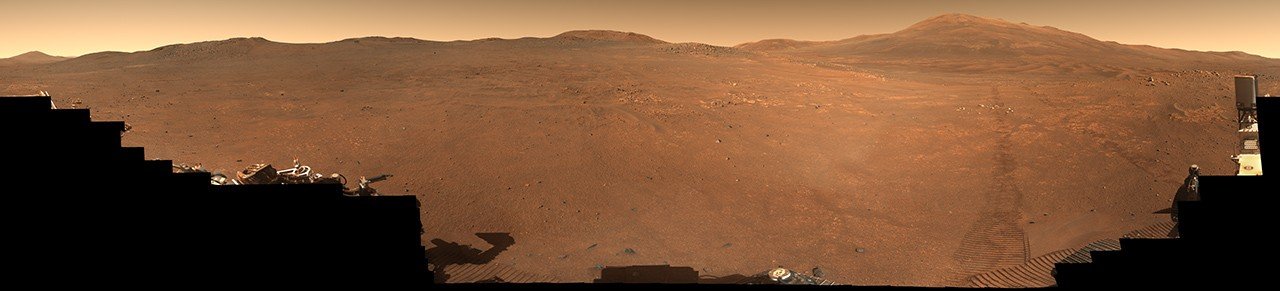
NASA’s Perseverance Mars rover used its Mastcam-Z camera system to capture this 360-degree panorama of a region nicknamed “Crocodile Bridge” on Jezero Crater’s rim. The panorama is made up of 980 images, 971 of which were taken on Dec. 18, 2025, the 1,717th Martian day, or sol, of the mission. An additional nine were taken on Jan. 25, 2026, Sol 1,754. This natural-color view has been processed to show the landscape as the human eye would see it.
Jezero Crater’s rim and the regions around it hold some of the oldest rocks anywhere in the solar system; they serve as time capsules of the Red Planet’s early history, when its crust and atmosphere were still forming. No terrain this ancient exists on Earth, where tectonic plates constantly recycle the surface. (Mars lacks tectonic plates, allowing some of this very old material to be preserved.)
“Crocodile Bridge” represents a transition into an area nicknamed “Lac de Charmes,” which Perseverance will explore for several months later this year.
[Full-resolution image versions of figures A through E can be downloaded at the bottom of this page.]
Figure A is the natural-color view panorama.
Figure B is the same panorama in an enhanced-color view, which brings out subtle details.
Figure C is an anaglyph (3D) version of the natural-color view of the panorama.
Figure D is an anaglyph red-color view of the enhanced version of the panorama.
Figure E is an anaglyph blue-color view of the enhanced version of the panorama.
Managed for NASA by Caltech, NASA’s Jet Propulsion Laboratory in Southern California built and manages operations of the Perseverance rover on behalf of the agency’s Science Mission Directorate as part of NASA’s Mars Exploration Program portfolio.
Arizona State University leads the operations of the Mastcam-Z instrument, working in collaboration with Malin Space Science Systems in San Diego, on the design, fabrication, testing, and operation of the cameras, and in collaboration with the Niels Bohr Institute of the University of Copenhagen on the design, fabrication, and testing of the calibration targets.
To learn more about Perseverance, visit:
science.nasa.gov/mission/mars-2020-perseverance